

"A multipolar world does not automatically become a fairer world. Amid uncertainty, Indonesia is faced with one fundamental question: how do we remain firm in our principles, while also being resilient in the face of change?
The answer lies in the combination of a Principled Foreign Policy and Strategic Resilience. Our foreign policy must remain grounded in the constitutional mandate, uphold sovereignty and international law, and consistently strive for justice and oppose all forms of colonialism."
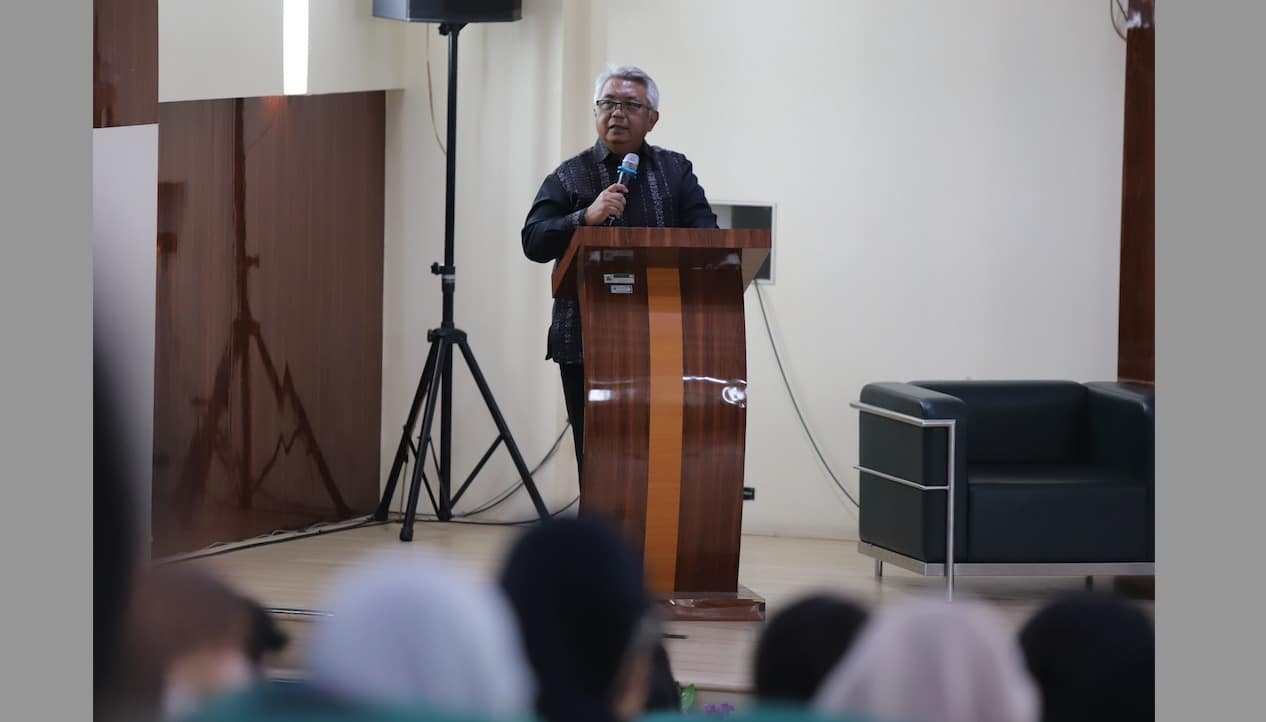
By
Masni Eriza, S.H., M.Si.
Head of the Center for Multilateral Policy Strategy, Foreign Policy Strategy Agency (BSKLN)
Ministry of Foreign Affairs of the Republic of Indonesia
Delivered at geopolitical seminar as Keynote Speaker; NEOCOLONIALISM-NEONAZISM; THE CHALLENGE OF A MULTIPOLAR WORLD, SOUTHERN COUNTRIES AND ASEAN, at the Mulyono Sudirman Auditorium, Faculty of Medicine, UPN "Veteran", Jakarta, 5 November 2026. Organized by the Global Thinkers Institute-GTI, Faculty of Social and Political Sciences, Department of International Relations, UPN "Veteran" Jakarta, and the Global Future Institute-GFI.
Assalamu'alaikum Warahmatullahi Wabarakatuh.
The Rector of UPN Veteran Jakarta, whom I respect, the Dean of FISIP, the Head of the Department of International Relations, the Director of the Global Thinkers Institute-GTI, the Director of the Global Future Institute-GFI, the speakers, lecturers, researchers, and the students I am proud of.
First of all, allow me to express my appreciation to UPN Veteran Jakarta and GTI for organizing this national seminar.
The discussion on the challenges of a multipolar world and neocolonialism is very timely amid the geopolitical crisis and growing threats to global governance.
For Indonesia and the countries of the Global South, the changing configuration of world power presents opportunities to expand influence, but also the risk of the re-emergence of dependence and domination in new forms.
The question is, how do we ensure that multipolarity produces a fairer order, rather than merely replacing one form of domination with another.
Ladies and gentlemen,
The world today is marked by increasingly widespread geopolitical instability. The conflict in Ukraine, which has been ongoing for several years and still shows no indication of ending soon, the humanitarian crisis in Gaza and Palestine, tensions in the Middle East as well as instability in various regions of Africa demonstrate the growing threat to international peace.
The impact goes beyond conflict areas, disrupting supply chains, trade, energy and food security.
For the Global South, this situation is very concerning because developing countries often bear the impact of conflict without having a comparable influence in global decision-making.
Seven symptoms have been identified that erode the credibility of global governance:
- Narrow national interests have defeated our common security interests
- International law is too often misused through a selective approach.
- Global governance institutions are struggling to keep up with the realities of the times.
- A number of countries are beginning to withdraw from their responsibilities in global governance.
- Rules that have been mutually agreed upon are simply violated without consequences.
- The world is moving toward increasingly sharp competition and deepening fragmentation.
- International cooperation is becoming increasingly transactional.
This condition demonstrates a crisis of trust in the international system, while at the same time opening space for inequality and neocolonialism in new forms.
This situation raises a fundamental question regarding the relevance of multilateralism.
At the World Economic Forum in Davos in 2024, a warning emerged that the world must act immediately to face serious threats, even those with potentially existential consequences. This warning reflects a growing anxiety about the direction of world developments.
However, amid the growing need for cooperation, trust in multilateral institutions, including the UN, faces pressure. The threats faced by the international community are now not only conventional war. We also face climate change, economic inequality, technological disruption, global health threats, and various nontraditional security risks.
The problem is that these various challenges are cross-border in nature and cannot possibly be resolved unilaterally by one country. However, at a time when the need for international cooperation is growing, a question arises: are multilateral mechanisms still capable of providing effective solutions?
The legitimacy of international organizations is determined not only by the existence of a charter, membership, or institutional structure, but also by the trust that the organization is capable of producing real decisions and actions.
This is where a major challenge arises for the UN and other multilateral organizations.
If the international community sees that various conflicts continue without resolution, while multilateral institutions are unable to take effective action, then trust in the system will be increasingly under pressure.
For Indonesia, multilateralism is a necessity, not merely an option. The question is not whether we still need multilateralism, but how to make it more effective and capable of answering today's world challenges.
One of the main problems of the current multilateral system is the performance gap, namely the gap between increasing international participation and the ability of institutions to produce solutions. As highlighted in the 2024 Multilateralism Index, state participation and institutional inclusiveness are increasing, but various global crises are actually developing faster than the multilateral system's ability to respond to them.
This condition shows that: more countries participating in the international system does not always mean more effective decisions are produced. For the Global South, this issue is very important. Developing countries need an international order that not only provides space for presence and participation but also produces fair and implementable decisions.
Therefore, the challenge of multilateralism is not only a matter of representation but also of effectiveness and the ability to produce real action.
The problem of the performance gap is clearly visible in the use of the veto power in the UN Security Council.
If we observe, since 2000 the use of the veto has been largely related to major conflicts, including Syria, Ukraine, and the Middle East. Russia, the United States, and China have different patterns of veto use, reflecting their respective geopolitical interests.
When great power rivalry enters into decision-making, the Security Council can experience deadlock, even when the humanitarian situation requires immediate action. For Indonesia, this reinforces the urgency of UN Security Council reform.
Reform must strengthen the representation of developing countries, increase transparency and accountability, and improve decision-making effectiveness, including in the use of the veto.
The Security Council must be able to carry out its mandate to maintain international peace, not become an arena of great power competition that hampers conflict resolution.
The weakening effectiveness of multilateralism becomes increasingly concerning when accompanied by the growing risk of the use of military force or the kinetic option.
As noted in The State of Southeast Asia 2025 Survey Report, the Southeast Asian region faces pressure due to increasing strategic competition among great powers.
When diplomacy faces deadlock, the risk of confrontation and the use of instruments of power may increase.
For Indonesia, this development is highly relevant given Southeast Asia's strategic position in Indo-Pacific trade and security connectivity.
Therefore, Indonesia has an interest in preventing the region from becoming an arena of open confrontation.
Dialogue, preventive diplomacy, respect for international law, and regional cooperation mechanisms must continue to be strengthened so that geopolitical competition does not develop into conflict.
Differences in political systems and strategic orientations among countries are increasingly sharpening the lines of geopolitical rivalry in a multipolar world. However, international relations today can no longer be understood through a simple divide between friend and foe. The United States, China, Russia, India, and various other powers have increasingly complex relationships, where a country can be a partner in trade and investment, but at the same time a competitor in technology, security, and geopolitical influence.
For the Global South countries, this condition presents a strategic dilemma. On the one hand, multipolarity opens opportunities to expand and diversify partnerships, but on the other hand it also increases pressure to determine alignment in great power rivalry. This situation has the potential to give birth to new forms of neocolonialism, where economic dependence, technological domination, control of strategic resources, and geopolitical pressure can limit the sovereignty and decision-making space of developing countries, even though they are politically independent.
Therefore, for Indonesia, the policy implication is the need to strengthen strategic autonomy through a free and active foreign policy, diversify economic and technological partnerships, enhance national resilience against external pressure, and strengthen Global South solidarity to strive for fairer and more representative global governance.
Indonesia also needs to continue its role as a bridge-builder to maintain dialogue space amid great power rivalry, while ensuring that every international partnership provides real benefits for national development.
Thus, Indonesia not only seeks to avoid dependence and new domination but also actively shapes a more equal, inclusive multipolar order grounded in respect for the sovereignty of every nation.
Amid this fragmentation, we need to seek alternative approaches to sustain international cooperation. An approach that emphasizes the importance of finding common ground among countries with different interests and orientations.
In a multipolar world, cooperation does not always have to be based on identical political views.
Countries can still build constructive relations through shared interests, mutual respect, and mutually beneficial goals.
For Indonesia, such an approach is in line with the tradition of open and inclusive diplomacy.
In an increasingly fragmented world, we need more bridges, not more dividing lines.
This alternative approach rests on three important elements.
First, strategic positioning, namely the ability of a state to determine its strategic position amid changes in the global power configuration.
Second, a new multilateralism, namely multilateralism that is more representative, adaptive, and capable of producing concrete solutions.
Third, leadership goals, namely leadership that is not solely determined by the size of economic or military power, but also by the ability to build consensus and bridge differences.
These three elements are highly relevant for the Global South. The growing economic and political strength of Southern countries must be followed by an increase in voice and influence in the formation of international rules.
Multipolarity must become an opportunity to create more equal relations among countries, not merely present new centers of domination.
Ladies and gentlemen,
In this context, Indonesia has the modalities to play a strategic role as a middle power:
Indonesia is the fourth most populous country in the world, has a strategic geographic position between the Indian and Pacific Oceans, and has significant economic and diplomatic capacity.
Indonesia has a diplomatic influence score of 67.2 in the Asia Power Index and ranks ninth in the comprehensive power measure used.
Indonesia also has a large Islamic economic ecosystem and plays a role in ASEAN, G20, BRICS, OIC, D-8, and is currently in the process of OECD accession.
These modalities provide Indonesia with the ability to build relationships with various centers of power without having to depend on one party. However, what is most important is not merely the magnitude of Indonesia's influence, but how that influence is used.
Indonesia certainly needs to continue its role as a trusted bridge-builder, bringing together the interests of developed and developing countries, as well as various great powers that are competing.
This role is rooted in the principle of a free and active foreign policy.
As affirmed in Law Number 37 of 1999, Indonesia's foreign policy is implemented based on the free and active principle dedicated to national interests.
Free means Indonesia independently determines its stance and policy, without being bound to the interests of one great power.
Active means Indonesia is not merely a spectator but contributes to creating peace and resolving international problems.
In a multipolar world, this principle is increasingly relevant to maintaining Indonesia's strategic autonomy while expanding our diplomatic contributions.
The moral foundation of Indonesia's foreign policy is rooted in the experience of the struggle against colonialism. The Preamble to the 1945 Constitution affirms that independence is the right of all nations and that colonialism must be abolished because it is contrary to humanity and justice.
This historical experience teaches the meaning of sovereignty, equality, and solidarity among nations. However, the struggle against colonialism does not stop at political independence.
Independence must also mean the ability to determine the direction of development, manage resources, and obtain fair opportunities to achieve prosperity. This is the relevance of the struggle against new forms of neocolonialism today.
Therefore, this moral foundation must be translated through a Principled Foreign Policy and the strengthening of Strategic Resilience. For Indonesia, principled diplomacy means remaining firm in the constitutional mandate, respect for sovereignty, international law, and the struggle against colonialism and injustice, without applying double standards due to geopolitical pressure.
This historical and moral foundation is translated into national development goals.
Through the RPJPN 2025–2045, Indonesia directs development through the stages of strengthening the foundations of transformation, accelerating transformation and resilience, global expansion, and achieving Golden Indonesia 2045.
Diplomacy must support these goals through strengthening national resilience, expanding markets, investment, technology access, and development cooperation.
Thus, foreign policy is not only about Indonesia's position in international relations but also its contribution to the security and welfare of the people.
Indonesia's Strategic Response in Facing a Multipolar World
Ladies and gentlemen whom I respect,
In facing an increasingly multipolar and fragmented world, Indonesia cannot merely be reactive to geopolitical developments. We need diplomacy that is adaptive, principled, and capable of turning challenges into opportunities. To that end, Indonesia puts forward four strategic approaches.
First, Bridge-Builder. Indonesia seeks to be a trusted bridge amid the increasingly sharp rivalry of great powers. Through the free and active principle, Indonesia can bridge interests between North and South, developed and developing countries, and various powers with different views. In an increasingly polarized world, the ability to build dialogue, trust, and consensus becomes Indonesia's strategic contribution to international peace.
Second, Multi-Alignment in Non-Alignment and Good Neighbour Policy. Indonesia does not view a multipolar world as a binary choice to side with one power and distance itself from another. On the contrary, Indonesia expands partnerships with various countries based on equality, mutual respect, and shared interests. This approach allows Indonesia to maintain strategic autonomy while reducing the risk of dependence that could open space for new forms of neocolonialism.
Third, Dynamic Resilience. In an increasingly transactional and uncertain world, Indonesia needs to strengthen national resilience through diversification of economic, technological, and security partnerships. Indonesia's involvement in various forums, including G20, BRICS, OIC, and D-8, as well as the OECD accession process, is part of efforts to expand strategic options. Strong resilience not only enables Indonesia to face external pressure but also enhances its capacity to contribute to global stability and prosperity.
Fourth, ASEAN Centrality. At the regional level, Indonesia continues to strengthen ASEAN centrality as an anchor of stability amid great power rivalry in the Indo-Pacific. ASEAN must remain an inclusive forum for dialogue and cooperation and be able to prevent the Southeast Asian region from being trapped in geopolitical confrontation. For Indonesia, maintaining the unity and relevance of ASEAN also means preserving the strategic independence space of the countries in the region.
These four approaches simultaneously reflect Indonesia's commitment to promoting a new multilateralism that is more representative, inclusive, and effective. Indonesia views UN reform and the multilateral system as an urgent necessity so that international institutions not only reflect current geopolitical realities but are also capable of producing real solutions. Reform must strengthen the representation of the Global South, increase the accountability of decision-making, and ensure that global governance does not continue to reproduce structural inequality.
This spirit also underlies Indonesia's re-nomination as a Non-Permanent Member of the UN Security Council for the 2029–2030 period. As Foreign Minister Arrmanatha Nasir emphasized recently before the UN Secretary-General, "Multilateralism is not only about having a seat at the table. It is about what we contribute around that table." For Indonesia, this nomination is an opportunity to make a real contribution to bridging differences, strengthening dialogue, promoting peaceful conflict resolution, and bringing the perspective of developing countries into discussions on international peace and security. With four terms of experience as a Non-Permanent Member of the UN Security Council, Indonesia is committed to continuing its role as a bridge-builder, peacemaker, and norm-setter in strengthening multilateralism.
Indonesia does not want to merely adapt to changes in the global order but also to participate in shaping the direction of those changes so that an increasingly multipolar world becomes more peaceful, fairer, and more equal.
Ladies and gentlemen,
This spirit is not new in the history of Indonesia's diplomacy.
Since the beginning of independence, President Soekarno has warned of the danger of colonialism in all its forms, including neo-colonialism and imperialism.
He also mentioned the existence of Old Established Forces and New Emerging Forces, which reflected the aspirations of developing nations to build a fairer world order. This spirit became an important foundation for the 1955 Bandung Asia-Africa Conference, which inspired the independence of many countries and the solidarity of developing countries, and the emergence of the Non-Aligned Movement.
In his speech at the UN in 1960, To Build the World Anew, President Soekarno called for the renewal of the international order and affirmed the importance of economic justice after political independence. More than six decades later, this message remains relevant. Multipolarity must provide greater opportunities for the Global South to determine its own future.
Ladies and gentlemen and the students I am proud of,
A multipolar world does not automatically become a fairer world. Amid uncertainty, Indonesia is faced with one fundamental question: how do we remain firm in our principles, while also being resilient in the face of change?
The answer lies in the combination of a Principled Foreign Policy and Strategic Resilience. Our foreign policy must remain grounded in the constitutional mandate, uphold sovereignty and international law, and consistently strive for justice and oppose all forms of colonialism.
However, firmness of principle must also be supported by strong national resilience, independence in decision-making, and the ability to build partnerships with various parties without being trapped in dependence. Because principles without resilience will be difficult to maintain, while resilience without principles will lose direction. This is the essence of Indonesia's free and active foreign policy: firm in the values we believe in, independent in determining our stance, and always actively contributing amid a constantly changing world.
The free and active foreign policy becomes the foundation for maintaining independence while contributing to international peace and justice. I hope this seminar will produce constructive ideas for Indonesia's diplomacy. As with the spirit of Bandung 1955, Indonesia must not merely be a spectator but must participate in shaping the future of a more peaceful, just, and equal world order.
Thank you.
Wassalamu'alaikum Warahmatullahi Wabarakatuh.