
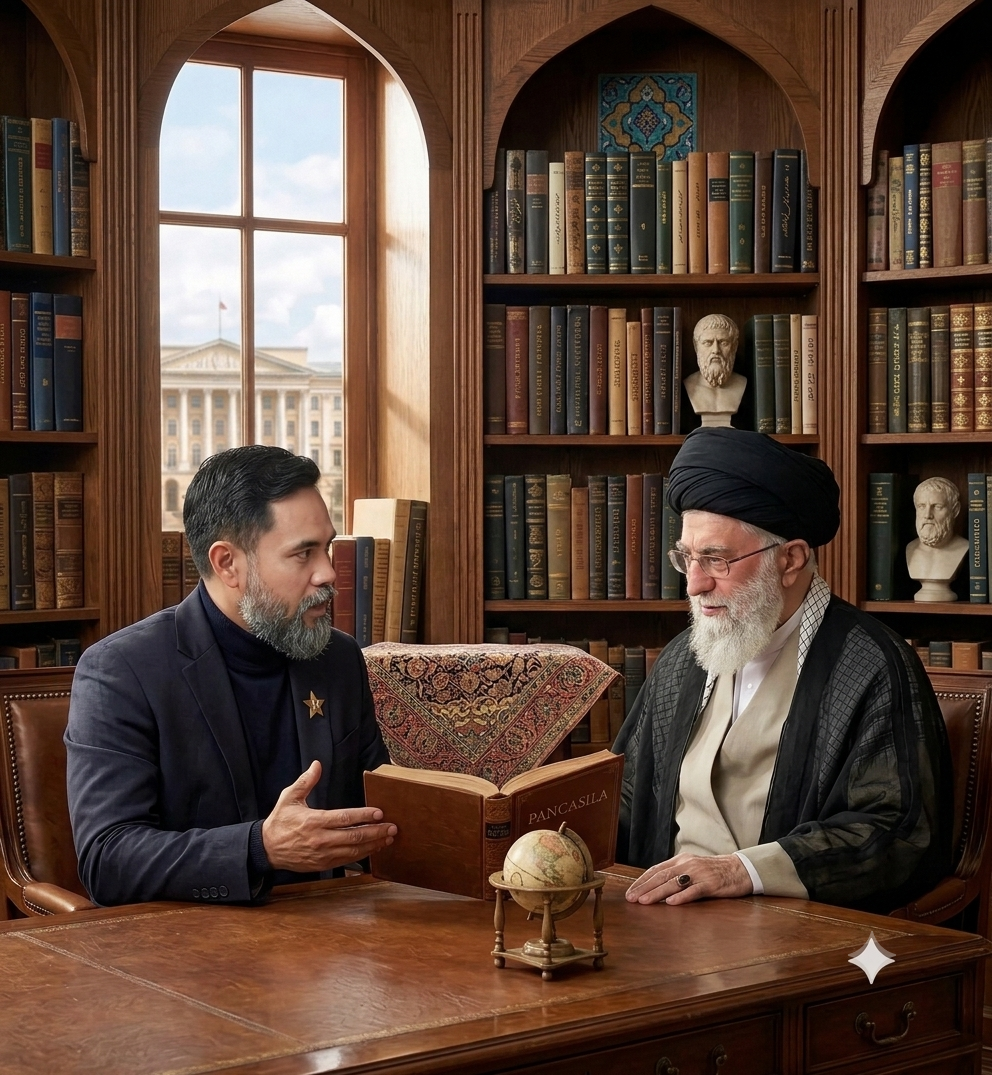

By, Muhammad Ma'ruf, Ph.D
Director, Global Thinkers Institute (GTI)
Presented at the international discussion "UNDERSTANDING NATIONALISM AND DEVELOPMENT IN IRAN," July 22, 2026, DPW PRIMA Party Central Java, Po Han House, Semarang, Indonesia.
"From an Islamic perspective, formative factors such as race, language, religion, and culture are accidental and possess no essential reality. The diversity of skin color, language, and traditions in human society are differences that can be seen as manifestations of the richness and variation of existence, as well as forms of manifestation of a single reality. Every flower has its own color, fragrance, properties, and uses. However, all can be evaluated and measured according to the criteria of contribution to human achievement before the highest sources."
Introduction
Nationalism comes from the word "nation." The word "nation" in Arabic means a path or method, through a spiritual path and spiritual leaders, as in Surah Al-Hajj: 78, "This is the path and method of your forefather Abraham."
Or in (Al-An'am: 161). Raghib Al-Isfahani in the book "Mufradat Al-Quran" says, "Millah and Imlaal come from the same root word" (Al-Baqarah: 282). This means that the supervisor must provide guidance towards justice. Raghib said, "The reason why the path of God is called 'Millah' is because that is the path commanded by God." Millah or nation and "diin" have one meaning. Something is called a religion, with the same thing being called a nation. Nation and religion will be guided by God through the prophets, and the prophets must guide society. The word nation has the same meaning, repeated seventeen times and fifteen times in various verses in the Quran.
The word nation is close to the modern term "mazhab" (school of thought), which relates to the leader of a method or way (of life). Just as "maktab" (school) has a close relationship with nation, "millah" (Persian) means a guidance.
Nationalism in the Western Perspective
One prominent characteristic of the definition of Western nationalism is that it does not place religion as a positive factor or element in forming nationalism. It is as if nationalism contradicts the spirit of religion. Neither Renan, Otto Bauer, nor Anderson mention the positive role of religion. All three depart from the spirit of the Enlightenment and the French Revolution, which placed Christianity as a symbol contradictory to the spirit of nationalism. The existence of Christian-based royal sovereignty and feudalism in the Middle Ages collapsed due to the rationalist spirit of the Western Enlightenment and alongside the growth of a spirit of local nationalism based on territorial sentiment and cultural sovereignty.
Western nationalism is usually defined as the emergence of a nation as a result of shared destiny, culture, language, goals, and geographical commonality. However, it should be noted that this definition of Western nationalism, where factors such as language, skin color, culture, and past value systems in forming an independent social unit, "lacks an internal and permanent foundation" in the formation of collective consciousness.
From an Islamic perspective, formative factors such as race, language, religion, and culture are accidental and possess no essential reality. The diversity of skin color, language, and traditions in human society are differences that can be seen as manifestations of the richness and variation of existence, as well as forms of manifestation of a single reality. Every flower has its own color, fragrance, properties, and uses. However, all can be evaluated and measured according to the criteria of contribution to human achievement before the highest sources.
The factor of shared suffering due to colonization, the common aspiration to resist the exploitation of individuals and institutions, is not a "permanent builder" of shared consciousness unless it must be injected with factors of justice, truth, freedom, and piety (objective and progressive human goals). This factor is the elan vital when injected into a person or group, so that they move collectively, dynamically, evolving, resulting in the creative development of culture and traditions that become the manifestation of an independent and characterized nation.
Islam does not have a specific character, but it has similarities and parallels in its relationship with all nations, namely absolute, universal, and acceptable human values, and it is not considered something foreign, because it comes from outside. "Something without any character can be adapted to a thousand conditions," but something with specific properties cannot be adapted to any condition. Like in natural science theory, it belongs to everyone. Scientists, philosophers, and prophets belong to all humans in the world; their works and ideals do not belong to one specific nation.
"Thus, scientific reality belongs to the whole world. The Pythagorean theorem or Einstein's theory of relativity does not belong to a specific nation and does not contradict any nation, because this reality is colorless and has no specific character of a particular nation."
According to Muthahhari, Islam rejects negative nationalism that contradicts logic, which separates one individual from another in the name of national differences, bringing hostility among them. Islam accepts nationalism that enhances unity, friendship, and service to others. Islam has a limited definition of nationalism, ethnicity, and prejudice rather than rejecting them.
"Nationalism will be condemned by reason only if it has a negative side, i.e., which separates individuals under the title of different nations, brings hostility among them, and does not consider the rights of others."
The Islamic view on the criteria for such nationalism also applies to religions, ideologies, and doctrines that are not the exclusive property of a particular nation. The criteria for Islamic nationalism are universal, have no specific color, coincide with the formation of a state of law, and thus do not become foreign. Foreignness comes from the process of wholehearted and voluntary acceptance. All major religions and ideologies are accepted in various lands and sometimes far from their origins. Jesus was born in Palestine, which is in the East, but his followers are mostly in the West; Europeans and Americans are followers of Christ and do not feel foreign. If Islam is "foreign" in Indonesia, then certainly Christianity in Europe and America would also be "foreign."
Similarly, with the ideology of Karl Marx, who lived in England, he predicted that Communism would be accepted in England and Germany, but both countries rejected it; however, Marxism was accepted in Russia and China. The sense of Russian and Chinese patriotism grew even though their ideology came from outside. Similar to Islam, an ideology originating from Mecca is accepted by various nations. On one hand, the teachings of Islam are rational and intellectual; on the other hand, they consider something natural to be understood.
German Nazi nationalism was racist and expansionist; Zionist nationalism based on racism justified the occupation of Palestine; French nationalism based on chauvinism justified the aggression against Algeria. The nationalism of Asian-African nations developed and aimed for independence. All nationalism is based on liberation. However, nationalism from an Islamic perspective has a fundamental value that can unite humanity. That is nationalism based on justice, truth, freedom, and piety with the main foundation of Tauhid (monotheism).
If asked, which ideology teaches fundamental human freedom with clearer evidence? The answer is “Tauhid”, and Islam is a tool for liberation, freedom from all binding chains, opening human evolution towards God.
"You do not worship besides Him except [mere] names you have named, you and your fathers, for which Allah has sent down no authority. Legislation is not but for Allah. He has commanded that you worship not except Him. That is the correct religion, but most of the people do not know." (QS. Yusuf: 40)
"O people, an example is presented, so listen to it. Indeed, those you invoke besides Allah will never create [as much as] a fly, even if they gathered together for that purpose. And if the fly should steal away from them a [tiny] thing, they could not recover it from him. Weak are the pursuer and the pursued." (QS. Al-Hajj: 73)
"And strive for Allah with the striving due to Him. He has chosen you and has not placed upon you in the religion any difficulty. [It is] the religion of your father, Abraham. Allah named you 'Muslims' before [in former scriptures] and in this [revelation] that the Messenger may be a witness over you and you may be witnesses over the people. So establish prayer, give zakah, and hold fast to Allah. He is your protector; and excellent is the protector, and excellent is the helper." (QS. Al-Hajj: 78)
"O mankind, indeed We have created you from male and female and made you peoples and tribes that you may know one another. Indeed, the most noble of you in the sight of Allah is the most righteous of you. Indeed, Allah is Knowing and Acquainted." (QS. Al-Hujurat: 13)
"And hold firmly to the rope of Allah all together and do not become divided. And remember the favor of Allah upon you - when you were enemies and He brought your hearts together and you became, by His favor, brothers. And you were on the edge of a pit of the Fire, and He saved you from it. Thus does Allah make clear to you His verses that you may be guided." (QS. Ali Imran: 103)
"You are the best nation produced [as an example] for mankind. You enjoin what is right and forbid what is wrong and believe in Allah. If only the People of the Scripture had believed, it would have been better for them. Among them are believers, but most of them are defiantly disobedient." (QS. Ali Imran: 110)
The Nation According to Imam Khomeini
The color of nationalism that developed in Iran after the 1979 revolution was largely inspired by the political thought of Imam Khomeini. The Iranian nation is understood as a society guided towards God. Just as nations in ancient times were guided by the prophets towards God from the oppression of every era.
For Imam Khomeini, the nation is a matter of political education, i.e., the education of the nation related to the development of religious democracy. For Imam Khomeini, the nation is a mirror of the validated voice of the people; therefore, it is important to raise the people's consciousness to inspire the freedom of responsibility in determining their own destiny. Regarding the education of the nation, Khomeini provided direction on the importance of consciousness, freedom, the people's voice, and faith.
1. Political Awareness and Consideration
The issue of the nation for Imam Khomeini is the issue of the people's consciousness based on Islamic commitment.
"With great pride, I want to thank the honorable Iranian nation for your political development and Islamic commitment... at the end of my life, I will move towards the blessed abode of truth with optimism and full pride in your intelligence."
Religious democracy arises not from deceit but from the awareness of loyalty to the essence of Islam. This is the main foundation of legitimacy for the existence of an Islamic government, namely the Islamic Republic.
"The Islamic community of Iran, which has accepted the Islamic Republic and its lofty values and the sovereignty of God's laws with its political knowledge and maturity, and remains committed to this loyalty and great contract."
2. Seeking Freedom
Freedom for Imam Khomeini is the essence and strengthens religious democracy, not weakens it. Because after the people have consciousness of Islamic commitment, the people have the right to freely choose and determine the destiny of their own nation.
"One of the most important basic tasks when a group takes over responsibility for affairs is to create conditions for free elections so that under no circumstances is there any exercise of power and influence from any strata or groups in the elections. You are free and must hold the destiny of your country in your own hands... Today, the destiny of Islam; the destiny of Muslims in Iran and the destiny of our country is in the hands of this nation."
3. Precision and Accuracy of the People's Vote
One of the manifestations of participation in the consciousness of Islamic commitment and the freedom to determine the destiny of the nation is participating in elections. Religious democracy is based on the results of the people's choice. The people's vote is generally correct, with negligible error.
"Surely when the people are free, they choose competent individuals, and the general vote cannot make a mistake; if someone wants to do something, he makes a mistake; a country with thirty million souls cannot make a mistake."
Imam Khomeini linked the people's vote to the embodiment of the nation's will, which must be obeyed.
"Walk the path that our nation has chosen even if you believe that the path the nation has taken is not good for it. Well, let it be. The nation wants it this way; what is it to you and me? The nation has chosen; the vote it has cast must be obeyed."
4. Inclination towards Faith
Imam Khomeini noted that a strong nation is a nation supported by competent righteous people who have strong roots in Islam.
"This is the way to win the hearts of the nation; the hearts of Muslims are won with Islam; we have understood their weak points; the hearts of Muslims must be won through Islam... all hearts are in the Hand of God... focus on God so that human hearts focus on you."
In essence, according to Imam Khomeini's political thought, the result of a certain type of democracy, i.e., religious democracy, is supported by the validity and credibility of Muslims who have consciousness, freedom which is an effective factor for the legitimacy of divine democracy.
From the 1979 Revolution to the US-Israel War of 2026
Iranian nationalism, colored by Islam after the 1979 revolution, has been tested and considered part of national political education guided by a spiritual leader (Wali Faqih), Imam Khomeini and Ali Khamenei.
The nationalism of the Iranian nation was tested during the 8-year war with Iraq, which was supported by Western and Eastern powers. Afterwards, it faced pressure from economic sanctions in the form of freezing assets abroad and trade restrictions since November 1979. This included embargoes and bans on investment by US industrial, oil, and gas companies in Iran since 1995.
Sanctions limiting nuclear technology came through the JCPOA (Joint Comprehensive Plan of Action) since 2015, followed by Trump's withdrawal in 2018. There were also assassinations of many Iranian scientists, such as Ardeshir Hosseinpour (died January 2007), Masoud Ali-Mohammadi (killed January 2010), Majid Shahriari (killed November 2010), Darioush Rezaeinejad (killed July 2011), Mostafa Ahmadi Roshan (killed January 2012), and Mohsen Fakhrizadeh (killed November 2020).
The assassinations of Iranian military figures by the US-Israel included Hossein Salami, Mohammad Bagheri, and Amir Ali Hajizadeh.
There was blocking of banking access (SWIFT) and crude oil exports in 2010. Sanctions labeling the IRGC as a terrorist organization were imposed by the US and the EU. Sanctions also blocked Iranian websites, including Press TV (disconnection from the European satellite provider Eutelsat).
Most recently, since February 28, 2026, Iranian nationalism has been tested by facing illegal military aggression by the US-Israel, supported by Gulf states. The spiritual leader, Seyyed Ali Khamenei, and his immediate family were killed, and key figures continue to be targeted as of the writing of this article.
Great Nationalism, Great Spirituality
Despite the many sanctions, assassinations, and military aggression inflicted upon Iran, it actually gives a unique weight to Iranian nationalism, which is, of course, under the guidance of the spiritual leader. All trials are given new, actual meaning (hikmah berjalan - ongoing wisdom) that is dynamically received by the public inside and outside Iran.
After the death of Imam Khomeini on June 3, 1989, the first phase of the revolution was completed, leading the war for eight years. It was continued by Ali Khamenei, who led the 12-day war with Operation True Promise. Then, under Mujtaba Khamenei, leading the third phase of the revolution, he became the commander-in-chief of the 40-day war (Ramadan War), and it continues as of the writing of this article.
The second phase of the revolution under Ali Khamenei successfully transformed Iranian nationalism beyond Iran's geography, to the Gulf region, and even globally. The delegation that condoled for Seyyed Ali Khamenei from 100 countries and the presence of 43 million general mourners who came to Iran and Iraq is proof that the message of justice, truth, freedom, and the common nature of humanity succeeded in becoming the essence that envelops Iranian nationalism. The spiritual nationalism of Iran echoed purely and sincerely, welcomed throughout the world, challenging the illegal US-Israel military aggression under the umbrella of a new colonialism project- the doctrines of Monroe (Donroe) and Greater Israel. Bung Karno was right, colonialism is not dead, it has just changed its clothes.
Ref
Murthada Mutahhari, 2004, “The Reciprocal Service between Islam and Iran”, Publication of International Center For Islamic Studies, Qom
Khomeini, Imam, 2013, “Religious Democracy from the Viewpoint of Imam Khomeini: collection of articles”, Uruj Publishing Center (Affiliated to the Institute for Compilation and Publication of Imam Khomeini’s Works), Iran
Imam Khomeini, “Sahifeh-Ye Imam” vol. 12, January 2, 1980 – July 6, 1980, The Institute for Compilation and Publication of Imam Khomeini’s Works (International Affairs Department)
The Holy Quran