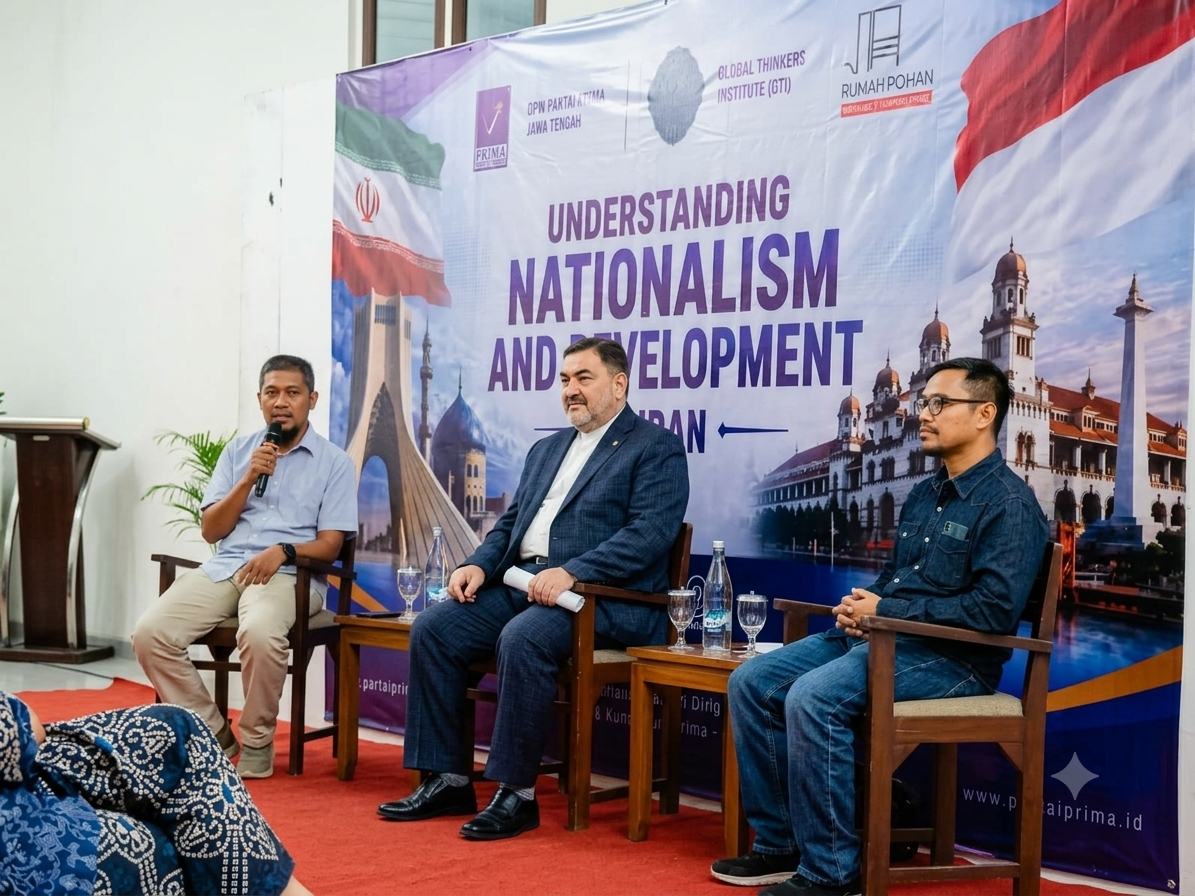

GTI-Global Thinkers Institute (GTI), in collaboration with the Regional Leadership Council (DPW) of the Prosperous Justice Party (PRIMA), held an international discussion titled "Understanding Nationalism and Development in Iran" on July 22, 2026, at Po Han House in Semarang's Old Town, Central Java. Present were the Iranian Ambassador to Indonesia, Mohammad Boroujerdi; Muhammad Ma'ruf, Ph.D., Director of the Global Thinkers Institute (GTI), and Bagas Ardianto Saputra, Chairman of the Central Java DPW of the PRIMA Party.
This discussion was part of a series of visits by the Iranian Ambassador to foster friendship and share understanding of the current situation in Iran with parties, religious communities, the government, and universities around Semarang. These included discussions, sharing insights, and potential collaborations in various fields.
These included scientific dialogues at UNDIP, UIN Wali Songo, UPGRIS, Agung Putra University and SCCR, Azzuhri Islamic Boarding School, the Ahlul Bayt Community, and the Central Java governor's and mayor's offices.
The event was opened by the representative of the mayor of Semarang, Rochmad Wahyudi, SE, ST, MM, Head of the Domestic Politics Division at the National Unity and Politics Agency (Kesbangpol) in Semarang City. Rochmad emphasized the importance of understanding geopolitical conditions so that Indonesia can adapt quickly and appropriately. Indonesia-Iran cooperation is crucial for building a bridge of peace and shared progress.
Boroujerdi emphasized the importance of a unified understanding between religious nationalism and national independence. The experience of resilience against US-Israeli sanctions and military aggression against Iran serves as a testament to Iran's religious nationalism. Without nationalism grounded in strong faith, national independence will be impossible or incomplete. Colonialism always targets the idea and practice of independence. Iran is a prime example of how nationalism and national independence are tested in both war and peace.
Meanwhile, Ma'ruf highlighted why understanding Iranian nationalism is urgent and significant, because what has befallen Iran now, in the form of illegal military aggression and barbaric Western sanctions, has not destroyed Iran; in fact, Iran's resilience and development progress have seen a significant leap. Development in Iran since the 1979 revolution has focused on resistance against the injustice of the US-Israeli empire, thus embodying the spirit of resistance—known as the economy of resistance. This economy is based on self-reliance in all areas.
While the origins of Iranian nationalism are indeed based on Islam and the Quran, Annahl, 123, explains that "nation," "millah," and "din" all have one meaning, the path to God. According to Imam Khomeini, nationalism is a matter of national education.
Just as God guided his people through the prophets, Iran's spiritual leader, the martyr Seyyed Ali Khamenei, who was assassinated by the US-Israel alliance, became the spiritual guide of the Iranian nation. Iranian nationalism understands that differences in race, skin color, and suffering are accidental and can only become essential when grounded in truth, justice, freedom, and the human innate desire for God. Iranian nationalism is a political issue based on the heart—human nature—faith. It is a matter of guiding the heart—the cry of the people.
This contrasts with Western nationalism, which is based on the French Revolution without any consideration for religion. Western nationalism is understood to be in conflict with religion.
The first principle of Pancasila, Belief in One Almighty God, as the foundation of the Indonesian state, makes Indonesian nationalism religiously in line with Iranian nationalism.
As long as nationalism is based on the struggle for truth, justice, freedom, and the path to God, it has a positive value, while nationalism that narrows the state, especially chauvinism, has a negative connotation. At the beginning of the 1979 Iranian revolution, demands were 40% cultural, 30% political, and 20% economic. This signifies that the demand for the liberation of oppressed souls (culture) from the US and the monarchy (politics), while economic demands were colored and aligned with the spirit of the revolution.
Many third world countries, after independence, adopted Western economic development recipes as the sole path to prosperity, but in reality, they fell into a trap of dependency not only economically, but also politically and culturally, eroding their identity and nationalism.
Bagas highlighted the importance of learning from Iran's nationalism, progress, and independence, which had been tested by 47 years of sanctions. Bagas expressed pride in Iran's consistent resistance to colonialism and imperialism despite the harsh embargo.
The discussion was attended by party activists, journalists, cultural figures, and Semarang residents.