
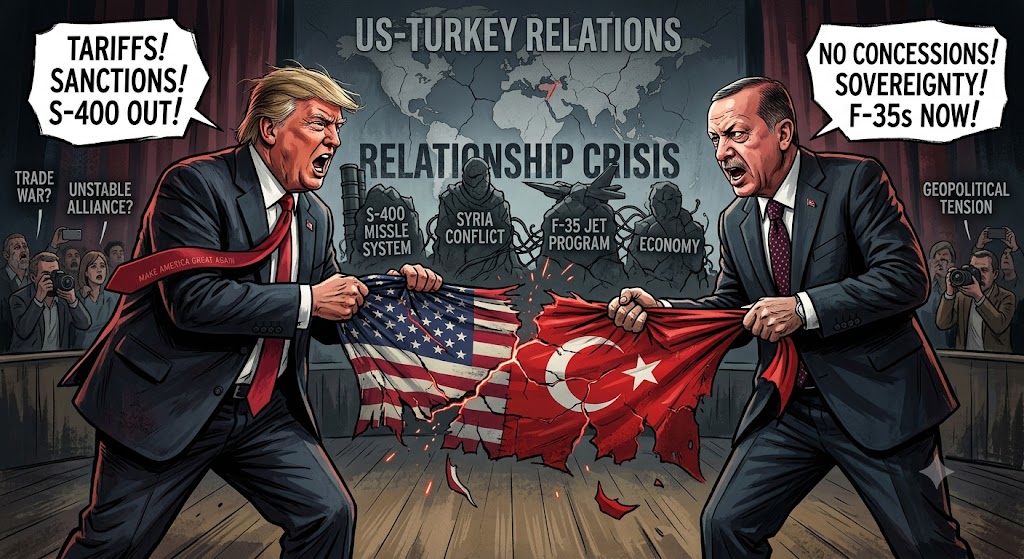

GTI-The arrival of US President Donald Trump in Ankara on Tuesday, July 7, for the annual NATO summit was a moment charged with tension and controversy. On one hand, Trump displayed a friendly attitude toward Turkish President Recep Tayyip Erdogan; on the other, he threatened to withdraw US military support for European members of the bloc.
Trump's Pressure on European Allies
Trump arrived in Turkey amid rising tensions between Washington and Europe. The US President has been pushing his NATO allies to increase defense spending to 5% of their GDP—an figure that was agreed upon at last year's summit, but has become increasingly difficult to meet due to Europe's stagnating economy.
"I am very disappointed with NATO," Trump told reporters, arguing that the alliance had failed to meet defense spending targets and had not supported the US-Israel war against Iran. He even hinted at the possibility of announcing further reductions of US troops in Europe as a response to this non-compliance.
A Special Respect for Erdogan
Interestingly, Trump acknowledged that his decision to attend the summit was solely out of respect for Erdogan, whom he praised as a "very strong leader." Although Erdogan had previously condemned the war in Iran and the rising tensions between Turkey and Israel, Trump took the controversial step of announcing the lifting of sanctions on Ankara for Erdogan's purchase of the Russian S-400 air defense system.
Furthermore, Trump stated he would consider lifting the ban on the sale of F-35 fighter jets to Turkey—a move predicted to anger Israel. This decision showed how the personal relationship between the two leaders could alter long-standing diplomatic dynamics.
Mass Demonstrations: "NATO Killer, Get Out!"
While NATO leaders gathered in Ankara, a wave of large-scale protests marked the summit. Demonstrators marched from Taksim Square to the Bosphorus, chanting "NATO killer, get out!" and "No to NATO, killer of nations!"
The march successfully united various elements of society—trade unions, leftist parties, and professional organizations, including TMMOB (Turkey's largest association of engineers and architects) and the main trade union federation, DİSK. Participants also voiced support for Palestine and Gaza, carrying banners that read: "NATO means poverty, mass murder, and destruction."
NATO-Turkey Relations: A History of Double Standards
The relationship between NATO and Turkey, which has lasted since 1952, has always been complex—a partnership marked by recurring crises. As the alliance's second-largest military power after the US, Turkey has carried significant responsibilities for decades. However, when Ankara’s core security interests clash with US or European priorities, allied solidarity often comes with conditions. Here is a data timeline of NATO-Turkey crises:
- Cuban Missile Crisis (1962): The US agreed to withdraw nuclear missiles in exchange for the Soviet withdrawal from Cuba, without consulting Turkey. This unilateral decision created one of the first major tensions in the bilateral relationship.
- Johnson Letter (1964): US President Lyndon B. Johnson warned Turkey against intervening in Cyprus due to increasing pressure on the Turkish community on the island. Johnson even hinted that NATO might not defend Turkey in the event of a Soviet retaliation and restricted the use of US-supplied weapons.
- Cyprus Operation & Arms Embargo (1974):After Turkey acted to protect Turkish Cypriots, the US imposed a three-year arms embargo. Turkey responded by taking over US military facilities on its territory.
- Iraq War Dispute (2003): Before the US invasion, France, Germany, and Belgium delayed Turkey's request for Patriot air defense systems. In retaliation, Turkey refused to allow the deployment of over 60,000 US troops on Turkish soil for the Iraq campaign.
- S-400/F-35 Crisis (2019): After failing to obtain Patriot systems from its allies, Turkey purchased the Russian S-400. The US responded by expelling Ankara from the F-35 program—despite Turkey having paid its share—and imposing CAATSA sanctions.
- Counterterrorism Dispute: Turkey has long criticized NATO allies, particularly the US, for supporting Kurdish groups like the YPG, which Ankara considers linked to the PKK—an organization classified as terrorist by Turkey, the US, and the EU.
- Allegations of Coup Involvement: Claims of NATO involvement in the 1980 Turkish coup and criticism of NATO countries harboring FETÖ members after the 2016 coup attempt continue to fuel distrust among the Turkish public.
The Future of Transatlantic Relations
Trump's visit to Ankara and this NATO summit confirmed that transatlantic relations are at a crossroads. Trump's decision to give Turkey special treatment while threatening European allies has created a new rift within the 75-year-old alliance.
The lifting of S-400 sanctions and the possibility of canceling the F-35 ban for Turkey show that Trump prioritized his bilateral relationship with Erdogan over alliance solidarity. Meanwhile, the threat to withdraw US troops from Europe signals that the US is not hesitant to use its military influence as a tool of diplomatic pressure.
On the other hand, the mass demonstrations show that a significant portion of Turkish society rejects the presence of NATO and the US military in their country. This anti-NATO sentiment, fueled by a long history of double standards and intervention, presents a challenge for Erdogan's government, which must balance alliance interests with the aspirations of its people.
The Ankara summit may be remembered not for any major decisions, but as a moment when the true face of NATO relations—between cooperation and crisis—was clearly revealed to the world.
The Back-and-Forth of the Caliphate Agenda
Trusted intelligence sources say Turkey permitted US AWACS surveillance aircraft to operate during the strikes on Iran, although Turkey has denied this. Meanwhile, Turkey has no access or sovereignty inside the Incirlik Air Base in southern Turkey, which is operated by the 39th Air Base Wing and houses dozens of US B61 nuclear weapons.
In another move, Turkey also sent a delegation to attend the funeral procession of Seyyed Ali Khamenei, who was killed by Trump, at the Imam Khomeini Mosalla in Tehran. The delegation included Vice President Cevdet Yilmaz, Deputy Foreign Minister Musa Kulaklikaya, Turkish Ambassador to Iran Hicabi Kirlangic, and several Turkish parliament members.
Trump is well aware of and accommodates Erdogan’s caliphate agenda and that of the Muslim Brotherhood in Syria. Erdogan also uses rhetoric supporting Palestine to accommodate his citizens who support Palestine. Will Erdogan allow himself to be trapped by Trump into supporting Julani and the IDF in their aggression against Lebanon to destroy Hezbollah? Can Erdogan and Julani attack Israel without Iran? This is Erdogan’s back-and-forth politics, between diplomacy and controversy, between being friendly and exploiting enemies, between maintaining Iran as a neighbor and competing for control of the Islamic world.
Considering the historical facts of Erdogan’s support for establishing ISIS alongside NATO in Syria and Iraq, and his achievement of toppling Bashar al-Assad to establish Julani’s rule in Damascus—which paved the way for the IDF to take control of the Golan Heights—Erdogan may ultimately choose to destroy Hezbollah alongside Trump rather than attack Israel alongside Iran. This is because a small caliphate would be established in Lebanon after Syria. After that, Erdogan would raise the Turkish flag in Jerusalem, after Israel and the US, along with the remainder of a crisis-ridden NATO, are defeated by Iran.