

Muhammad Ma’ruf, Director, Global Thinkers Institute (GTI)
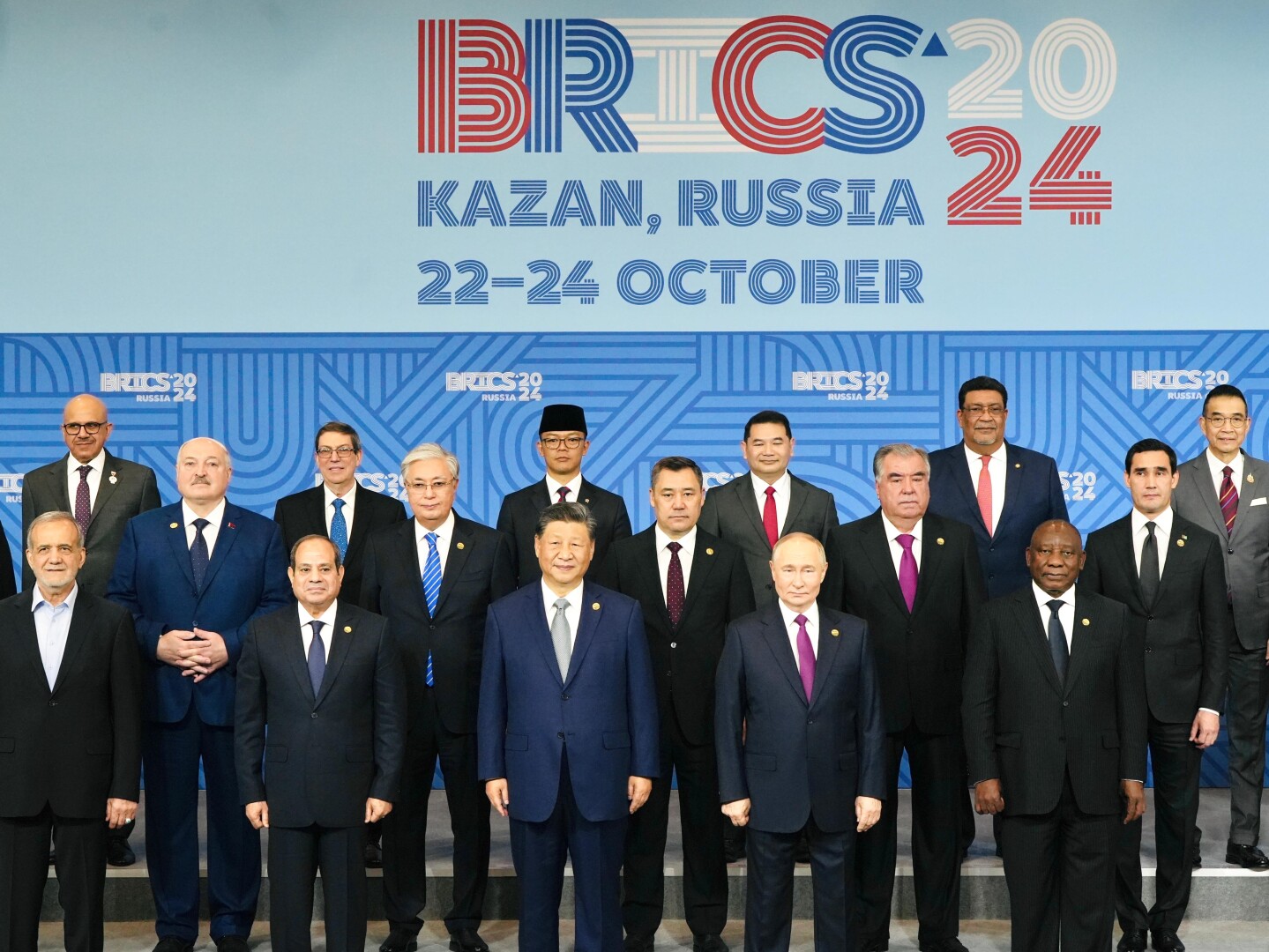
Prabowo has been President of the Republic of Indonesia for more than four months, since being inaugurated on 20/10/2025. One of Prabowo's breakthroughs in the economic field is to restore the ethos of the Pancasila economy. At the same time, Indonesia has officially become a full member of BRICS.
What is Pancasila economy, what is its relationship to Indonesia's full membership in the BRICS group. This article will briefly explain the relationship between the two.
What is Pancasila Economy?
Pancasila economy is often equated with "people's economy, controlled market economy, middle way economy, mixed economy, and third way economy, some even bring it closer to the concept of a welfare state. An economy that has the spirit of taking a middle path between capitalism and socialism.
Pancasila is also often referred to as a combination of the Declaration of Independence (blue stream) and the Communist Manifesto (red stream). So from an economic aspect, it is a combination of capitalist and socialist economy.
The historically-politically, Pancasila is a combination of three ideologies, namely Nationalism, Socialism and Democracy, but all are based on Godly Humanism. Bung Karno said that Pancasila is sourced from Nationalism, Islamism and Communism. While Bung Hatta mentioned three other sources, namely Islam, Socialism and Indonesian culture. So that Pancasila economically, is based on the three mixtures of ideologies.
By its thinkers, such as Mubiarto, the Pancasila economy is defined as a people's economy based on the five Pancasila. A market economy controlled by the state. The actual people's economy is carried out by the majority of society. Such as economic activities carried out by most farmers in Indonesia. The life of the traditional class market economy, the meeting of farmers, traders, fishermen, etc.
The face of the Pancasila economy can be found in the regions, in rural areas, small towns and villages throughout Indonesia (there are many people's industries or crafts). This kind of understanding makes the Pancasila economy close to the Green school in Johan Galtung's theory.
According to Galtung, the Green school is characterized by collectivism where collective ownership of production factors that produce collective and individual products applies. In economic distribution, it relies on local markets, local plans and exchange. It can also be called a traditional economy.
Mubyarto emphasized the practice of Pancasila Economics or Pancasila Economics "in action", which can easily be found and recognized everywhere throughout Indonesia. The practice of "people's economy" is moralistic, democratic and independent.
According to Mubiyarto, the Pancasila economic system has 5 basic principles, first, the wheels of government are driven by economic, social and moral stimuli; second, the strong will of the entire community towards social equality (egalitarianism) in accordance with the principles of humanity; third, the priority of economic policy is the creation of a strong national economy, which means that nationalism inspires every economic policy; fourth, cooperatives are the "main drivers" of the economy and are the most concrete form of joint ventures; and fifth, there is a clear and firm reward between planning at the national level and decentralization in the implementation of economic activities to ensure social justice.
According to Kwik Kyan Gie, an Indonesian economist and politician of Chinese descent, former Coordinating Minister for Economic Affairs and Minister of National Development Planning & Head of Bappenas (2001-2004), said that the Pancasila economy is a capitalist economy that is fully regulated by the government. Capital is a "genuine" term, where every individual is allowed to have capital to make a profit.
Prof. Dr. Dawam Rahardjo, an Indonesian economist, limits the Pancasila economy to the term cooperative as opposed to competition. The basis of the economy is driven by cooperatives. The Pancasila economy is an economy that is developed based on the theory of resistance against the capitalist economy.
According to Dawam, the Pancasila economy needs to be emphasized as an economy that aims to eradicate society from poverty and eliminate inequality, gaps, exploitation and dependency, through people's participation in economic activities so that a just society or a just and prosperous society based on Pancasila is achieved. Therefore, a normative formulation regarding the Pancasila Economy needs to be prepared. As stated by Bung Hatta, we must always remember the normative guidelines in economic activities, namely Pancasila which needs to be interpreted socio-economically.
Emil Salim, an Indonesian economist and politician is considered to have first popularized the term Pancasila economy in 1967, and in 1979, Emil made the concept of Pancasila economy more mature in theory.
Emil argued that an economic policy concept, after experiencing a movement like a clock pendulum from left to right, until it reaches a point of balance. To the right means free to follow market rules, while to the left means experiencing state intervention in the form of centralized planning. Or a market economic system with government control or a "controlled market economy". It can also be called a "mixed economic system", between capitalism and socialism" or "third way economic system".
From the many definitions of Pancasila economy, it can be summarized that Pancasila economy is an economic activity that is driven and limited by the five values of Pancasila as the basis of the ideology of the Indonesian state. Limited means that the course of the economy, both macro and micro, is not controlled by entities that only benefit individuals, oligarchies or companies. The state emerged to protect the economy of the weak majority of the people. The Pancasila Economy emerged to protect the people's economy that had long been exploited by colonial companies.
After 1945, many foreign companies operated as a new form of colonialism. Therefore, Sukarno nationalized Dutch companies that were still operating after independence in 1945. After that, Sukarno was overthrown with the help of the CIA. In 1967, the IMF practically controlled the Indonesian economy under the leadership of Suharto during the New Order. Although Suharto encouraged development and indoctrination of Pancasila practices in everyday life. The Development Economy was driven by a liberal economic recipe.
Now, the Prabowo era has effectively begun to define and revive the Pancasila economy. The economy is driven and planned by Bappenas (Badan Perencanaan Pembangunan Nasional) and is run periodically and in stages. As expected by the founding fathers and carried out by the old and new orders. Prabowo rejects liberal economics.
The economy is based on the opening of the Constitution, protecting all Indonesian citizens, advancing public welfare, educating the nation and participating in world peace.
In other words, the Pancasila economy according to Prabowo is a constitutional economy. An economy driven by the spirit of the constitution.
Then the question is, when the spirit of the Pancasila economy began to be revived by Prabowo, did this have a consequential implication on the choice to join the BRICS economic bloc.