
Why did BRICS emerge?
The emergence of BRICS is generally perceived by the world public as a response to the western neoliberal economic model.
The western liberal economy is characterized by a combination of the implementation of the liberal democratic political model and the western liberal economy. An economy driven by a pure private market. Making the state the guardian of individual and private interests. In its development, it is controlled by oligarchies and deep states.
Its normative narrative is built on the basis of human rights advocacy programs, freedom, minority defense, and LGBT campaigns. However, in actual implementation, it is done by dictating the development of developing countries with the mode of loan stimulus from the IMF and World Bank, etc. Making the puppet regime an extension to fulfill western economic interests.
For countries or individuals who oppose the western liberal economic and political hegemony model, they will be sanctioned by the US, whether or not approved by the UN and western European countries.
Unilaterally, the US can sanction individual entities, companies, regions, countries on the grounds of violating human rights, sponsoring terrorism arbitrarily.
The countries sanctioned include the old category, Cuba, Iran, North Korea, Syria. Among the countries that have been sanctioned by the USA; Afghanistan, The Balkans, Belarus, Burma, Central African Republic, Cuba, and the Democratic Republic of Congo, Ethiopia, Hong Kong, Iraq, Lebanon, Libya, Mali, Nicaragua, Somalia, Sudan, South Sudan, Ukraine, Venezuela, Yemen and Zimbabwe.
Recently, China and Russia were also sanctioned, on the grounds of aggression against Ukraine. Therefore, China and Russia, including large countries economically, hold veto rights and are pioneers in the formation of BRICS, then slowly, BRICS membership is getting bigger and solid. BRICS was founded in 2009, and until now, its members continue to grow. The progressive development of BRICS is a serious challenge for the unilateralism of the western bloc.
The development of BRICS makes the western bloc increasingly aggressive in attacking countries that will become BRICS members. On the other hand, the aggressiveness of NATO's expansion politics into eastern Europe with the mode of defending (Ukraine) as a tool to weaken Russia.
On the other hand, Nato Middle East was activated to run the genocide project in Gaza as the last step of colonizing the land of Palestine and surrounding countries, and making BRICS as a hope for a solution to the political crisis.
Thus BRICS grew naturally and found its popularity. It is not an exaggeration if we consider, BRICS is a way out for countries that are sanctioned and still experiencing colonization by the West.
Narratively, BRICS is a counter narrative of Western hegemony not only at the level of economic practice, but also redefining politics, economics, culture, education and also world governance in general.
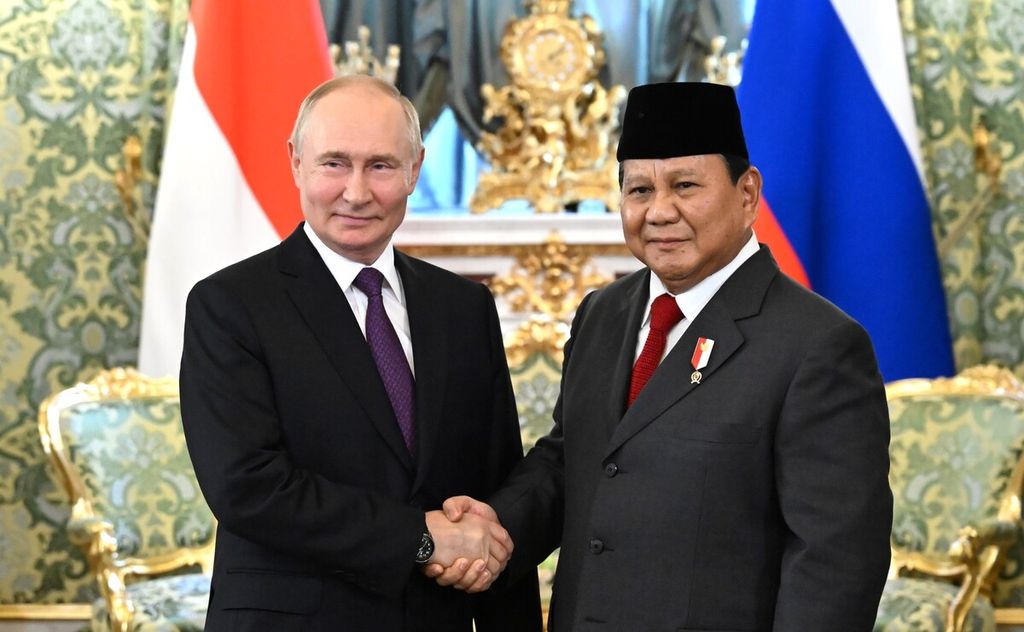
For certain countries that have a tradition close to the former Soviet Union, such as North Korea, Cuba, Venezuela, Syria, China, it is natural to be sanctioned. But the emergence of BRICS and seeing Russia, China, Iran, makes countries that have a tradition close to the West begin to be interested in becoming members of BRICS. Indonesia is one example.
Indonesia's full membership in BRICS signals that Indonesia has found its identity, "on the track" returning to the spirit of the 1945 Pancasila constitution, which is anti-colonial, will heal its sovereignty which was partly taken by western colonial capitalism at the local and international levels. This is the spirit of Prabowo's leadership, returning to the vision and mission of the 1945 constitution.
The nature of Pancasila economy
The economic system in a country actually develops following the dynamics since the country was founded. Economic theorization emerged later after the economic phenomenon. Economic activities develop periodically. Starting from the nomadic periodization and the hunting livelihood stopped, humans settled, civilization developed. Then farming, livestock raising, fishing, gardening emerged producing various products and the need to exchange goods (barter) arose and markets were formed from traditional markets to capital markets. The economy developed from a family economy transformed into small, medium and large industries. Gold and money exchange tools emerged.
When the government emerged, either in the form of a kingdom, monarchy and republic, economic activities began to be regulated more neatly to maintain power and improve the welfare of its people.
In its development, the economic system that applies in North America and Western Europe, for example, can be called a mixed economic system, because it is no longer purely capitalist, but not socialist either.
However, the general perception is that the US economic system is the most representative capitalist economic model, while the economic system in the Soviet Union (before 1991) or the PRC is the most standard socialist economic model. Perhaps the closest to the mixed economic model is the British economic system or Western European countries which are commonly referred to as welfare states.
Johan Galtung, divides 6 colors of economic thought schools; red, blue and green. Blue, symbol of capitalist economy, focuses on market and capital. Red, socialist economy, focuses on state and power. Green, Third World economy, focuses on civil society and dialogue. The other three schools are mixed economies. Pink School, Western European countries minus England, especially Nordic countries, namely countries that follow the concept of a welfare state.
Blue and Red, represented by Far Eastern countries, especially Japan, South Korea, Taiwan, Hong Kong and Singapore, firmly combine elements of market and state, capital and power.
Another school of thought he mentioned was a mixture of Green, Pink and Yellow which was considered an ideal combination, because it did not directly mix the colors Blue and Red which were the most, most likely to cause conflict and violence.
Referring to Galtung's theory, the idea of Pancasila Economics is derived from the combination of the political essence of the Declaration of Independence (blue school) and the Communist Manifesto (red school). A combination of three ideologies, namely Nationalism, Socialism and Democracy. Sukarno called Pancasila the result of the power of nationalism, Islamism and Communism. Hatta called it a combination of Islam, Socialism and Indonesian culture.
Meanwhile, Prabowo emphasized that Pancasila economics is an economy that takes positive aspects from various economic schools. A planned economy, not a liberal economy that should not be planned. As the inevitability of the existence of the National Planning Agency (Bappenas) is economic development that is planned periodically.
Constitutional Economics is Pancasila economics
The many definitions of Pancasila economics that have been explained, Pancasila economics has a clear constitutional basis. Reflected in, article 33, the Republic of Indonesia law. So that the Pancasila economy is a constitutional economy.
As in the 1945 Constitution, the regulation related to the national economy is regulated in Article 33 which reads as follows: paragraph (1) The economy is structured as a joint effort based on the principle of family; paragraph (2) Branches of production that are important to the state and that control the livelihoods of many people are controlled by the state; paragraph (3) The land and water and the natural resources contained therein are controlled by the state and used for the greatest prosperity of the people; paragraph (4) The national economy is organized based on economic democracy with the principles of togetherness, efficiency with justice, sustainability, environmental awareness, independence, and by maintaining the balance of progress and unity of the national economy; paragraph (5) Further provisions regarding the implementation of this article are regulated by law.
So that the Pancasila economy has several characteristics; economy based on the five principles of Pancasila, based on family, driven by the people through small and medium enterprises (cooperatives) totaling more than 60 million, which contribute 30% of GDP, a market managed by the state.
BRICS, Pancasila and Prabowo
Now Indonesia has become a member of BRICS, does full membership have the potential for a better Indonesian economy? Will Prabowo fight the hegemony of the liberal western political economy? It seems that Prabowo will use “a practical wise economy policy” (practical economic wisdom, not an anti-hegemonic political narrative head to head with the west. At that point, we can measure Prabowo's strengths and limitations when history calls for action.
The choice of the Pancasila economy desired by the Prabowo Government and Indonesia's joining BRICS at least give Indonesia new hope, the actual Pancasila economy.
Not relying on the western liberal economic recipe which has proven to be manipulative. Prabowo's tactical steps give hope for changes in the liberal economy in the New Order era and increasingly gripping in the reform era can change, transform into a Pancasila economy based on the spirit of the 1945 constitution qualitatively and quantitatively.
Ref
Prof. Mubyarto, “Ekonomi Pancasila, Warisan Pemikiran Mubyarto”, 2016, UGM Press