
"So the phenomenon of the fall of Ukrainian President Viktor Yanukovich and the support of the US and the Western bloc in bringing forth Viktor Poroshenko as a US-Western proxy president, with the support of political groups of a fascist bent such as the Svoboda Party and others, further strengthens the indication that the Liberal Capitalism Scheme driven by global corporations is currently in a critical situation."
By, Hendrajit
Geopolitical Analyst, and Director, Global Future Institute-GFI.
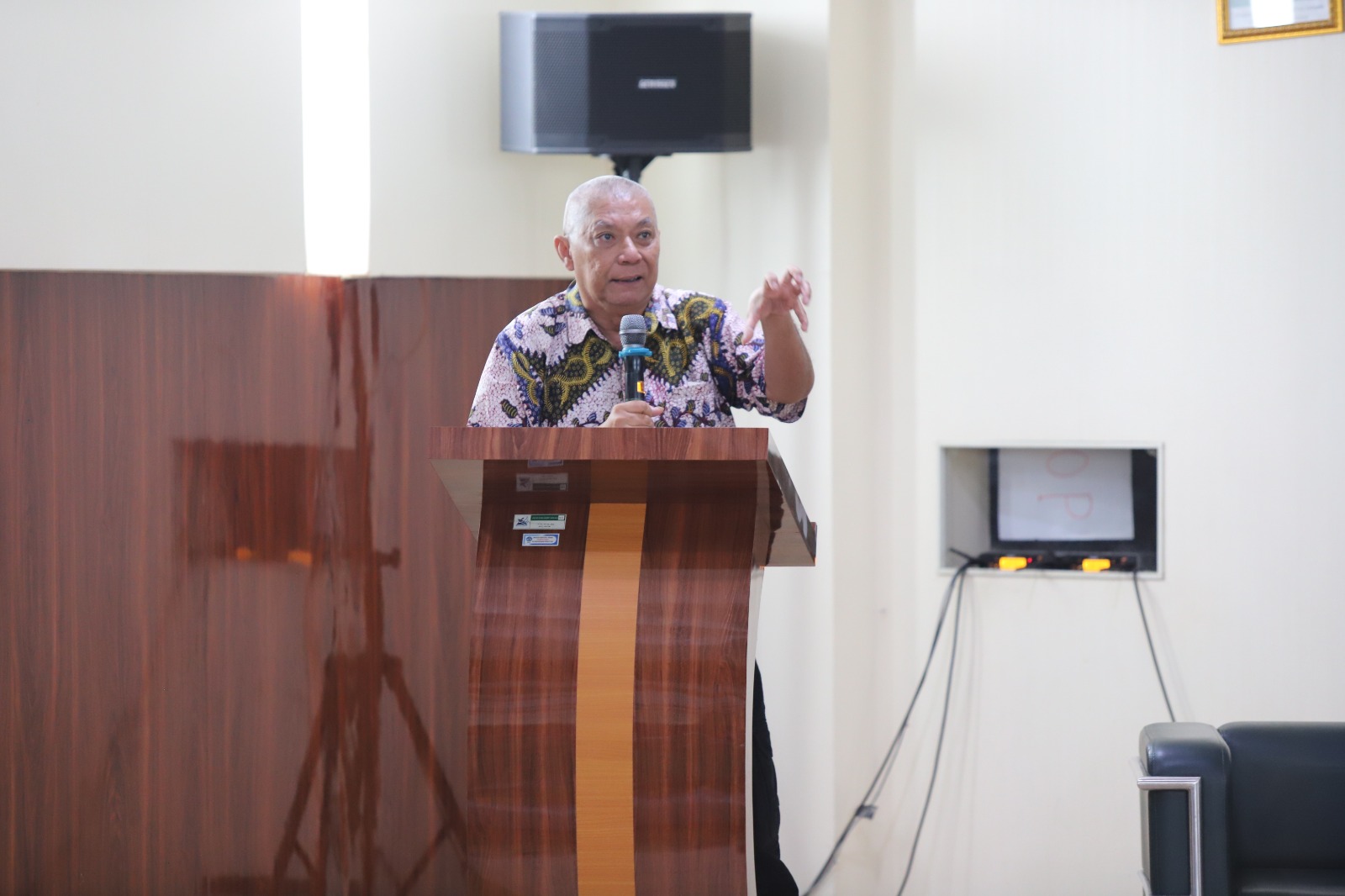
Presented at a geopolitical seminar on the subject; NEOCOLONIALISM-NEONAZISM; THE CHALLENGE OF A MULTIPOLAR WORLD OF SOUTHERN COUNTRIES AND ASEAN, at the Mulyono Sudirman Auditorium, Faculty of Medicine, UPN "Veteran", Jakarta, November 5, 2026. Organized by the Global Thinkers Institute-GTI, Faculty of Social and Political Sciences, Department of International Relations, UPN "Veteran" Jakarta, and the Global Future Institute-GFI.
GTI-Examining and reviewing Neocolonialism and Neo-Fascism on the European continent must be done in one breath with Global Capitalism, the fruit of the Smokestack Industrial Revolution since the 19th century. The rapid development of industry, marked by the birth of a new social class that controlled the system of production and the financial system, in its development drove multinational conglomerates in Britain, the United States, France and Germany to expand their living space (lebensraum) beyond the geographical borders of their respective nation-states. So from the Global Capitalism scheme as its master plan, Colonialism and Imperialism became the legitimate offspring of the Global Capitalism Scheme driven by Western countries.
Britain penetrated the Indian subcontinent, Burma (now Myanmar), Sri Lanka, and most of the Sub-Saharan countries on the African continent. France launched its colonial expansion into Cambodia, Laos, Vietnam in Southeast Asia, as well as into the African region, especially in the Maghreb countries such as Algeria, Tunisia, Morocco and surroundings. As for the Netherlands, it colonized the archipelago territories that are now Indonesia from the end of the 16th century and the beginning of the 17th century.
As the end of World War II approached, in the New Hemisphere, the United States, in 1944 a meeting was held of economic and business actors from various countries, both from the United States and Western Europe, to discuss the prospects of the world economy after World War II. That was the open agenda. However, in the closed agenda, what was actually discussed was a global strategy to preserve the Colonialism Scheme of these imperialist countries when the independence of their colonies in various regions of the world could no longer be contained. That meeting is what we later know as the Bretton Woods Meeting.
In reality, what they predicted and worried about indeed came to pass when in April 1955 the countries of the Asia-Africa region, both those newly independent such as Indonesia, or several countries still struggling for independence such as Algeria or Ghana, attended the Asia-Africa Conference (AAC) held in Bandung, Indonesia. At the end of the conference, the Ten Principles of Bandung (Dasa Sila Bandung) were proclaimed, affirming that colonialism in all its forms and manifestations must be eradicated from the face of the earth.
That is precisely why the 1944 Bretton Woods meeting was actually intended to anticipate how to perpetuate the Colonialism-Imperialism Scheme in various non-European regions, only no longer based on the Classical Colonialism Scheme, but rather on the importance of creating a New-Style Colonialism Scheme. From that idea came the context and meaning of what we now know as Neocolonialism. Indirect colonization, in the sense that the colonizing country is not physically and directly present in the countries that are its colonial targets.
The Neocolonialism Scheme, which in essence is non-violent and non-military, drove the Western imperialist countries to then also develop a New-Style War, which I often call Asymmetric War. In that Asymmetric War Scheme, multinational corporations play a role from behind the scenes, while state authorities play a role at the front line or spearhead.
This is somewhat different from the time of Classical Colonialism, when state authorities—generally monarchies at that time—actually played a role from behind the scenes, and the traders or multinational conglomerates were at the front line. For example, the Dutch Trading Company (VOC) began penetrating several spice-rich regions in the archipelago such as North Maluku, with the blessing and prior direction of the Dutch kingdom.
The Portuguese penetrated archipelago regions such as Ternate and Tidore, which were also rich in spices, with the blessing of the Portuguese kingdom. Likewise when the Spanish trading company penetrated the region we now know as the Philippines, also with the blessing and direction of the state authority, the Spanish Kingdom. Also, the English trading company (East India Company (EIC)) penetrated India, Sri Lanka, Burma and the countries of the Malay Peninsula (Malacca Strait Settlement), with the blessing and direction of the English kingdom. These trading companies were then given the authority to act outside the sovereignty of the kingdom but in the name of the kingdom, to form their own armies and make international treaties with other countries in the name of the kingdom.
However, as I mentioned earlier, in the Neocolonialism Scheme, where Global Capitalism relies on heavy-industry-based factories such as oil, gas, coal mining, gold, nickel, and the like, corporations not only transform into a state within a state, alias a Deep State, but the corporations themselves already possess apparatus like that of a nation-state. They have private armies, private intelligence, and their own research and think-tank bodies that lie outside the scope of authority of a country's government.
This is what then, in line with the rapid development of Economic Neoliberalism driven by British Prime Minister Margaret Thatcher since the late 1970s, and US President Ronald Reagan since the early 1980s, caused the strategic interests of corporations to merge with government authorities and their states when forging unequal economic-trade cooperation with developing countries in Asia, Africa, the Middle East, and Latin America.
Especially with the fall of the Berlin Wall in 1989 and the dissolution of the Soviet Union in 1991, the US and Western countries thought they would become a Unipolar force or the sole hegemonic power without rivals following the end of the Cold War. Just like the prediction full of confidence and optimism from Francis Fukuyama in his book, The End of Ideology.
However, in its development, since the beginning of the 21st century, there has been a Plot Twist or a change in the storyline situation that Francis Fukuyama could not have imagined. That the rapid progress of China's economy, grounded in Deng Xiaoping's strategic idea of the Four Modernizations Program (Agriculture, Industry, Science-Technology and Defense-Military), is essentially a Cultural Strategy to revive China from the decline that had been ongoing since the 1960s.
China's rapid progress, which then coincided with Vladimir Putin replacing Boris Yeltsin as President of the Russian Federation, also began to stir and strive to rise from its decline since the early 1990s. China's rapid progress as a new superpower in the economic field, and Russia's success in consolidating its political configuration that had been chaotic in the Yeltsin era, then led these two countries from the European and Asian regions to forge a strategic alliance within the Shanghai Cooperation Organization (SCO) Scheme in June 2001, which then became increasingly solid by rallying strategic cooperation with three developing countries namely Brazil, India and South Africa in 2005. That is what we now know as BRICS.
In this constellation of the mid-2000s, the US and the West faced a situation that I call Disruption or Shock. Where China, Russia and the Global South countries, increasingly solid in forging strategic alliances, gradually became more effective in creating a Balance of Power Strategy against the dominance of the US and the Western bloc. So that the bargaining position of the Global South countries driven by China and Russia also grew stronger. Even now they are beginning to pioneer a De-Dollarization movement.
Meanwhile, in the domestic conditions of each Western European and Eastern European country, in line with the beginning of the decline of their respective national economic conditions, and the failure of parliamentary democratic systems as well as US-style presidential systems to channel the increasingly widespread social aspirations of new social classes emerging in line with the rapid development of the information and digital era, a new phenomenon began to emerge. Namely the widespread phenomenon of Right-Wing Populism in Europe and lately also in the US following Donald Trump's success in seizing presidential power.
So as the economic crisis grows stronger, marked by the increasing number of poor people in these developed countries, Right-Wing Populism in America and Western Europe such as Germany, France, the Netherlands, Sweden and even Britain, in its development became a precondition to inspire marginalized social groups to reconsider the idea of Fascism as a political movement to respond to the global economic crisis marked by the beginning of the ineffectiveness of the Corporation-based Economic Neoliberalism Scheme in exerting economic pressure on developing countries by using the two world bodies built by these corporate capitalists, namely the IMF and the World Bank.
Thus, with Donald Trump's appearance for the second time as US president, Trump, by exploiting the sentiments of right-wing populist groups who feel marginalized and blame migrants from developing countries residing in America, develops a New Scheme to preserve his Neocolonialism Scheme. That is, changing the Economic Neoliberalism Strategy back to the Classical Colonialism Scheme based on Neo-Mercantilism. Exactly as I stated in explaining the classical colonialism Scheme. State authority is behind the scenes, businessmen and multinational conglomerates are at the front line.
This then explains why the global trend marking the increasing prevalence of the Right-Wing Populism phenomenon then becomes a precondition for considering the rise of the idea of fascism as a political movement that they believe is the solution to overcome the crisis. Whereas in reality, fascism, characterized among other things by justifying and supporting differences in race and skin color, always goes hand in hand with colonialism. So when Neocolonialism, which is currently in crisis, including Global Capitalism itself, is in crisis following the outbreak of the US-Israel versus Iran Armed Conflict, the rise of right-wing populism which in its development inspires the rise of fascism or ultra-nationalist groups in the style of the former German NAZI, should be observed carefully and with full vigilance.
For in a condition when Capitalism is in crisis, then fascism—one of whose basic ideas is that the state takes over private economic power as a form of protection so that the capitalist system can be saved—[becomes relevant].
So the phenomenon of the fall of Ukrainian President Viktor Yanukovich and the support of the US and the Western bloc in bringing forth Viktor Poroshenko as a US-Western proxy president, with the support of political groups of a fascist bent such as the Svoboda Party and others, further strengthens the indication that the Liberal Capitalism Scheme driven by global corporations is currently in a critical situation. So that the right-wing populism phenomenon now in Europe is beginning to show increasingly fascistic symptoms, it seems also increasingly affecting Ukraine, which geographically borders directly on the national sovereign territory of Russia.
However, apart from that, Indonesia and developing countries such as ASEAN should begin to think more strategically. Besides having to develop cooperation patterns increasingly based on Multipolarity or a diversity of poles as a momentum for the SCO and BRICS to be increasingly taken into account, forums in which Indonesia was once a pioneer such as the 1955 Bandung AAC and the 1961 Non-Aligned Movement, it is time to reactualize them in line with the developments and challenges of the present era.