
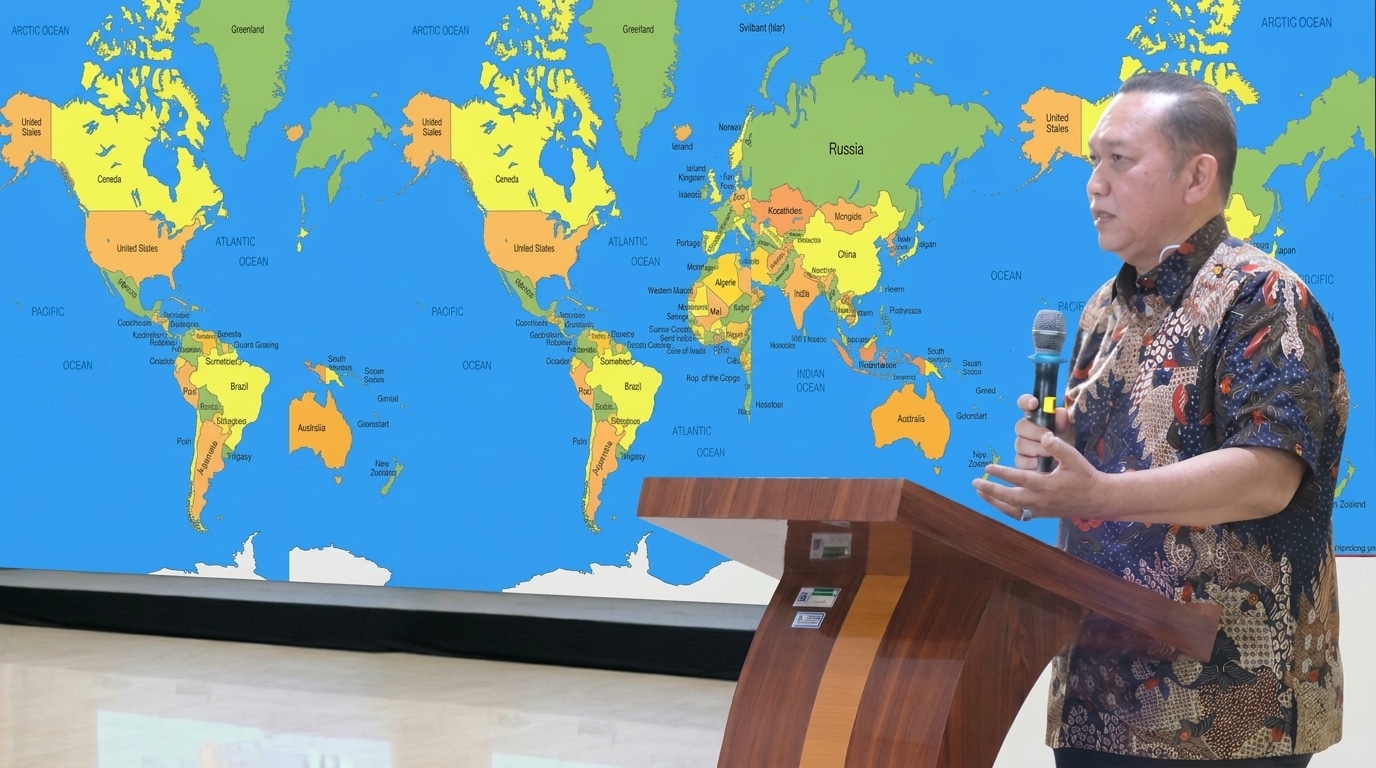

"We must also understand the rise of extremist ideologies, ultranationalism, and neo-Nazism as threats to international stability, particularly when such ideologies are used to sharpen conflicts and proxy wars."
By First Marshal TNI (Ret.) R. Agung "Sharky" Sasongkojati
Delivered at the geopolitical seminar at the geopolitical seminar; NEOCOLONIALISM-NEONAZISM; CHALLENGES OF A MULTIPOLAR WORLD OF GLOBAL SHOUTH AND ASEAN, at the Mulyono Sudirman Auditorium, Faculty of Medicine, UPN "Veteran", Jakarta, November 5, 2026. Organized by Global Thinkers Institute-GTI, Faculty of Social and Political Sciences, Department of International Relations, UPN "Veteran" Jakarta, and Global Future Institute-GFI.
Assalamu'alaikum warahmatullahi wabarakatuh.
Good morning, peace and prosperity be upon us all.
To the esteemed leadership of the National Development University Veteran(UNPNV) Jakarta, the lecturers, academics, and all the students of the Department of International Relations whom I am proud of.
First of all, I would like to express my gratitude for the opportunity given to me to present a perspective on world geopolitical and military changes.
I would like to begin this presentation with a fundamental question: is the world currently undergoing an ordinary shift in the balance of power, or is it in fact witnessing the end of a global power architecture that has lasted for approximately three decades?
In my view, we are witnessing a far greater transformation process. The unipolar dominance of the United States after the collapse of the Soviet Union is beginning to face serious challenges. China is developing as an economic and industrial power, Russia is once again projecting its military power, while the countries of the Global South are increasingly bold in fighting for their economic and political sovereignty.
However, these changes are not only taking place through conventional warfare. Competition also takes place through economic instruments, diplomacy, information, international law, technology, and the shaping of public opinion.
Therefore, I will discuss these changes through the course of history, starting from mercantilism and colonialism, the bipolarity of the Cold War, the unipolarity of the United States, to the consolidation of multipolarism and its implications for Indonesia.
My main message is: in an increasingly competitive world, sovereignty cannot be maintained through diplomacy alone. Sovereignty must be supported by real national power.
THE HISTORY OF MERCANTILISM TO THE COLLAPSE OF THE OLD MULTIPOLAR ORDER
To understand contemporary geopolitics, we need to return to the historical roots of modern colonialism.
European colonialism essentially did not begin only through military expansion. It grew from the intersection of mercantile capitalist interests, control of international trade, and maritime power.
In the 16th to 18th centuries, companies such as the VOC and the East India Company were not merely trading companies. They obtained special authority from their home states to build fortresses, maintain armed forces, make treaties, and perform governmental functions in certain territories.
In other words, we see the early form of integration of the instruments of national power now known as DIME: Diplomatic, Informational, Military, and Economic.
The VOC in the Nusantara archipelago demonstrated how trade interests could be imposed through military force and local political engineering. The Dutch Vereenigde Oostindische Compagnie (VOC) and the British East India Company (EIC) acted as a "state within a state." In the Nusantara archipelago, the VOC used armed ship fleets to impose a monopoly on cloves and nutmeg in the Banda Islands (1621), expel foreign traders, and execute vassal treaties with local kings through divide et impera tactics. The VOC launched military interventions and palace coups during the Javanese War of Succession to replace anti-VOC kings with comprador figures. In India, the East India Company (EIC) applied similar tactics with a regime change operation against Nawab Siraj ud-Daulah in the Battle of Plassey (1757), by bribing the internal general Mir Jafar, transferring power into British hands. The EIC drained the wealth of the Mughal empire and transformed a trading company into a massive armed territorial ruler.
Entering the 19th century, the Industrial Revolution changed the needs of European empires. They no longer merely needed spices, but also oil, rubber, coal, minerals, and markets for their industrial products.
The Berlin Conference of 1884–1885 demonstrated how European powers divided the African continent based on imperial interests, without adequately considering the structure of local societies.
Subsequently, competition among imperial powers reached its peak in World War I and II. Six old empires experienced destruction or major transformation. World War II also weakened the economic capacity of Britain and France to maintain their colonies.
Indonesia was part of that great wave of the struggle for independence.
From the destruction of European imperial multipolarism, the world then entered the bipolarity between the United States and the Soviet Union.
But there is a historical lesson we need to underline: control of trade, resources, logistics routes, and political instruments often becomes the foundation for the expansion of military power.
Classical colonialism may have formally ended, but the question of who controls resources and global supply chains remains relevant to this day.
THE EVOLUTION OF INSTRUMENTS OF NATIONAL POWER AND ASYMMETRIC WARFARE
After World War II, the world entered an era of bipolarity. The United States and the Soviet Union possessed enormous military capabilities, including nuclear weapons.
The threat of mutual destruction or Mutually Assured Destruction caused both countries to be very cautious about engaging in direct warfare.
As a result, competition was shifted to various instruments of national power.
America built NATO, while the Soviet Union formed the Warsaw Pact. Both used propaganda, economic aid, intelligence, military support, and proxy wars to expand influence.
Indonesia had an important experience through the 1955 Asia-Africa Conference in Bandung. Newly independent countries sought to build their own political position so as not to become objects of competition between the two blocs.
This is where we see that diplomacy can also be an instrument of resistance against the dominance of great powers.
Later, the Korean and Vietnam Wars demonstrated the limitations of conventional military superiority. In the Vietnam War, the United States had air technology superiority and enormous firepower. However, such power did not automatically produce political victory.
Logistics networks, geographic depth, adaptability, and the resilience of Vietnamese society made the war increasingly costly for America.
A similar experience was undergone by the Soviet Union in Afghanistan in 1979–1989. American support through Operation Cyclone to the Mujahideen, including the provision of Stinger missiles, became one of the factors that increased the cost of Soviet military operations.
In December 1991, the Soviet Union finally dissolved.
The strategic lesson from this period is very important: even the greatest military power can experience strategic defeat when political objectives are not achieved and the cost of war exceeds the benefits obtained.
This means that the measure of victory is not only determined by the number of aircraft, warships, tanks, or missiles. Victory is also determined by the ability to maintain political will, legitimacy, economy, and national resilience.
US UNIPOLARITY, LAWFARE, & THE ARCHITECTURE OF GLOBAL HEGEMONY
The collapse of the Soviet Union in 1991 gave birth to what is known as the Unipolar Moment, a period when the United States became the dominant power without an equal competitor.
America not only possessed military superiority. Its influence was also embedded in the international economic and financial architecture, alliance networks, technology, and global institutions.
We must understand that hegemony is not always maintained through military force. Hegemony is also maintained through the ability to shape rules, determine standards, control market access, and build international legitimacy.
In Gramsci's perspective, the strongest domination is not merely the ability to coerce, but the ability to make other parties accept an order as something natural.
However, when consensus is insufficient, instruments of coercion can be used through economic sanctions, diplomatic pressure, intelligence operations, or military intervention.
We can see various examples in history, from Iraq 2003 to Libya 2011.
In the development of Eastern Europe, NATO's expansion after the Cold War also became one of the sources of geopolitical tension between Russia and the West. Ukraine then became an arena of conflict that demonstrated the complexity of this competition.
We must also discuss the phenomenon of the resurgence of radical ultranationalism and neo-Nazi elements in a number of political and military groups in Eastern Europe. This phenomenon needs to be read historically and critically, without equating the entire society or government of a country with such extremist groups.
Meanwhile, in the Asia-Pacific, the formation of AUKUS and the strengthening of the QUAD demonstrate how the United States is building a security partnership architecture to maintain its influence in the face of China's rise.
Thus, global competition is no longer only about who has the largest military power, but also who is able to control the architecture of the international system.
THE CONSOLIDATION OF BRICS+, DEDOLLARIZATION, & THE RESISTANCE OF THE GLOBAL SOUTH
Entering the 2020s, unipolar dominance began to face structural challenges.
One important factor is the use of the financial system as an instrument of geopolitical pressure, known as the weaponization of finance.
The freezing of the Russian Central Bank's foreign exchange reserves after the invasion of Ukraine in 2022 raised a major question for many countries: are state assets stored in the international financial system truly protected from political considerations?
This question has prompted various countries to seek alternative transactions, including the use of local currencies, the development of alternative payment systems, and the strengthening of funding institutions outside the traditional Western financial architecture.
This is where BRICS+ becomes important.
BRICS does not mean it has become a military bloc or a fully solid political entity. The interests of its members remain different. However, this forum reflects the growing desire of a number of countries to build more diverse economic and diplomatic options.
We know of Local Currency Settlement, China's CIPS system, Russia's SPFS, and the New Development Bank.
All of these are part of efforts to diversify the international economic system, although the dedollarization process still faces various obstacles and has not yet replaced the overall dominance of the dollar.
For Indonesia, this issue is highly relevant.
The nickel downstreaming policy demonstrates that resource-owning countries have the opportunity to increase economic added value through domestic processing.
In the perspective of economic geopolitics, this represents the rise of Resource Owner Power.
We must not merely become suppliers of raw materials, while the profits of industry, technology, financing, and trade are enjoyed by other countries.
However, downstreaming must also be supported by technology, industrial quality, legal certainty, environmental protection, and the ability to create domestic added value.
The lesson I want to convey is that economic sovereignty must be built through mastery of production capacity, not merely ownership of natural resources.
THE IRAN CASE STUDY: SHIFTING THE CENTER OF GRAVITY & WAR OF ATTRITION
Iran provides an interesting case study of how a country with certain economic and technological limitations builds an asymmetric defense strategy.
Since the 1979 Revolution, Iran has faced various forms of economic, diplomatic, military, and technological pressure.
Iran realized that it could not match the United States symmetrically in terms of the number of aircraft carriers, stealth fighter jets, or global power projection capabilities.
Therefore, Iran developed a different approach.
They built ballistic missile capabilities, cruise missiles, combat drones, distributed defense networks, and Anti-Access/Area Denial or A2/AD capabilities.
The goal is not merely to destroy the opponent's forces, but to raise the cost of military intervention against Iran.
One important example is the use of Shahed drones. Relatively cheap weapons can force the opponent to run out of ammunition in using far more expensive air defense systems.
This is what is called Cost-Imbalance Warfare.
In modern warfare, it is not enough to count how many targets are destroyed. We must also calculate how much it costs to destroy those targets.
Iran also developed a network of regional partners known as the Axis of Resistance, including Ansarullah in Yemen, Hezbollah in Lebanon, and various armed groups in Iraq.
This network expands the strategic dimension of the conflict beyond Iran's national territory.
Disruptions to shipping in the Red Sea and the Bab el-Mandeb region demonstrate how regional conflicts can impact global logistics and trade costs.
However, we must also see that a war of attrition carries great risks. Asymmetric resilience does not mean being immune to attack. Infrastructure, leadership, industrial capacity, and domestic support can still come under heavy pressure.
Therefore, the lesson from Iran is not that all countries should imitate its defense model.
The main lesson is: a country that is unable to match a great power symmetrically can still build deterrence through a combination of technology, geography, industrial resilience, and an asymmetric strategy suited to its own situation and conditions.
WESTERN MARITIME/AIR POWER VS LAND POWER & EURASIAN ASYMMETRIC RESILIENCE
In understanding world geopolitical changes, there are three very relevant classical concepts: Maritime Power, Air Power, and Land Power.
Alfred Thayer Mahan explained the importance of sea control as the foundation of national power.
Giulio Douhet and Billy Mitchell developed thinking about the importance of air dominance in modern warfare.
Meanwhile, Halford Mackinder placed the Eurasian landmass as a geopolitical space of great strategic significance.
The United States is the main representation of modern maritime and air power. The capability of aircraft carriers, overseas bases, fighter jet fleets, and global logistics networks provides extraordinary power projection capability.
However, technological developments have changed these calculations.
Integrated air defense systems, anti-ship missiles, drones, and A2/AD systems make the projection of maritime and air power increasingly complex.
We can see the development of Chinese anti-ship missiles, such as the DF-21D and DF-26, as part of a strategy to limit the maneuvering space of opposing aircraft carrier fleets.
In addition, the Russia-Ukraine war has once again demonstrated the importance of defense industrial capacity and the ability to produce ammunition in large quantities.
In a prolonged war, a country does not only need to have the most advanced technology. The country must also be able to maintain supplies of ammunition, spare parts, fuel, and logistics systems.
This is where the concept of Strategic Depth becomes important.
Geographic and industrial depth provides the ability to absorb attacks, relocate important facilities, maintain production, and continue operations over the long term.
For Indonesia, this thinking is highly relevant.
As an archipelagic country, we must not build land, sea, or air power separately. We must build interoperability among branches by utilizing Indonesia's geographic character.
Air power must be able to support sea power, sea power must protect logistics routes, and land power must guarantee territorial defense and the continuity of national operations.
STRATEGIC SYNTHESIS OF THE GLOBAL SOUTH, LAWFARE, & COGNITIVE DOMAIN WARFARE
Up to this point, we can see that modern geopolitical competition does not only take place through open warfare.
There are other increasingly important instruments, namely lawfare and cognitive domain warfare.
Lawfare is the use of legal instruments to achieve strategic objectives. In the international context, regulations, treaties, arbitration, and legal mechanisms can become arenas of interest competition.
For Indonesia, this issue must be understood seriously, especially concerning the management of airspace, management of maritime areas, energy resources, and natural resources.
We must understand the difference between airspace sovereignty based on the 1944 Chicago Convention and the arrangement of aviation navigation services through the Flight Information Region or FIR.
The FIR arrangement is a matter of aviation safety services and does not in itself transfer state sovereignty. However, strengthening operational control and air defense coordination as well as air law enforcement remains paramount to safeguarding our national interests being prioritized, not the interests of other parties.
Likewise with UNCLOS 1982 and the regime of the Indonesian Archipelagic Sea Lanes. Indonesia has rights and obligations as an archipelagic state that must be understood and implemented consistently but must not sacrifice national interests.
In the economic field, Indonesia also needs to have the capability to face investment disputes and international arbitration without sacrificing national interests.
However, I want to emphasize another thing: the greatest battle also takes place in the cognitive domain.
A nation may have a vast territory, large resources, and a large population, but still experience weakness if its elite and society have an inferiority complex.
When a nation always feels incapable, always considers foreign powers superior, and always fears making independent decisions, then dependence on outside parties becomes part of the national mindset.
Therefore, we need what I call Cognitive Resilience.
This resilience does not mean rejecting criticism, closing oneself off from the outside world, or building hostility toward other countries.
On the contrary, cognitive resilience means being able to distinguish national interests from propaganda, understand the interests of other parties, and make decisions based on Indonesia's own interests.
FOUR PILLARS OF TACTICAL ANALYSIS OF THE NKRI FREE-ACTIVE DOCTRINE
From all these developments, I would like to offer four pillars of strategic analysis for Indonesia.
The First Pillar is Multipolar Realpolitik.
Indonesia must understand that the international world moves based on interests, power, and strategic calculations. Therefore, we must not merely rely on the assumption that all countries will always act based on the same normative principles.
The Second Pillar is Counter-Lawfare.
Indonesia must strengthen its legal, diplomatic, economic, and defense capabilities to ensure that international legal instruments do not become obstacles to the exercise of national sovereignty.
The Third Pillar is the Eradication of Victim Mentality and the Building of a Counter-Coup Fortress.
We must have political, social, and informational resilience so that society is not easily divided through information manipulation, polarization, and intervention of external interests.
We must also understand the rise of extremist ideologies, ultranationalism, and neo-Nazism as threats to international stability, particularly when such ideologies are used to sharpen conflicts and proxy wars.
The Fourth Pillar is the NKRI Force Posture Doctrine: Peace Through Strength.
Indonesia must be able to maintain peace because it has the capability to defend its interests.
A Free-Active foreign policy is not a policy of passive neutrality. Free means not being dictated to, while Active means playing a role in shaping international peace and stability.
However, such freedom must be supported by adequate national capabilities.
CONCEPTUALIZING THE FREE-ACTIVE POLICY AS STRATEGIC DETERRENCE
I would like to bring this thinking to one conception: the Free-Active foreign policy must be operationalized as Strategic Deterrence. Why?
Because diplomacy that is not supported by national power will have limited bargaining power.
There are five elements that we must synergize.
First, sovereignty of resources and energy. Indonesia must master the ability to process strategic resources and build energy resilience.
Second, Maritime Power and Air Power. We must be able to safeguard the ALKI, airspace, EEZ, and strategic routes that are national interests as well as international trade interests.
Third, Land Power and Strategic Depth. Indonesia's archipelagic geography must become a defense advantage, not instead become a weakness due to limited connectivity and logistics.
Fourth, national industrial and technological strength. We need a defense industry capable of producing, maintaining, and developing weapon systems sustainably.
Fifth, People's Deterrence. A population of approximately 280 million people, the strength of the domestic market, and social resilience are strategic assets that must be managed productively.
With these five elements, Indonesia will not only be a country that is large geographically and demographically, but will also have the capability to defend its national interests.
CLOSING: INDONESIA MUST BE A GEOPOLITICAL SUBJECT, NOT AN OBJECT
Distinguished guests, I would like to close this presentation with one conclusion.
History shows that the international order is always undergoing change. Old multipolarism collapsed, bipolarity ended, unipolarity faced challenges, and now the world is moving toward competitive multipolarism.
In each of these changes, the countries that survive are those that have the ability to read changes, maintain national unity, master strategic resources, and build credible defense capabilities.
Indonesia must not return to being an object of competition among the interests of great powers.
We have a highly strategic geographic position, large natural resources, a large population, and control over shipping lanes and airspace that are very important for world trade.
However, all these potentials do not automatically become geopolitical power.
Potential will only become power if it is organized through consistent national policies, economic independence, technological mastery, smart diplomacy, and an adequate defense posture.
I want to affirm that the Free-Active policy must not be interpreted as an attitude that always keeps its distance and avoids strategic decisions. Free-Active must be the ability to cooperate with anyone, but not submit to anyone.
We do not have to be an enemy of the West to be a friend of the East. We also do not have to be part of a particular bloc to be respected by great powers.
What we must build is the ability to determine our own national interests.
Because ultimately, sustainable peace is not only produced by good intentions, but also by the country's ability to safeguard and defend its sovereignty.
Indonesia must be a country that is respected not because it asks for recognition, but because it has the strength, resilience, and ability to determine its own future.
That is the strategic meaning of Peace Through Strength within the framework of the Free-Active foreign policy.
Thank you.
Wassalamu'alaikum warahmatullahi wabarakatuh.