

Under the Trump administration, the US experienced the peak of the collapse of democracy that had been the symbol of US pride since after World War II. Press restrictions, the policy of military invasion of Iran, and Trump's dictatorship that is anti-US Constitution and anti-International Law became deadly variables for the collapse of US liberal democracy.
GTI-The United States was long seen as the beacon of world democracy, with press freedom as one of its main pillars. However, under the leadership of President Donald Trump—especially during the second period of his administration—a number of controversial policies and actions triggered deep concerns about the direction of the country's democracy. From the suppression of journalistic freedom, aggressive military involvement against Iran, to the emergence of the grassroots movement "No Kings" that opposes the authoritarian leadership style, all of these are indications that the pillars of US democracy are being tested.
Suppression of Journalism in the Trump Era
President Trump's policies and control actions against journalistic freedom are characterized by tightening physical access, legal pressure, and strict surveillance of the flow of information. The escalation of tension between his administration and independent media gave birth to a number of concrete policies considered to restrict the room for a free press.
Revocation and Restriction of Media Access
The Trump administration implemented strict control over journalists' physical access to key government institutions. Trump officially banned journalists from media such as CNN, MS NOW, and Politico from covering at the White House complex on the grounds that these media present "fake news" that deliberately corner his administration. Although this decision was temporarily blocked by a federal court order because it was considered to violate the First Amendment, this legal dispute continues.
In addition, the "Upper Press" area of the White House, which was once a free gathering place for reporters, is now required to use an appointment system. At the Pentagon, the Department of Defense issued new rules requiring journalists to seek written approval to cover certain information, restricting press workspace, and requiring escorts for journalists who enter.
Freezing of Public Media Funding
The Trump administration froze budgets and imposed mass forced leave for journalists at government-funded broadcasting institutions such as Voice of America (VOA), Radio Free Asia, and Radio Free Europe. This policy was taken amid a massive restructuring effort to erode what the government alleges is political bias. Through executive orders and legislative channels, Trump also cut federal funds by billions of dollars for national public broadcasting institutions such as NPR and PBS.
Legal Pressure
The Trump administration aggressively used legal instruments to intimidate media organizations. Trump and his team filed a series of defamation lawsuits worth billions of dollars against major media organizations such as the Wall Street Journal, CBS, and ABC News. To control information coming out of the government's inner circle, the Trump administration issued third-party subpoenas to track the phone records and digital communications of independent journalists—even targeting the communications of their family members.
Restrictions on Foreign Journalist Visas
Through the Department of Homeland Security (DHS), the Trump administration tightened the room for international journalists by proposing to drastically cut the duration of stay of foreign journalist visas—limiting it to only 90 days for citizens of certain countries (such as China) and a maximum of 240 days for other countries.
Politicization of the FCC
Through Trump's pick for Chairman of the Federal Communications Commission (FCC), Brendan Carr, the Trump government opened various regulatory investigations against major television networks (such as ABC, NBC, and CBS) on allegations of news distortion. Trump even repeatedly threatened to revoke the broadcast licenses of private television stations that present negative coverage about him.
Military Aggression against Iran
One of the most controversial foreign policies is US military involvement in the conflict against Iran—which some observers call the "2026 Iran War." This policy became one of the main triggers of public anger in the "No Kings" movement.
The protesters strongly condemned Trump's foreign policy, which is considered aggressive and disproportionate. US military involvement in aggression against Iran not only causes casualties and regional instability but also absorbs a very large state budget. The public questions the administration's priorities in channeling large funds to military operations rather than social assistance for the people at home.
Criticism of this policy also highlights how Trump uses the war issue to strengthen his political position and divert attention from domestic problems such as inflation, economic inequality, and the suppression of civil liberties. This military escalation is seen as part of a pattern of authoritarian leadership that ignores democratic processes, including the lack of consultation with Congress as mandated by the constitution.
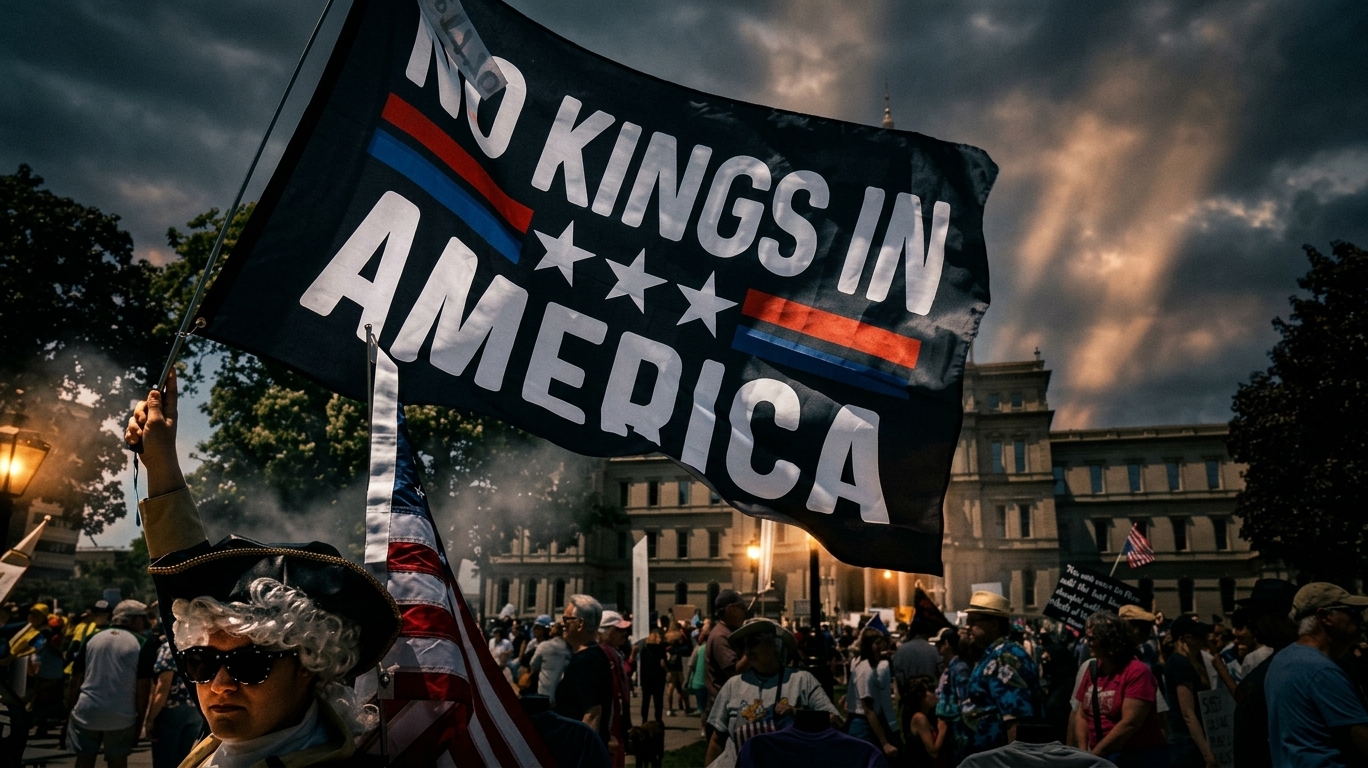
The "No Kings" Movement
The term "No Kings" is taken from the name of a grassroots movement initiated by progressive coalitions such as the 50501 Movement, Indivisible, and MoveOn, and supported by the legal institution ACLU. This name is a satire that the American people want a president who obeys the constitution, not a "king" or dictator who acts arbitrarily.
The masses criticized Trump because he is considered to have overstepped constitutional limits through the use of executive orders to overhaul the federal government and deploy security forces to domestic cities without the approval of local governors.
The "No Kings" movement emerged as a response to a number of policies and behaviors of the Trump administration:
Authoritarian Leadership Style: The protesters consider Trump to act like a king or tyrant who oversteps the limits of constitutional authority, not as the president of a republic.
Immigration Policy and ICE Raids: Strong rejection of tightening immigration and raids by federal agents—including the incident of shooting a US citizen during an immigration operation in Minnesota.
Involvement in Military Conflict: Condemnation of Trump's foreign policy, especially US military involvement and aggression against Iran.
Deployment of Security Forces and the Military: Protests against the deployment of the National Guard and federal troops to suppress demonstrations in various major cities such as Los Angeles.
Economic Problems and Cost of Living: Public anxiety over surging inflation, high living costs, and budget inequality flowing to military operations rather than social assistance.
Protection of Civil Rights and Democracy: Demand to protect voting rights, civil liberties, and stop efforts to crack down on political opposition and the media.
Wave of Actions and Crowd Numbers
Based on historical records, this national demonstration occurred in four main waves: On June 14, 2025: Attracting 4 to 6 million people in 2,100 locations. The action coincided with Trump's 79th birthday and a military parade in Washington D.C. October 18, 2025: Attended by nearly 7 million people at 2,700 points. March 28, 2026: Became one of its peaks with the mobilization of more than 8 million people in 3,300 locations across all 50 states. On October 17, 2026: The latest action spread across around 2,500 locations.
This movement even spread abroad, with solidarity actions held in major European cities such as Paris, Rome, and Berlin.
Antagonism of Democracy
The protesters and analysts see Trump's policies as a threat to the principle of checks and balances, where executive power dominates other branches of government and weakens the constitutional order.
This movement is positioned as a form of people power to defend democracy from oligarchy and militarization. Conversely, the supporting camp and senior Republican Party officials condemned this action by calling it extremely political.
Political experts note that although mass mobilization such as "No Kings" succeeded in showing a high level of public dissatisfaction, its effectiveness in stemming democratic decline depends heavily on the integration of these demands into electoral strategies and legitimate institutional channels.
Three phenomena—suppression of journalism, military aggression against Iran, and the "No Kings" movement—are manifestations of the democratic crisis currently sweeping the United States. The Trump administration has created an ecosystem where press freedom is restricted through various regulatory and legal instruments, foreign policy is carried out aggressively without democratic accountability, and the voice of the people rejecting authoritarianism instead faces the deployment of security forces.
The "No Kings" movement with its mass mobility reaching millions of people across the country shows that public awareness of threats to democracy remains high. However, whether this movement is capable of changing the direction of US politics remains a big question. As noted by experts, the effectiveness of mass mobilization depends heavily on the ability to transform street demands into institutional change through electoral and constitutional channels.
In the end, the fate of US democracy will be determined by the extent to which its people are able to safeguard the pillars of democracy—press freedom, executive accountability, and respect for the constitution—from the increasingly strengthening pressures of authoritarianism.
But everything is too late. Trump is the last president of the US—the gravedigger of the final phase of liberal democracy.