
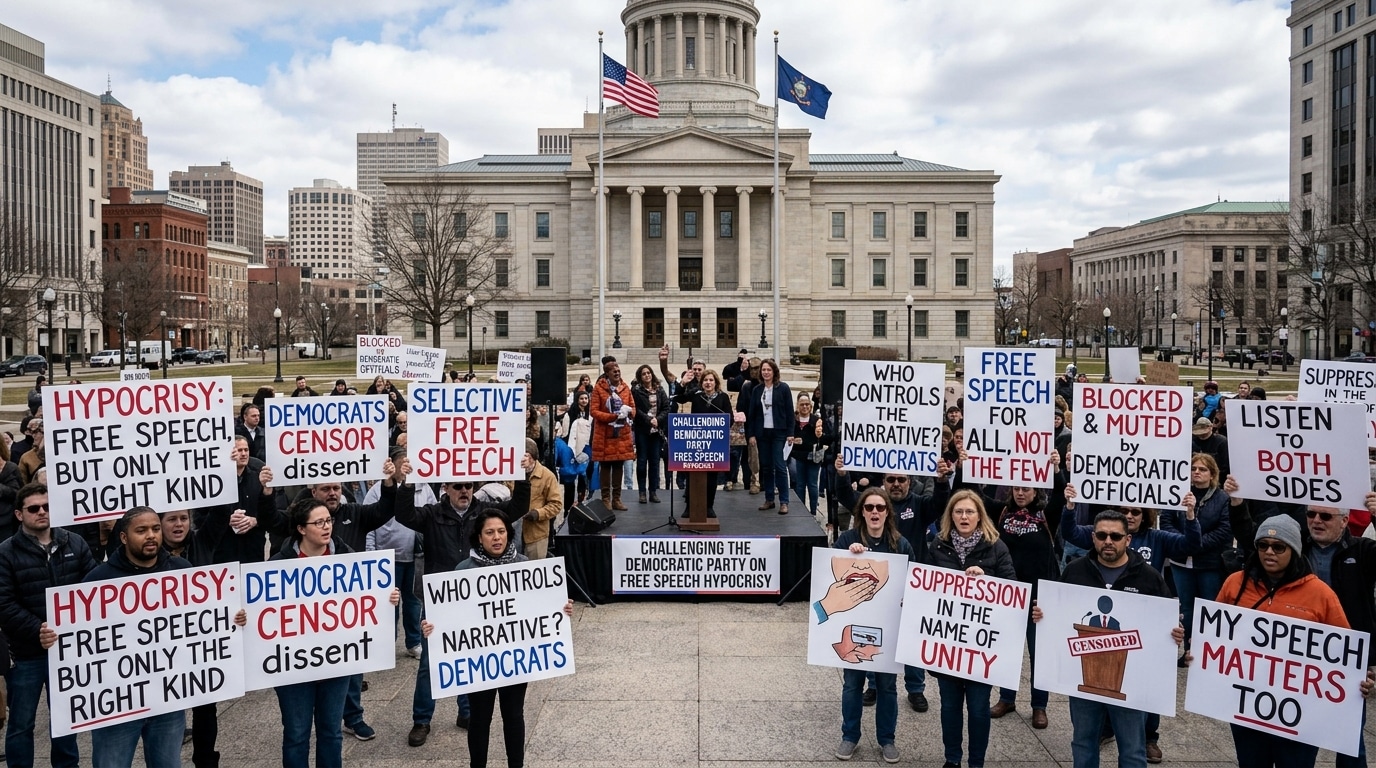

The phenomenon of hypocrisy in press freedom, identity politics, and why the United States is no longer a democracy mentor for Indonesia and the world"
Rhetoric That Does Not Align with Reality
GTI—For decades, the United States has positioned itself as the beacon of democracy for the world.
Freedom of speech in the United States is grounded in the First Amendment to the US Constitution, ratified in 1791 as part of the Bill of Rights. This amendment also protects four other fundamental rights: freedom of religion, freedom of assembly, and the right to petition the government.
The US "freedom" mandate of 1791 was also adopted by Indonesia in 2000 through Article 28E paragraph (3) and Article 28F of the Second Amendment to the 1945 Constitution of the Republic of Indonesia (UUD 1945).
In 2026, the freedom rights of Indonesian society stand under the shadow of a "reciprocal" trade agreement. On February 19, 2026, Indonesia and the United States signed the Agreement Between the United States of America and the Republic of Indonesia on Reciprocal Trade (US–Indonesia RTA). Among the most impactful provisions is Article 3.2 of the digital trade chapter, which states:
"Indonesia shall provide certainty regarding the ability to move personal data out of its territory to the United States by recognizing the United States as a country or jurisdiction that provides adequate data protection under Indonesia's law."
From the UN podium to CNN broadcasts, Washington consistently campaigns for press freedom, freedom of speech, and open society as universal values that all nations must adopt. However, a fundamental question now arises: is that claim still relevant?
The answer, if we examine US domestic policy itself, tends to be negative. At the same time that America criticizes other countries on press freedom, the Department of Homeland Security (DHS) and the State Department are actually implementing visa policies that restrict the movement of foreign journalists. At the same time that the West claims to uphold academic freedom, security forces crack down on students who protest. This is the paradox that many observers call "freedom hypocrisy."
Press Freedom Hypocrisy — When Foreign Journalists Are Silenced Through Bureaucracy
The 240-Day and 90-Day Policy
At the end of 2026, the US administration through DHS introduced a new policy eliminating the indefinite "duration of status" system for foreign journalists. Instead, a fixed 240-day limit was imposed on international reporters in general, and a far stricter limit — 90 days — for citizens of certain countries, including China.
Moreover, foreign journalists applying for visas are now required to open their social media accounts for inspection. This policy has drawn widespread condemnation from international press freedom monitoring bodies. Reporters Without Borders (RSF) and the Committee to Protect Journalists (CPJ) warn that this step opens the door to political censorship, self-censorship, and selective punishment of critical reporting.
Instrumentalization of Administrative Tools
The United States uses its legal, economic, and administrative infrastructure — including sanctions and immigration policies — as geopolitical tools to pressure adversary nations and reward loyal allies.
It is clear that Washington's policy framework is not a neutral administrative procedure but a deliberate mechanism of coercion.
This view finds its relevance in the media visa policy. By limiting the duration of stay for foreign journalists and requiring social media screening, the US effectively creates a system that enables narrative filtering — ensuring only "safe" voices can report from within their country.
Criticism of Western Media and Double Standards
Regarding Western media, there is a fundamental contradiction: the US advocates democratic principles globally — such as press freedom — yet at the same time implements restrictive domestic measures or targets foreign entities.
Double Standards in Speech and Identity Politics
When "Freedom" Is Only for Like-Minded Others
Freedom of speech in the West, according to many observers, has turned into conditional freedom. As long as an opinion aligns with the mainstream narrative, it is permitted — even promoted. But the moment it deviates, various mechanisms kick in: labeling, deplatforming, and even criminalization.
The digital and media landscape of the West operates within an insincere framework. The West is in no position to speak of an open society. Clearly it is not a free society, not democratic, nor does it adhere to press freedom in any genuine sense. More precisely, all those labels are merely a facade.
Identity Politics as a Tool of Control
Identity politics, originally developed to fight for the rights of marginalized groups, is now often used as a tool of social control. It fractures society into opposing identity blocs, diverting attention from more fundamental structural issues — economic inequality, concentration of power, and militarism.
In the international context, identity politicization also serves as a tool of delegitimization. Countries that do not align with Washington are labeled with various negative identities — "authoritarian," "repressive," "anti-democratic" — without considering the historical context and sovereignty of each nation.
Social Media Screening and the Illusion of Open Discussion
One of the most tangible examples of this double standard is the social media screening policy. US Citizenship and Immigration Services (USCIS) began examining social media posts of visa applicants — including foreign students and researchers — to detect what is considered "anti-American" sentiment or certain political content.
This policy triggered a federal lawsuit from academic groups such as the "Coalition for Independent Technology Research," after the government sought to restrict visas or deport researchers and students involved in content moderation research or pro-Palestinian activism.
The Marandi Experience: A Real Threat to Critics
Prof. Marandi, a lecturer at the University of Tehran, himself reported that his safety was threatened due to unfair moderation guidelines on platforms like X (formerly Twitter). After a verified account posted a $1 million bounty calling for his kidnapping, he noted that the content remained online despite complaints.
He compared this direct threat to his life with the swift action of "removing graphic content showing civilian victims." This difference in treatment, according to him, reveals an uncomfortable truth: digital platforms are not neutral spaces, but arenas governed by particular political and commercial interests.
The US and the West Are Not Open and Free Societies
Harsh Crackdowns on Students
One of the most naked moments of Western hypocrisy is the handling of student protests. Across various campuses in the United States and Europe, student demonstrations — particularly those calling for a ceasefire in Gaza and criticizing Western foreign policy — were met with harsh crackdowns. Security forces were deployed, students were arrested, and academic freedom was restricted.
Marandi sharply criticized Western governments for these crackdowns, while comparing them to how Western media portray civil unrest in other parts of the world:
"I mean, the facade or pretense that they are a free and open society — all of that has vanished. No one believes it anymore. Western media have turned a blind eye... to what they are doing to students in the United States, and the list goes on."
"However, unlike some of my friends and students, I think this is not something to laugh about."
Academic Independence Under Pressure
In a statement highlighting systematic pressure on academia, Marandi asserted:
"It is difficult for Iranian academics and universities to maintain their independence — and to appear truly independent — when a culture war is being waged by some of their American partners."
This statement illustrates how US foreign policy not only targets other countries' governments, but also academic and intellectual institutions deemed out of line.
The evidence above leads to one conclusion: the United States and its Western allies can no longer honestly call themselves open and free societies. The standards they apply to criticize other countries they do not apply to themselves. Press freedom, freedom of speech, and academic autonomy — all are conditional, depending on whether the content benefits or harms their geopolitical interests.
The US Is No Longer a Democracy Mentor for Indonesia
A Long History of Problematic "Guidance"
During the New Order era through the early Reformasi period, the United States was often positioned as a democracy mentor for Indonesia. Various aid programs, training, and "capacity building" were rolled out, often with conditions reflecting Washington's interests. However, after more than two decades of reform, and after witnessing US behavior itself, a widespread awareness has emerged: why learn democracy from a country that fails to practice it?
When the Mentor Loses Credibility
US credibility as a democracy mentor has been eroded by a series of its policies:
Visa restrictions on journalists — demonstrating that press freedom is only valued when it aligns with the desired narrative. Social media screening — creating a system that criminalizes thought and opinion. Crackdowns on students — proving that academic freedom is not a priority. Double standards on international issues — supporting repression in "ally" countries while criticizing "adversary" countries. Identity politics as a tool of control — dividing society to maintain power.
In this context, Marandi's statement that "the West is in no position to speak of an open society" becomes highly relevant for Indonesia. It is time for Indonesia to develop its own democratic model — one that aligns with local values, cultural history, and national interests — not a model imposed from outside.
It is time for Indonesia to be independent and self-reliant in its way of thinking, speaking, and pursuing prosperity free from the hegemony of the US model.
The "Agreement Between the United States of America and the Republic of Indonesia on Reciprocal Trade (US–Indonesia RTA)" and the US "Visa Restriction & Social Media Screening" policy are not two separate matters. Sovereignty of speech, economy, and digital are one unified whole as a nation and state. Indonesia has the right not to trade with the US as long as it continues to support genocide in Gaza-Palestine, because it contradicts democratic principles (decolonization) and international law.
Indonesia also has the right to censor and control foreign media and digital companies, including those from the US, that seek to divide and destroy Indonesia under the guise of national security of the Unitary State of the Republic of Indonesia.