
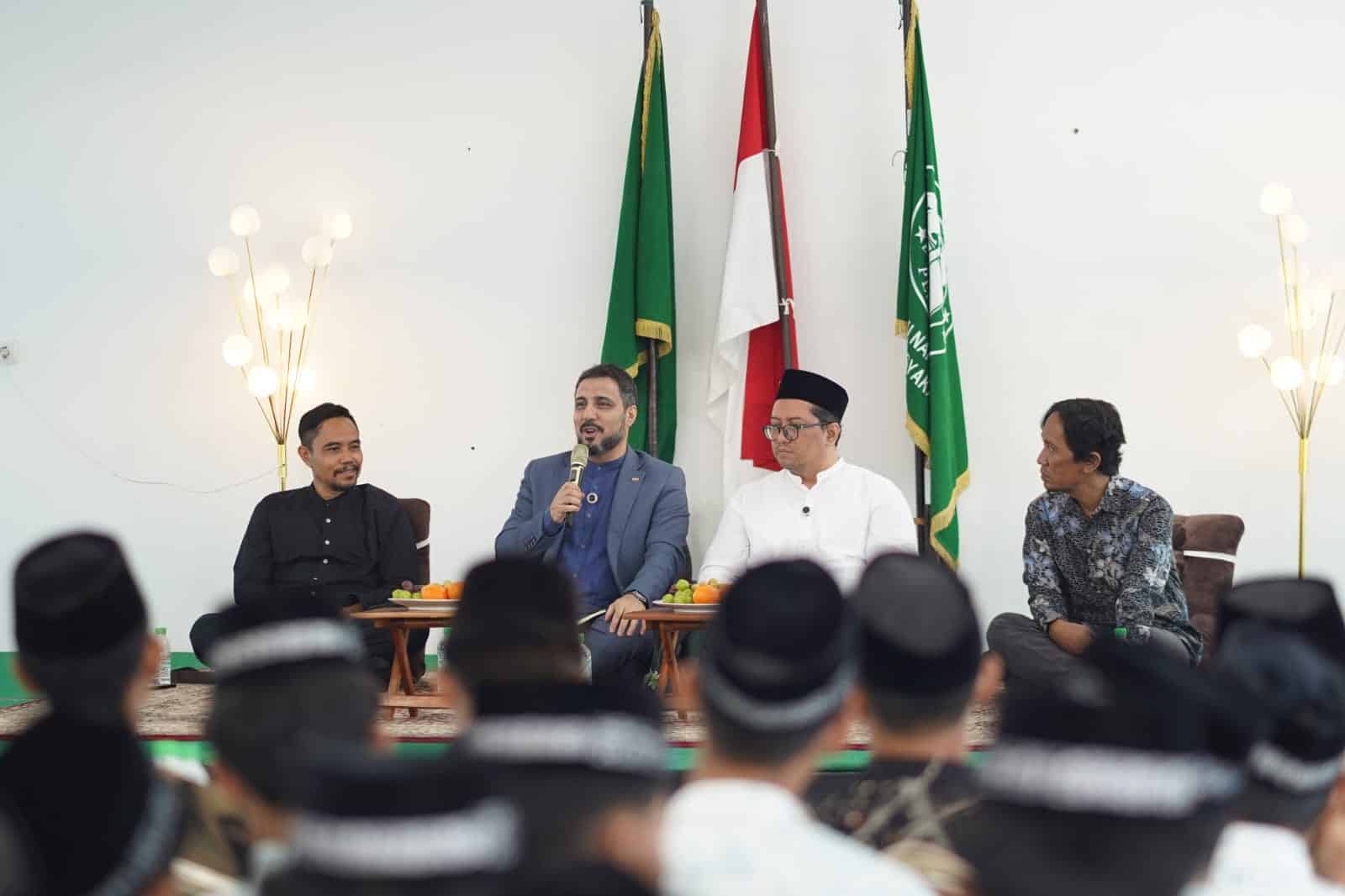

GTI-Afkaaruna Islamic Boarding School and the Global Thinkers Institute (GTI) convened a cultural dialogue, "From Persia to Nusantara; Weaving Wisdom, Tradition and Civilization," on 24/09 at Afkaaruna Islamic Boarding School, Yogyakarta.
The event featured speakers Muhammad Ma'ruf, Ph.D. (Director, Global Thinkers Institute-GTI), Samsul Maarif Mujiharto Arif, Ph.D., Head of the Islamic boarding school-Afkaaruna, Yahya Jahangiri, Ph.D., Cultural Counselor of the Embassy of the Islamic Republic of Iran, and Irfan Afifi, Curator of Islamic-Javanese Arts and Culture.
Ma'ruf elaborated that global world order is now moving at breakneck speed, from a Unipolar, anti-tradition toward a Multipolar world that is pro-tradition. The expansion of Unipolar-colonial power is not only exploiting natural resources but also human resources. Unipolar forces are awakening a world without order — dismantling international law, tradition and religion.
Modern Iran and Indonesia face a real challenge in the form of the destruction of Islamic values and the values of Pancasila.
The consolidation and revitalization of the linguistic, cultural and religious wealth of Persia and Nusantara, interwoven over hundreds of years, can serve as a bulwark for defending the identity of modern Indonesians and Iranians.
As a result of US and Israeli military aggression, modern Iran with its wilayatul faqih system has embodied the divine attributes of jamal (peace) and jalal (firmness-defense). Iran successfully waged a hybrid war as a form of self-defense.
Meanwhile, Dr. Yahya Jahangiri Shurowahdi, Counselor at the Embassy of the Islamic Republic of Iran, stated that Iran cannot be reduced to mere political and military affairs. Iran is rich in thought, philosophy, sufism, literature, science and a love of peace.
The closeness between Indonesia and Iran has long been established, evidenced in language, literature and tradition. Hundreds of Persian loanwords have been absorbed into Indonesian, such as "anggur" (from angur), "cadar" (from chādar), "rubah" (from roobah), "jawab" (from javab), "acar" (from āchār), and "bandar." In literature, forms such as the syair — an old poetic form in Indonesian and Malay literature — historically trace their roots to the Persian (Iranian) poetic tradition.
Examples include Hikayat Amir Hamzah: an epic heroic tale sourced from oral tradition and Persian epics concerning the uncle of the Prophet Muhammad. Hikayat Bayan Budiman: a collection of frame stories adapted from Indian and Persian literary works (Tutinama). Taj al-Salatin (The Crown of Kings): a work on statecraft and governance ethics by Bukhari al-Jauhari, steeped in Persian philosophical and literary thought.
Hikayat Muhammad Ali Hanafiyah: a heroic and tragic tale of the family of Ali bin Abi Thalib, influenced by the Islamic-Persian storytelling style. Hikayat Burung Pingai: a Sufi/mystical literary work reflecting the influence of Persian mystical thought.
Meanwhile, Nusantara traditions influenced by Persian (ancient Iranian) culture are most clearly visible in the Tabut or Tabuik celebrations and the tradition of preparing Asyura porridge during the commemoration of 10 Muharram.
Yahya conveyed a message that Afkaaruna Islamic Boarding School must produce santri and santriwati capable of offering our economists, our politics, our culture, our literature, rooted in a profound Islam.
Meanwhile, Arif spoke about the importance of knowing the world without losing our identity. Our identity is shaped by faith, adab (etiquette) and the world. Nusantara and Persia, as historical subjects of Iran and Indonesia, have strong roots. The question is: what must we do with these two wisdom (hikmah)?
How close the two nations have been in all things, beyond expectation. The words "bandar," "dewan" and "pahlawan" come from Persia. Through language, stories, books, figures, trade and friendship, the two nations grew close. Both possess long civilizations.
Yet these two civilizations share the same essence, shaped by faith, adab, family language and pesantren. Through knowledge, wisdom and adab, the two meet. Pesantren in both Iran and Indonesia teach the same ethical principles: honesty, mutual assistance, mutual respect and responsibility. Arif's message: be proud of your roots, care about the world, and be prepared to differ.
Meanwhile, Irfan emphasized that evidence of Persia and Nusantara exists in many Sufi and literary thoughts, such as the works of Hamzah Fansuri.
Sheikh Hamzah Fansuri was a Sufi scholar, poet and great literary figure of 16th-century Nusantara from Barus (Fansur), North Sumatra, recognized as the pioneer of the syair form and the Father of Classical Malay Literature.
Born in Barus/Singkel, he traveled to study in Baghdad, Mecca, Medina and Gujarat. He mastered Arabic, Persian and Urdu.
A disseminator of wahdatul wujud teachings in Nusantara, influenced by the teachings of Ibn Arabi. His famous works include Syair Dagang, Syarab al-Asyikin, and Asrar al-Arifin, influenced by the poets Rumi, Hafiz and Attar.
His syair became a bridge breathing Arabic, Persian and Malay. He employed metaphors of birds, boats and wine characteristic of the Persian tradition. The dialogue proceeded vibrantly and warmly, opening with a salawat performance accompanied by angklung (a traditional bamboo musical instrument) played by 20 santri and santriwati (Islamic boarding school student).