
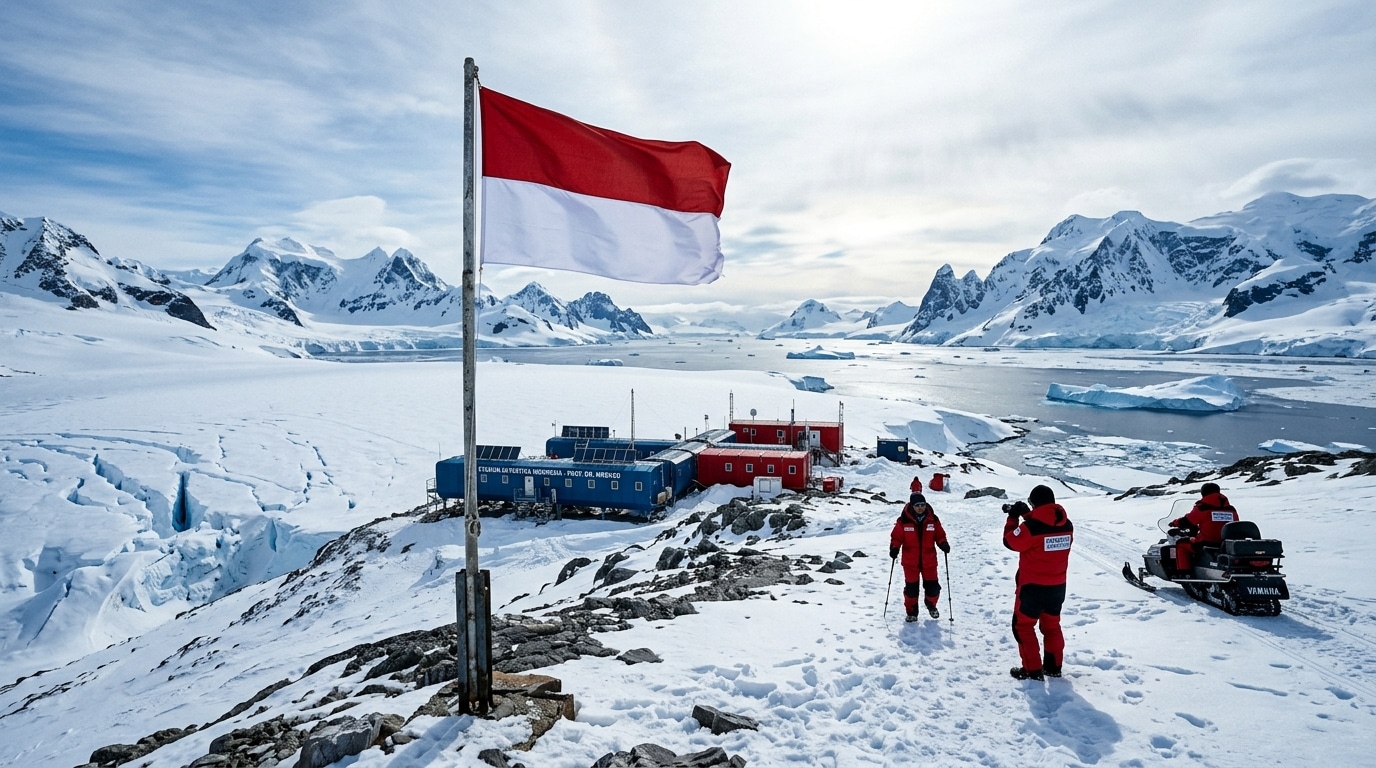

GTI-In a virtual room filled with hope, an important discussion was taking place. In the center of the screen, the young face of Gerry Utama appeared serious yet enthusiastic. As the youngest Antarctic researcher from Indonesia and ASEAN, he was not merely a speaker; he was a symbol of a dream that had just begun. The webinar was organized by a think tank of brilliant yet oppressed young people, the Global Thinkers Institute (GTI) on June 16, 2024, titled "The Future of Antarctic Research," a topic that might sound distant to many Indonesians, but for Gerry and GTI, it was about the urgent future of Indonesia's human resources.
Gerry began his story not from the freezing ice, but from a "memory." "Antarctica is the Earth's great 'hard drive,'" he said, his eyes sparkling. On the world's most remote continent, neatly preserved records are stored about the history of global volcanic eruptions, traces of ancient climate, and clues about the movement of the Earth's contours. "By reading the data there, we can reconstruct the past to predict the future, including the fate of our small islands threatened by sinking," he continued. The distance from Jakarta to Mirny Station in Antarctica, which is only about 5,600 km, feels so close when realizing how great its impact is on Indonesia.
However, Gerry's story was also colored by bitter reality. Before him, GTI Director Muhammad Ma'ruf revealed a "deficit" that has lasted for 65 years. Since the Antarctic Treaty was signed in 1959, Indonesia has not moved much. Its status is merely as an observer, it has not ratified the treaty, and it has no dedicated institution. Meanwhile, on the other side of the world, Roman Romanov from the Russian Embassy and Nikita Kuklin, an ASEAN expert from Moscow, spoke about their country's long legacy. Russia, the discoverer of the Antarctic continent, has long planted the flag of science there with its seven research stations. They offered collaboration, not as rulers, but as partners in a mission of peace and scientific progress.
That discussion two years ago was not merely about sharing anxiety. Gerry, with his experience at the Institute of Earth Sciences Saint Petersburg State University and the Arctic and Antarctic Research Institute, had opened a path. Muhammad Ma'ruf is a typical progressive thinker; his principle is to convey the best ideas, engage the government, and leave the results to time. Whether accepted or rejected by the Indonesian government, for Ma'ruf, what matters is that the moral obligation has been fulfilled. One day the next generation will realize it.
Gerry is a typical solitary scientist; two years ago, Muhammad Ma'ruf, a fellow UGM alumnus, was perhaps the only friend who supported Gerry in the early days of the 2024 expedition. Ma'ruf tried to shape Gerry so that his endeavors would be integrated with a more strategic Indonesian science-geopolitics program.
Gerry is living proof that Indonesian youth are capable of conquering extreme challenges. Mapping the lichen ecosystem and geomorphology on King George Island, as well as monitoring the melting of ice in West Antarctica that could alter global ocean circulation.
From this story, a grand vision was born: the Indonesian Antarctic Exploration Agency (BEAI). Gerry envisioned Indonesia not only as a spectator, but also as a player. With a 2025-2029 roadmap, he dreamed of Indonesia becoming an ASEAN logistics hub to Antarctica, building its own icebreaker ship, and establishing the first research station in ASEAN. Three previous expeditions—with Australia, Japan, and Russia—had become stepping stones. Now, Gerry Utama's story is no longer about himself, but about how Indonesia, through small courageous steps, is beginning to write its new chapter on the eternal ice of Antarctica.
Two years ago, Gerry-Ma'ruf had a dream that Prabowo would accept Russia's offer to establish more serious Arctic and Antarctic research cooperation, and also approve the creation of an Arctic and Antarctic Research Agency for greater efficiency. But that dream remained just a dream.
For two years, Gerry and Maruf—the latter also a Deputy Director of the Arctic and Antarctic Institute of Russia—have been trying to convince Febrian Alfyanto Ruddyard, Deputy Minister of BAPPENAS, to make Arctic and Antarctic research a national strategic research program. His diplomatic answer makes us hopeful, though we doubt whether this idea has been conveyed to President Prabowo.
Prabowo cares more about stomachs, so the Free Nutritious Meals program-MBG and the Red Village Cooperative-KDP, which absorb a large budget, have become priorities, as if the Unitary State of the Republic of Indonesia-NKRI were being treated like Ethiopia during extreme famine.