
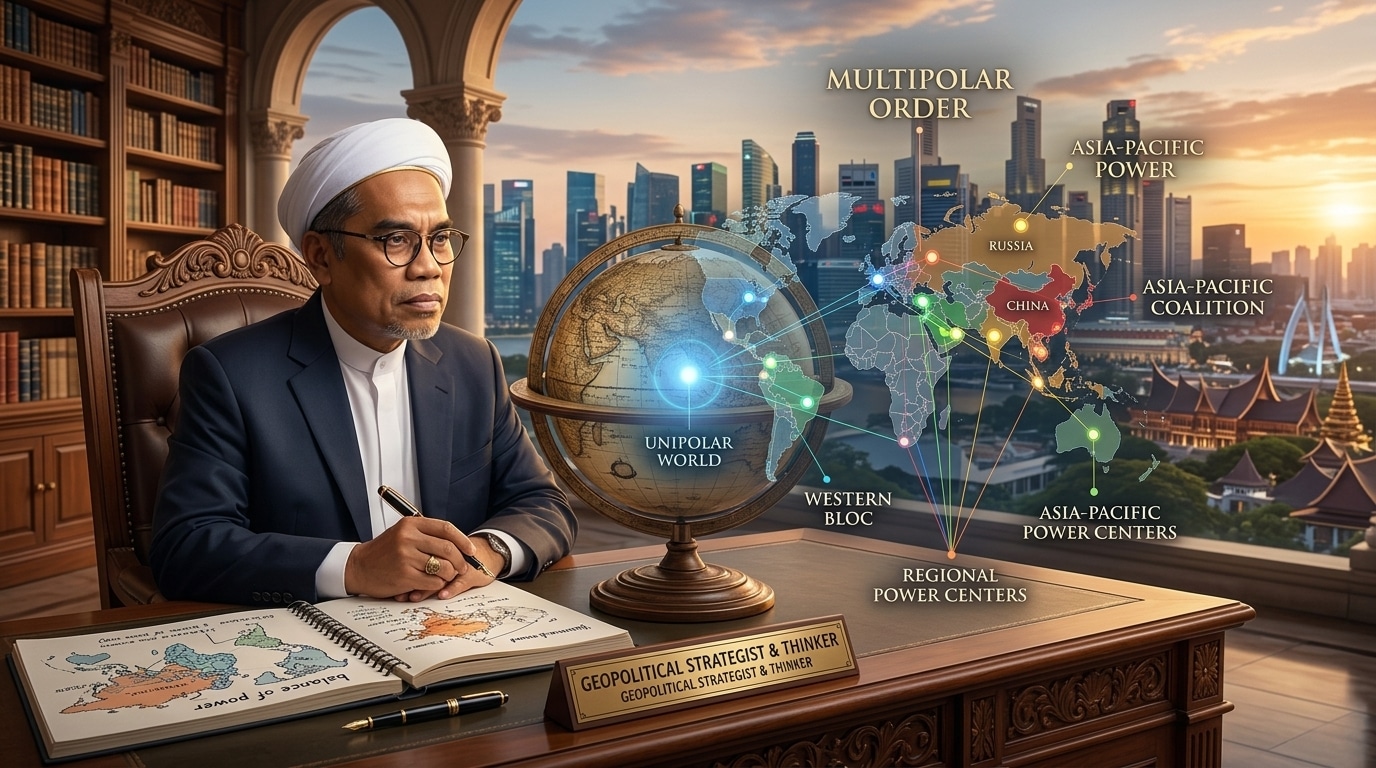

By: Prof. Ali Mochtar Ngabalin
Chairman of the Golkar Party Central Executive Board (DPP) for Foreign Policy and International Relations Affairs
“For me, the most appropriate word in viewing this relationship is that Golkar's position is more towards guarding (mengawal). The Golkar Party does not take over state diplomacy, nor does it form its own foreign policy.
President Prabowo's meeting with President Putin demonstrates that the Indonesia–Russia relationship is entering an increasingly substantive space of cooperation. The government itself refers to Russia as an important and strategic partner for Indonesia, while Indonesia is seen as one of Russia's main partners in the Asia-Pacific region, particularly within ASEAN. This is the momentum that must be translated through inter-party diplomacy.”
GTI-There are times when a head of state's diplomatic journey needs to be understood as more than just a meeting between two leaders. The meeting between President of the Republic of Indonesia Prabowo Subianto and President of the Russian Federation Vladimir Putin at the Kremlin, Moscow, on 13 April 2026, is one such example.
The meeting lasted approximately five hours, comprising two hours in a bilateral format, followed by three hours of tête-à-tête talks. The two leaders discussed strengthening strategic cooperation, including in the fields of energy and mineral resources, energy and oil-gas resilience, downstream processing, as well as industrial development. The broader agenda also encompassed space, agriculture, pharmaceuticals, and education.
Therefore, I view the Prabowo–Putin meeting not merely as a diplomatic event. It provides an increasingly clear picture of Indonesia's direction in facing global geopolitical shifts: Indonesia seeks to forge friendships, expand cooperation, and build strategic partnerships with as many countries as possible in line with its national interests, and Russia is one of the important partners for Indonesia.
State Diplomacy and Inter-Party Diplomacy
In this context, I see the relevance of the Golkar Party's international diplomacy. Foreign policy is the authority of the state, implemented by the government under the leadership of the President of the Republic of Indonesia. This position must be clearly understood and cannot be interchanged.
However, in modern international relations, diplomacy does not only take place through government-to-government channels. Diplomacy can also be conducted through parliaments, the economic sector, culture, education, people-to-people diplomacy, and certainly party-to-party diplomacy.
For the Golkar Party, the relationship with the United Russia Party is not something that emerged suddenly due to President Prabowo's visit to Moscow.
The Golkar Party and the United Russia Party have already established a foundation of formal relations. On 11 June 2021, both parties signed a memorandum of understanding on cooperation covering the political, economic, health, and educational fields. At the same time, opportunities for cadre exchanges and the development of communication between the two parties were also discussed.
This means the bridge for this relationship has been built. Our task now is to ensure that this bridge becomes increasingly productive and capable of contributing to Indonesia's interests.
Towards Productive Diplomacy
Observing these dynamics, I am of the view that party-to-party diplomacy must not stop at the signing of memoranda of understanding, delegation exchanges, photo opportunities, or ceremonial visits.
Instead, diplomacy must generate trust. Trust must give birth to cooperation. And ultimately, cooperation must provide benefits for the people.
Therefore, the relationship between the Golkar Party and the United Russia Party needs to be continuously filled with concrete strategic agendas.
We can build regular dialogues on geopolitical developments in the Asia-Pacific and Eurasia. We can expand cooperation in the field of education and relations between research institutions. We can bring together the youth and cadres of both parties. We can also open communication with the business community, and broaden discussions on energy security, food security, technology, industry, investment, and other various strategic interests.
In this way, through these strategic agendas and concrete steps, mutually reinforcing and nurturing relationships towards a better direction will naturally be formed or established.
Naturally, President Prabowo and President Putin work at the state-to-state and government-to-government levels. Meanwhile, the Golkar Party and the United Russia Party strengthen communication at the party-to-party level.
Likewise, parliaments can strengthen parliament-to-parliament diplomacy. Universities can expand academic diplomacy. The business community can open up business-to-business cooperation. Meanwhile, the peoples of both countries can strengthen people-to-people relations.
Should all these channels move within the framework of aligned national interests, then the Indonesia–Russia relationship will possess a much more solid foundation.
Golkar Guards, Not Takes Over
For me, the most appropriate word in viewing this relationship is that Golkar's position is more towards guarding (mengawal). The Golkar Party does not take over state diplomacy, nor does it form its own foreign policy.
As a political party within the government, Golkar bears the political responsibility to support government agendas that provide benefits for the national interest.
Therefore, the work of the Golkar Party's DPP Department for Foreign Policy and International Relations Affairs must be placed within that framework: guarding the diplomacy of President Prabowo Subianto and expanding Indonesia's network of friendships in the international arena.
President Prabowo's meeting with President Putin demonstrates that the Indonesia–Russia relationship is entering an increasingly substantive space of cooperation. The government itself refers to Russia as an important and strategic partner for Indonesia, while Indonesia is seen as one of Russia's main partners in the Asia-Pacific region, particularly within ASEAN. This is the momentum that must be translated through inter-party diplomacy.
If President Prabowo has opened a great door for the Indonesia–Russia strategic relationship, then the other diplomatic channels must help ensure that this door yields as many opportunities as possible for the nation's interests.
Free and Active: Being Friendly Without Losing Independence
However, in this context, there is a principle we must not abandon. Indonesia adheres to a free and active foreign policy. Therefore, strengthening relations with Russia must not be interpreted as Indonesia's choice to join a particular geopolitical bloc.
Indonesia can be friends with Russia while simultaneously building productive relationships with the United States, China, European nations, Japan, South Korea, India, Middle Eastern countries, Africa, Latin America, and all friendly nations.
This is precisely where Indonesia's strength lies. We do not need to become a satellite of anyone. Indonesia must be a trustworthy friend, a partner to be reckoned with, and a nation that possesses the courage to determine its own interests.
Amidst a world increasingly fragmented by conflict, great power rivalry, and geopolitical competition, Indonesia's ability to communicate with various parties constitutes a tremendous diplomatic asset.
Indonesia Does Not Have to Choose Between East and West
In such global dynamics, Indonesia does not have to choose one axis, but Indonesia must choose Indonesia's national interests.
Therefore, I welcome and appreciate the increasingly intensive relationship between President Prabowo Subianto and President Vladimir Putin.
The meeting at the Kremlin in April 2026 demonstrates the seriousness of both nations. President Prabowo emphasized that Indonesia–Russia communication is developing productively and mutually beneficially, while both nations strengthen the implementation of the strategic partnership declared in 2025.
For the Golkar Party, these developments simultaneously open up greater space to make the relationship with the United Russia Party more substantive.
However, the key is that we must move from MoU towards action. From communication towards implementation. From a party-to-party relationship towards a party-to-party strategic partnership that provides tangible contributions to the Indonesia–Russia relationship. Ultimately, all these efforts must culminate in one interest: Indonesia.
I believe that strong diplomacy does not always begin at the formal negotiation table, but sometimes great interstate relations grow from trust nurtured over many years through various channels.
Therefore, the Golkar Party must continue to be present. Opening communication, nurturing friendships, expanding networks, and maintaining trust. And when national interests require a bridge, Golkar must be able to become one of the parties helping to build it.
President Prabowo Subianto and President Vladimir Putin are strengthening the Indonesia–Russia strategic partnership at the state level. The Golkar Party and the United Russia Party have the space to reinforce it through party-to-party diplomacy.
All of this is not for the benefit of a single party. Nor is it to lead Indonesia into a specific bloc, but rather to help ensure that every international friendship we build can provide the greatest possible benefits for the nation and state.
This is the diplomacy we must nurture: diplomacy that adds friends, expands cooperation, safeguards sovereignty, and always places the Red and White (Merah Putih) above all other interests.
Prof. Ali Mochtar Ngabalin is a Visiting Professor of International Relations at Tomsk State University (TSU), Siberia, Russia. He also serves as a Special Professor of International Relations and Communications at Busan University of Foreign Studies (BUFS), South Korea, for 2024 – 2026.