
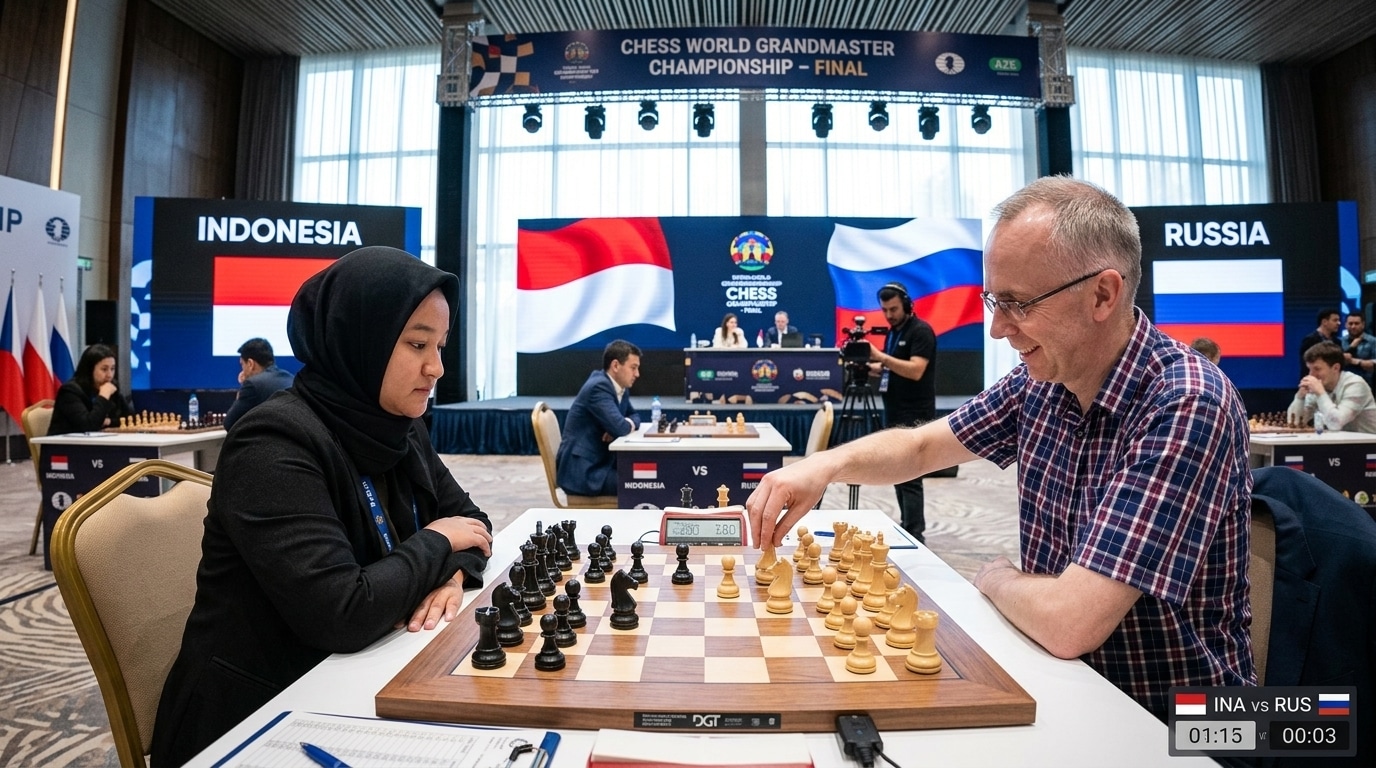

Exclusive Interview by Global Thinkers Institute (GTI) with Medina Warda Aulia, Indonesia's Youngest Woman Grandmaster (WGM), 31/08.
"The epicenter of chess knowledge, curriculum, and strategy in the world is Russia. It was the rigorous training and mentorship from my coach, Rustam Shcherbakov from Russia, that shaped me into a world-class chess athlete."
GTI-Since the age of 11, Medina Warda Aulia has undergone world-class chess training and education through the "Indonesian Dream Girls" program. It was here that Rustam Shcherbakov, a world-renowned coach from Russia, mentored young Medina. The result? Medina achieved the title of Indonesia's youngest Woman Grandmaster (WGM) in 2013, at just 16 years and 2 months old. She secured her second WGM Norm at the Catka Close Tournament in Russia. The lineage of Medina's chess mastery, along with that of her mentor Shcherbakov, is deeply rooted in the prestigious Russian chess school.
Shcherbakov himself studied under the tutelage of the legendary Alexander Panchenko from 1981 to 1992. In 1990, he collaborated with Panchenko to coach the Russian team at the Soviet Youth Team Championship—a team that included future World Champions like Vladimir Kramnik and Sergei Rublevsky.
Shcherbakov earned the title of Soviet Chess Master in 1987, International Master in 1989, and Grandmaster in 1992. In 1990, he shared first place in the Russian Chess Championship alongside Andrei Kharlov, Vladimir Kramnik, and Maxim Sorokin. He was also a key member of the Russian team that clinched the gold medal at the 2019 European Senior Team Championship (50+ category). Beyond his own achievements, he has mentored prodigies such as Parimarjan Negi, Kateryna Lagno, and Dinara Saduakassova. In 2014, he was awarded the esteemed title of FIDE Senior Coach.
Medina has mirrored the brilliance of her mentor. Her impressive list of victories includes: World School Chess Champion in Juiz de Fora, Brazil; Champion of the Czech Open in Pardubice, Czech Republic; Champion of the Albena Cup in Bulgaria; Champion of the Kuala Lumpur International Open Chess Championship; Team Champion (Group C) at the Chess Olympiad in Istanbul, Turkey; and Champion of the 2nd Women International Tournament in Singapore.
Medina earned her second WGM norm at the 2012 International Chess Championship in Satka, Russia, scoring an impressive 6.5/9 points. She navigated her first four rounds with draws against Maxim Vaseptsov (Russia 2209), Pavel Tsvetkov (Russia 2141), GM Rustam Khusnutdinov (Kazakhstan 2503), and her fellow Indonesian, WIM Chelsie Monica Sihite (2162). In the next four rounds, Medina showcased her attacking prowess with a consecutive winning streak against Alfia Nasybullina (Russia 2073), Albert Baigildin (Russia 2170), WIM Dinara Sadvakassova (Kazakhstan 2216), and the 2008 U13 World School Champion, WFM Alexandra Makarenko (Russia 2128).
GTI:Who do you credit most for shaping your early career as a world-class chess player?
MEDINA:
First and foremost, my parents and my extended family. My coach from Russia, Rustam Shcherbakov. Secondly, I owe a great deal to Mr. Eka Putra Wirya, Mr. Utut Adianto, and Mr. Kris.
My parents are my biggest supporters. When I was a child, they enrolled us in various extracurriculars, especially chess. During my middle school years, my father often took me to play matches at the companies where he worked in the Bekasi area.
Before chess, I actually took swimming and painting lessons. Interestingly, it was my second sibling—now a national athlete and national master—who initially started chess lessons. At that time, while my sister was learning at a chess school, I was just a member, not yet a student. After each of my sister's lessons, my father would teach me the same material, often mirroring what was taught at the school.
My father loved reading chess books and would then teach us. Every week, we'd have matches against my father's friends—he'd invite them over to our house. We also frequently played chess in local workshops, sometimes even until dawn.
GTI:
Besides your parents, who else was instrumental in making you a world-class player?
MEDINA:
In the chess world, I owe a lot to Mr. Eka Putra Wirya, Mr. Utut Adianto, and Mr. Kris. Mr. Eka was the owner, initiator, and coach of the chess school and our sponsor back then. It was through his "Dream Girls" program that I got my start. Mr. Utut, as a legendary player and official, has been a great inspiration to me, as has Mr. Kris.
The "Indonesian Dream Girls" program was an intensive chess training initiative established in 2009 to produce new Women Grandmasters (WGM) for Indonesia. This legendary program was the brainchild of Mr. Eka Putra Wirya, one of the country's most prominent chess figures.
Initially, the program brought together four exceptionally talented young female chess players to be molded into world-class athletes under the guidance of the Russian coach, Rustam Shcherbakov. They were me, Medina Warda Aulia (11 years old), Chelsie Monica Ignesias Sihite (13), Dewi Ardhiani Anastasia Citra (15), and Virda Rizka Aulia (14).
Through this program, I became Indonesia's second Woman Grandmaster in 2013. As you know, I was the second Indonesian woman to achieve this highest title, following WGM Irene Kharisma Sukandar. I was the youngest, at just 16 years and 2 months old.
GTI:
Do you have a special training regimen? How significant was your participation in a formal chess school?
MEDINA:
My world-class training came from following a structured curriculum. I was disciplined by the curriculum, accustomed to learning patterns, and mastering numerous chess formulas that are proven at the global level. My most influential teacher was an international chess player and coach from Russia, Rustam Shcherbakov. He earned his Grandmaster title from FIDE in 1992 and was awarded the FIDE Senior Coach title in 2014. His peak rating was 2580 in July 1993.
Shcherbakov has mentored other grandmasters like Parimarjan Negi (India) and Kateryna Lagno (Russia), as well as IM/WGM Dinara Saduakassova (Kazakhstan).
Mr. Shcherbakov has extensive experience coaching chess in many countries, including India. He is also a product of the well-established chess education ecosystem in Russia. As we know, Russia is the world's benchmark for chess education, with deep historical roots that have produced legendary world champions like Garry Kasparov, Anatoly Karpov, Mikhail Botvinnik, Alexander Alekhine, Boris Spassky, and Vasily Smyslov. In the post-Soviet era, we saw Vladimir Kramnik and Peter Svidler.
The epicenter of chess knowledge, curriculum, and strategy is Russia. Because of the rigorous training and mentorship from my coach, Rustam Shcherbakov from Russia, I became a world-class chess athlete.
GTI:
Do these players develop their own playing styles after learning so much chess theory at school?
MEDINA:
In my view, these world champions from Russia aren't just theoretical. They are disciplined in learning chess theory, training extensively with various patterns, studying core principles, and understanding the rationale behind why strategies A, B, or C should be chosen. I'm the same—I learn what they learned. We also absorb philosophies like "a strong player never stops." We are taught calculation, strategy, and the importance of focusing on our opponent's strengths—what their strategies are, what patterns they typically employ. This is crucial and determines our counter-strategies.
If you only focus on your own preferred strategies, you will lose. You need concentration, meticulous data collection on your opponent, patience under pressure, maintaining a balance of confidence and humility, and constant vigilance. You must know your strategy for defense, for attack, and how to handle pressure to stay balanced. You have to figure out the best moves to survive and become a champion.
The key is to be disciplined in learning the formulas and practicing to sharpen your gameplay. Then, your instincts will become sharp, strong, and decisive through extensive competition.
GTI:
Could you tell us more about that Russian coach?
MEDINA:
Sure. The coach was in Indonesia from 2009 until the 2022 SEA Games. He taught in Indonesia and was stationed at Mr. Utut's facility. Usually, he was brought in to prepare for specific events. At that time, with the Dream Girls program, we were trained from 2009 to 2013, right up until I became a Grandmaster. After that, he would come and go for events like the SEA Games or ASEAN Games. While it was expensive, this program successfully produced world-class chess athletes.
GTI;
Why was the coach sourced from Russia, rather than America or other countries?
MEDINA:
Because in chess, the primary reference point is Russia, sir. In terms of scientific knowledge, curriculum maturity, and literature, much more comes from Russia. Kasparov, Karpov—they're all from Russia.
GTI:
In general, how is Indonesia's performance on the international chess stage today?
MEDINA:
Indonesia's achievements in chess are still at a mid-level. We haven't been consistently competitive in the World Cup. However, in 2023, I managed to reach the round of 16, which was a significant achievement for Indonesia internationally. We also have Asian champions, including myself.
At the SEA Games level, the Indonesian team has always been dominant, with fierce competition from Vietnam. We also compete hard in the ASEAN Games, and our results at the ASEAN Indoor Games have been better than at the ASEAN Games.
GTI:
What is the current state of chess development for young people in Indonesia?
MEDINA:
Honestly, chess is currently "booming." Many parents are enrolling their children in chess lessons, both for cognitive development and to pursue achievements. Programs like Dream Team, Dream Girls, and the Junior National Training Center are helping popularize chess from generation to generation.
GTI:
How should chess be managed in Indonesia, in your opinion?
MEDINA: That's a difficult question, sir. The main obstacle is the lack of sponsorship. This impacts public interest and the burden of training costs. Chess schools are expensive, especially when hiring world-class coaches.
GTI:
Around September 26, 2026, there will be a FIDE Presidential election in Samarkand, Uzbekistan. Who do you support—Jan Henric Buettner (Germany), Wadim Rosenstein (Germany), or Timur Turlov (Kazakhstan)?
MEDINA:
I'm not well-informed on that, sir. What's clear is that I support anyone who can bring progres and steer FIDE in a better direction.
GTI:
Has your profession as a chess athlete been able to support your family's livelihood?
MEDINA:
I work hard to meet my family's needs, especially for my little one. I work as a private chess coach. However, for more security, I would like to become a civil servant. I'm only paid by the Ministry of Youth and Sports during national training centers.
GTI:
Who is your favorite chess player?
MEDINA:
My coach from Russia, Rustam Shcherbakov, is definitely one. Others include Grandmaster Judit Polgár from Hungary. She is considered the greatest female chess player of all time, with a peak rating of 2735 in 2005—at that time, she was ranked 8th in the world and the No. 1 woman in the FIDE World Rankings. And Grandmaster Hou Yifan from China, with a peak rating of 2686 in 2025.