
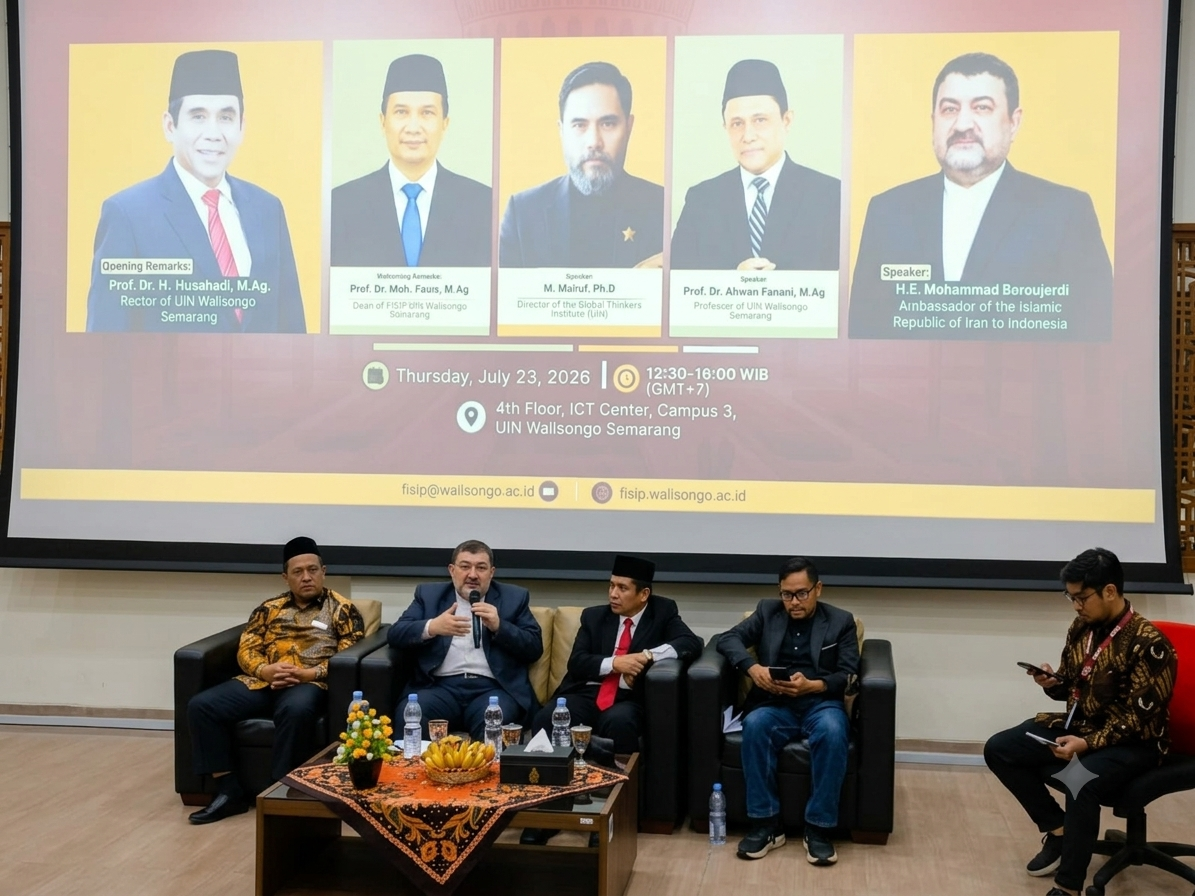

GTI-Global Thinkers Institute (GTI), in partnership with the Faculty of Political Science, UIN Walisongo, held an international seminar titled "Reconfiguring Middle East Geopolitics; Iran, Palestine, and the Future of Regional Order for Human Solidarity," on Thursday, July 23, from 1:30 to 4:00 p.m., at the ICT Center, Campus 3, UIN Walisongo, Semarang.
Speakers included H.E. Mohammad Boroujerdi, Ambassador of the Islamic Republic of Iran to Indonesia; Muhammad Ma'ruf, Ph.D., Director of the Global Thinkers Institute (GTI); and Prof. Dr. Ahwan Fanani, M.Ag., Professor at UIN Walisongo.
Welcoming remarks by: Prof. Dr. Musahadi, M.Ag., Rector, UIN Walisongo, Semarang; Prof. Dr. Moh. Fauzi, M.Ag.; Dean of the Faculty of Social and Political Sciences, Walisongo State Islamic University (UIN), Semarang.
Boroujerdi explained that the Islamic world, especially in the Middle East, also known as West Asia, is facing a severe test and is at a critical juncture. The illegal US-Israeli military attack on Iran from the Gulf States and Israel has dragged the region into a regional war.
For Iran, this forced war is an existential one, while for the US-Israel one, it is an adventurous war within the framework of the Greater Israel initiative. The assassination of Seyyed Ali Khamenei and other key Iranian figures has had a psychological and spiritual impact on the Iranian people and the entire world, further strengthening solidarity and support for the Iranian nation.
The closure of the Strait of Hormuz and Ben Mandeb is merely an act of self-defense against US-Israeli military aggression, which has resulted in a global economic crisis. The US-Israel illegal colonial actions are to blame, not Iran.
However, behind this war, the security vulnerability of the Gulf states, which rely on US security services, is at its weakest. The Gulf states cannot formally declare support for the US-Israel conflict because it is illegal. On the other hand, the war demonstrates the fragility of US military capabilities. The US can no longer protect Israel, let alone the Gulf states.
This data will lead to changes in governance, especially in the Middle East, and will undoubtedly have global repercussions. Indonesia is also affected: Indonesian peacekeepers in Lebanon were killed by Israel, an Indonesian hospital in Gaza was bombed, and Indonesian activists, along with activists from the Global Sumud Flotilla, were kidnapped by Israel.
Muhammad Ma'ruf emphasized that the US-Israel forced war on Iran will have repercussions not only for the region but also for resolving the crises in Eastern Europe (Ukraine) and the Pacific (Taiwan). This illegal US-Israeli military attack is part of the re-implementation of colonialism under the Monroe (Donroe) doctrine under Trump and the implementation of the Greater Israel expansion project under the Netanyahu administration. Politically, it is pure colonialism, while economically, it is aimed at seizing Iranian oil and the region.
Globally, it is part of a project to secure trade routes from Africa, Latin America, West Asia, South Asia, and the Pacific. However, Iran's well-planned military resistance since the 1980s has exhausted US-Israeli military capabilities, as well as NATO's military assets in general, making Iran a key player in changing the economic and security governance landscape in the Middle East.
Because Iran and Yemen control 30% of global trade passing through the Straits of Hormuz and Be' Mandeb, Iran's bargaining position is superior to that of the US. Concurrently, the increasingly aggressive US-Israeli attacks have drastically degraded the domestic economy and politics of both the US and Israel. It is no exaggeration to consider this war the final phase of US empire over the world.
The US-Israeli attack on Iran, which illegally attacked Iran, represents the final manifestation of unipolar power—NATO power. If Iran wins the war, a multipolar world will emerge more rapidly than Russia and China predicted.
The future of Palestinian independence certainly holds brighter prospects, as Iranian precision missiles have successfully struck Israel's strategic centers, significantly weakening Israel's military capabilities and potentially halting the Greater Israel project.
Meanwhile, Fanani emphasized that, given the Middle East's position as the center and heart of the world economy, connecting Asia to Africa and Europe, and the birthplace of major religions, political upheaval, especially war, will certainly impact the Islamic world and the world as a whole. Iran is key to establishing a new governance structure for the Islamic world that adapts to developments in the war on the ground. Naturally, the future of Palestine will also be impacted.
According to Fanani, the shift in the world order toward a multipolar system provides momentum for Middle Eastern countries to reduce their dependence on external powers and build more independent cooperation.
He believes the future of the region will not only be determined by conflict resolution, but also by the ability to build trust between countries, strengthen institutions, restore social services, and prioritize humanitarian values.
The seminar was attended by approximately 100 students, lecturers, and researchers.