

GTI-Russia, known for having one of the most powerful Electronic Warfare (EW) systems in the world, has indeed struggled and continues to struggle significantly to disable the Starlink satellite internet network in Ukraine.
There are several key technical and tactical reasons why SpaceX's technology has proven extremely difficult for the Russian military to subdue:
1. Massive LEO (Low Earth Orbit) Satellite Architecture
Unlike traditional communication satellites that use one or two large satellites in high geostationary orbit, Starlink uses thousands of small satellites in low Earth orbit (LEO).
- Fast-moving targets: Starlink satellites constantly move across the sky at high speed. If Russia wants to jam their signals, they must track thousands of moving targets simultaneously, not just fire jamming signals at a single static point in the sky.
- High redundancy: If Russia successfully disrupts a signal from one satellite, the Starlink terminal on the ground will automatically and instantly switch to find a signal from another Starlink satellite passing overhead.
2. Beamforming Technology and Directional Signals (Phased Array)
Starlink ground terminals use phased array technology. These antennas do not transmit or receive signals in all directions like conventional radio antennas, but instead focus their signal energy into a very narrow beam directed straight toward the passing satellite.
- Because the signal beam is extremely narrow and points directly upward, Russian jamming equipment located on the ground finds it difficult to "intercept" between the ground antenna and the satellite.
3. Extremely Rapid Software Updates
This is a dynamic cyber and electronic warfare battle. When Russia manages to map Starlink frequencies and attempts jamming, SpaceX engineers in the United States can update Starlink's firmware within hours. They change frequency hopping tactics to evade Russian interference, making Russia's rigid jamming efforts quickly obsolete.
4. Geographic Scale and Terminal Mobility
Starlink terminals are small, highly portable dishes. Ukrainian forces can mount them on moving vehicles, hide them in trenches, or even integrate them into long-range combat drones. Russia struggles to locate thousands of small terminals spread across a front line stretching thousands of kilometers.
Latest Developments
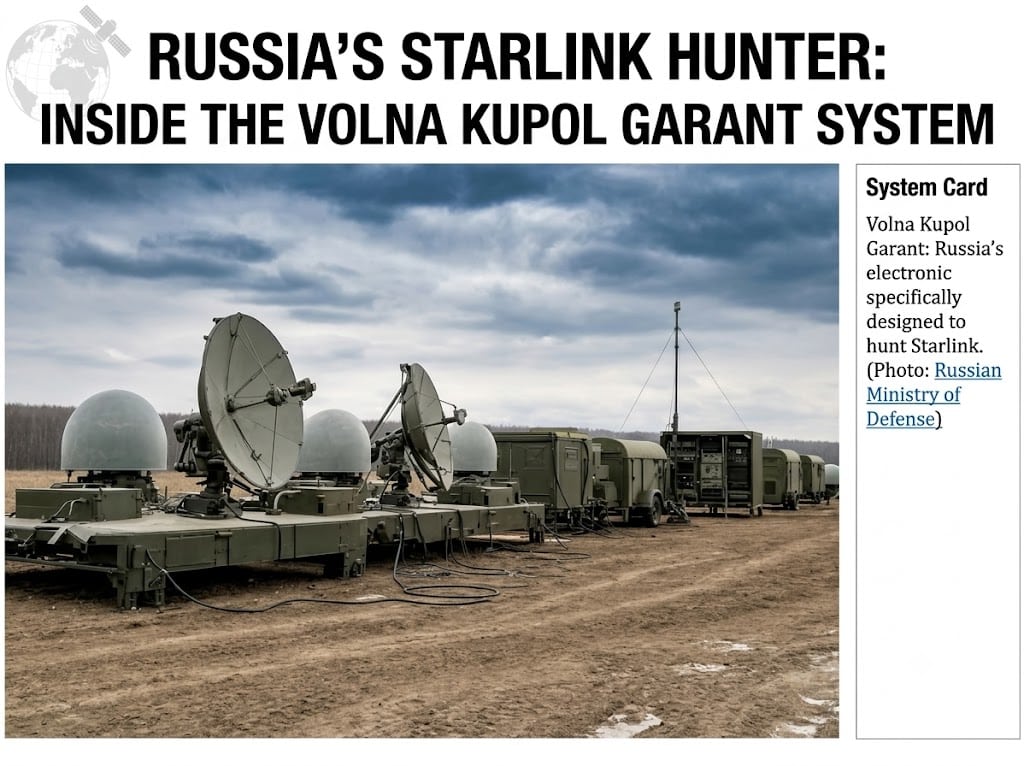
Russia continues to try to adapt. They have begun deploying special high-power jammer systems such as "Volna Kupol Garant" to disrupt Starlink signals in specific areas (approximately 20 square kilometers) in order to protect their logistics areas from Ukrainian drone attacks.
Russian specialists have created an advanced electronic warfare system named "Volna Kupol Garant". This system is specifically designed to disrupt Starlink satellite communications widely used by Ukrainian drones on the battlefield.
Capabilities and Range
This system has the ability to cover an area of up to 20 square kilometers, making it an effective tool for disrupting medium-range drone operations. Its primary targets are kamikaze drones equipped with Starlink terminals, especially in the 14–14.5 GHz frequency band.
Hardware Configuration
“Volna Kupol Garant” operates in the form of a trailer equipped with satellite antennas placed under a protective radome. Each trailer can carry two flexible antennas that can be removed and placed directly on the ground according to tactical requirements in the field.
Implementation and Effectiveness
The system has begun to be deployed to protect major Russian logistics centers. According to Ukrainian military sources, approximately ten units of such systems have been observed operating on the battlefield. Foreign researchers examining how this system works have concluded that electronic components of satellites whose orbits pass through an active jamming zone will suffer permanent damage over time.
Future Projections
The effective coverage area of Russian anti-satellite electronic warfare systems appears to be continuously expanding. In the near future, it is expected that this system can achieve full disruption of uplink communication channels, either through targeted jamming or by injecting false data packets, across areas stretching tens of kilometers.
With this capability, the Russian Armed Forces will gain the technical capacity to place not only individual tactical front-line sectors under an electronic "blanket," but entire broad operational-strategic defense regions. This marks a significant step in the evolution of modern electronic warfare, where control over the electromagnetic spectrum becomes as important as control over the physical battlefield.