
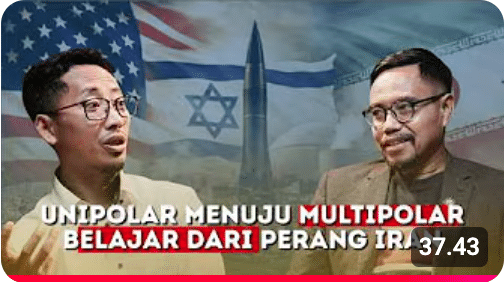

GTI - Since February 28, 2026, many people have been surprised by Iran's extraordinary resilience in the face of military aggression by two nuclear powers, the US and Israel. However, for Muhammad Ma'ruf, this is no secret and is understandable. In a podcast conversation, Muhammad Husein Gaza asked Muhammad Ma'ruf, Director of the Global Thinkers Institute (GTI), for details about Iran's strength.
In Ma'ruf's opinion, Iran has indeed gained more advantages over the US and Israel since its attack on Iran on February 28, 2026. Iran has cleverly exploited every opportunity for its enemies to make mistakes (miscalculations), turning the illegal US-Israeli military aggression into a strategic advantage for Iran and the world.
This can be seen in the failure of four targets desired by both Trump and Israel. First, there has been no political regime change in Iran, and instead, Iranian popular support has grown. Second, Iran's uranium enrichment capacity cannot be eliminated. Third, Trump and Netanyahu failed to stop Iran's support for resistance in West Asia. Fourth, Trump and Netanyahu failed to force Iran to abandon its nuclear program.
Conversely, for Iran, this illegal US-Israel military aggression against Iran presents four strategic advantages and opportunities for Iran and the world. First, Iran still manages to de facto control the Strait of Hormuz; second, the US and West Asian food markets are increasingly under pressure; third, Iran has successfully destroyed US military bases in West Asia. Fourth, Iran has successfully broken the political power and influence of the White House in the US and the world.
However, according to Ma'ruf, the most valuable victory for Iran was when it gained the moral support of the Iranian people and global civil society. This war was also invaluable because it provided a new hope for the independence of the Gulf states and Palestine from the grip of the US and Israel. For the American people, it provided a greater opportunity for the US to free itself from the Jewish lobby and Israeli interests. The rise in fuel prices in the US due to Iran's control of the Strait of Hormuz has fueled Trump's rapid downfall.
Ma'ruf acknowledged that Iran's resilience (soft power) to this point is based on a philosophy of suffering inspired by the Islamic Republic's understanding of the essence of Islam itself. In the words of Seyyed Ali Khameni, "oppressed but strong." Oppressed means accumulated suffering: economic embargoes, political sanctions, isolation from international relations, and labeling a terrorist state.
For eight years, Iran suffered military aggression from Iraq, supported by Western powers—the US, Israel, the East (the Soviet Union), and the Gulf states. For eight years, Iran was able to transform the war into a school of thought, calling it "sacred defense." The secular military aggression of Western and Eastern powers was transformed into a sacred defense for Iran. The values of the Iranian Revolution purified the West's dirty war and awakened awareness of human nature. The Iran War of 2026 also awakened and awakened the conscience of the world community.
The ongoing war, which began on February 28, 2026, is also a test for Iran. Therefore, war is not simply about killing each other and winning. War, in general, is not absolutely wrong, as long as it is waged in self-defense of the dignity of humanity, the nation, and the state.
This is the secret of Iran's strength: a war waged in the name of retaliation and self-defense to defend the sovereignty of the Iranian nation has become pervasive and a sacred duty for every individual Iranian citizen, just as the eight-year war did. This means there is a continuity of the revolutionary spirit from 1979 to 2026. Ma'ruf calls it geo-faith, a geopolitics based on the faith of all Iranians.
The philosophy of suffering for the Iranian nation, which has become Iran's strength, is the total accumulation of ways of viewing the world from the perspective of the Islamic Revolution. The operation of Iran's political system, based on wilayatul faqih (the legal system), has brought closer the sense of global injustice—the suffering of the Palestinian people—and turned the US and Israel into enemies of those who advocate global justice.
The series of blunders in US-Israel foreign policy toward Iran, from the 1979 Islamic Revolution to 2026, culminating in the Trump-Netanyahu era, increasingly demonstrates the ultimate downfall of the Unipolar system. The idea of accelerating Multipolarity, driven by an alternative global economic system through the BRICS, received a revolutionary boost through the Iran war. The US-Israel aggression and invasion of Iran paved the way for accelerated changes in the global financial system's hegemony (dedollarization), global energy and food supply routes (management of the Strait of Hormuz), and concrete hopes for Palestinian independence.
US-Israel military aggression against Iran also benefits strategically for Russia and China. NATO's power in the Middle East, the heart of global political and economic control, has drastically declined, weakening NATO's grip on the Pacific and Eastern Europe. A swift resolution of the Ukraine and Taiwan issues could be achieved if Iran wins the military and economic battle against the US-Israel alliance.