
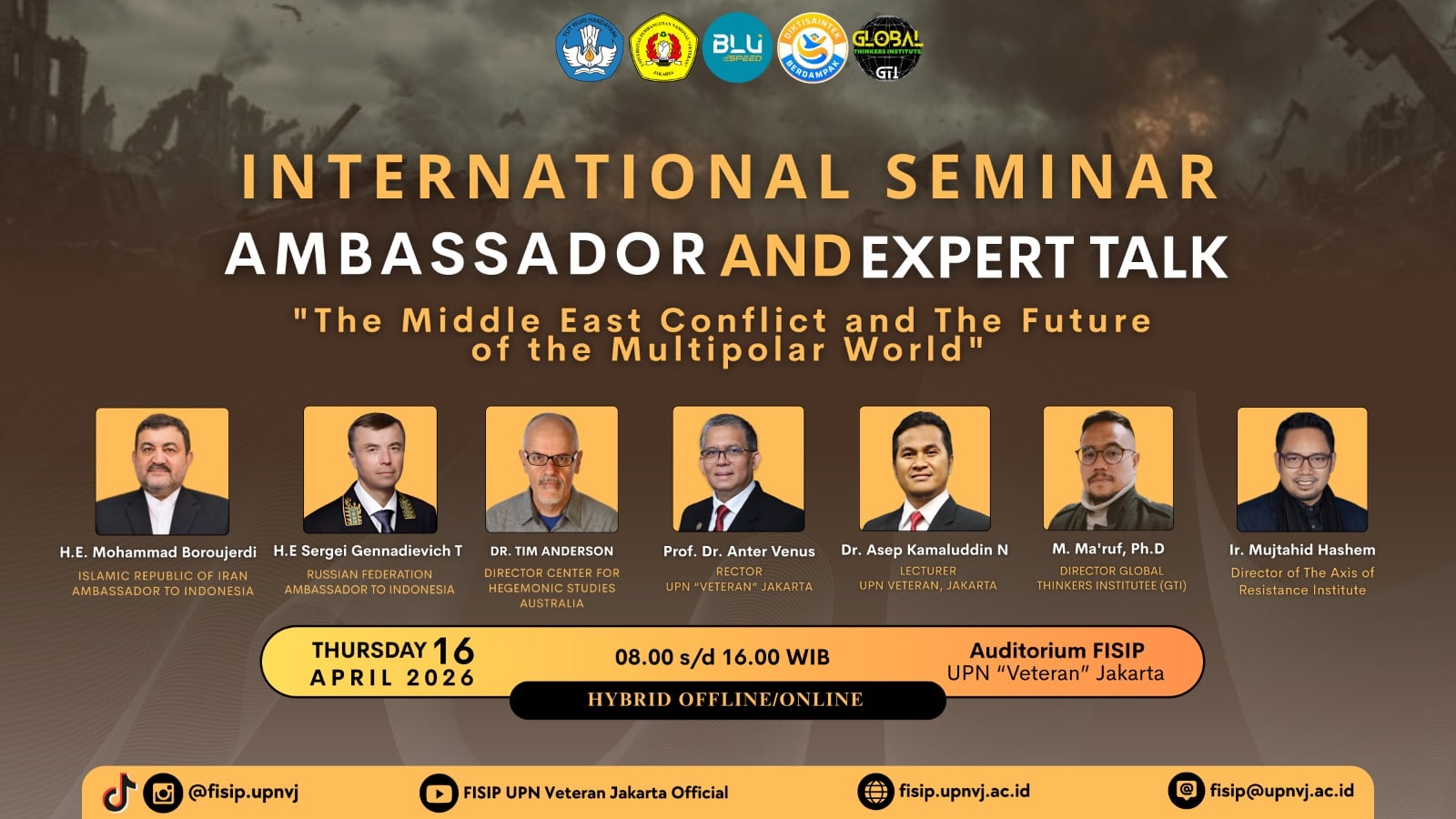

GTI - The Global Thinkers Institute editorial team interviewed Asep and Muhammad Ma’ruf, at the Faculty of Social and Political Sciences, Department of International Relations, UPN Jakarta, april 16th regarding the urgency of holding an international conference on the theme "The Multipolar Future and Conflict in the Middle East - The Iran War". Asep stated that the multipolar narrative is not yet familiar in Indonesian academic circles; if it does exist, it is only briefly mentioned without any serious discussion. This seminar will address the construction of a multipolar world.
Meanwhile, Muhammad Ma'ruf, one of the conceptors, explained the importance of the seminar, which could answer public questions about “Indonesia's free and active political doctrine-politik bebas aktif” and its relevance to the multipolar world as a tool to counter the unipolar Trump-Netanyahu era. He also discussed how the Iran war issue is viewed from the perspectives of the policies of the Islamic Republic of Iran, the Russian Federation, and international relations academics. How the outcome of the war shaped the global financial system, trade routes, energy routes, the Multipolar worldview as an alternative value to replace unipolar world.
Why is Indonesia confused?
According to Muhammad, indonesian academics have always been carried away by an atmosphere of free and active non-alignment, with the assumption that neither party is right in a conflict; rather, both entities are considered equally wrong, or at least one party is not taken seriously if it is indeed in the right.
Multipolarity is often considered a dedollarization narrative that conflicts with Western interests. It is seen as merely a choice of blocs or proxies, lacking any internal value. The old image remains that the West represents Western democracy, liberalism, capitalism, and individualism, while multipolarity, particularly represented by Russia and China, represents the communist-Eastern bloc. This kind of thinking was actually only relevant during the bipolar atmosphere of the Cold War era, from 1945 to 1990. Meanwhile, the multipolar idea emerged with the birth of BRICS around 2001 and 2006, and has developed rapidly since 2014.
Furthermore, its proponents believe that multipolarity has an internal basis of meaning (multiple poles—distribution of power, truth, non-unipolarity) that can be accounted for, such as the mission of equality and respect. Unipolar governance, on the other hand, signifies a single command: power, military (NATO), politics, economics, education, and values. Democracy, human rights, the financial system, and energy routes must adhere to the unwavering direction of the West.
Therefore, the background of the multipolar narrative must be explored clearly and scientifically, and expressed as rationally as possible, so that it is worthy of serving as a foundation for international relations (an alternative to global governance). According to Muhammad, the study of international relations must be grounded in the philosophy of international relations. This can guide Indonesian foreign policy. Multipolarity is the best alternative.
The issue of the US-Israel war, which illegally attacked Iran, clearly violated Iran's sovereignty as stipulated in Article 2 (4) of the UN Charter and UN General Assembly Resolution 3314. However, not many countries, including Indonesia, immediately condemned this illegal action. This is because members of the Board of Peace (BoP) were involved in funding and carrying out the attack, and their territory has been used by the US to attack Iran. These include Saudi Arabia, Qatar, Bahrain, Egypt, Jordan, Turkey, the United Arab Emirates (UAE), and Israel. Indonesia, as a member of the BoP, understandably expressed uncertainty and confusion.
This conference at least opened the door to the importance of exploring geopolitical issues clearly, scientifically, and rationally. The hope is that the "free and active policy" will not be misused to justify a neutral stance, not taking sides, between Iran and the US-Israel. In fact, the signing of the BOP and the Agreement on Reciprocal Trade (ART) is a de jure and de facto sign of Indonesia's support for the US-Israel conflict. It is acknowledged, however, that Indonesia also normatively supports Palestine, which Iran supports militarily.
On the other hand, the Trump-Netanyahu goal of attacking Iran is to quickly topple the regime, giving Iran the opportunity to retaliate with its old war strategy, closing the Strait of Hormuz, imposing a 30 billion rupiah tax on every passing ship, and making Chinese yuan payments a global trend, replacing the hegemony of the petrodollar. As a result, Russia, China, and Iran (BRICS members) are growing economically and politically, while simultaneously inspiring and giving hope to other countries to become more independent.
This is the initial information behind this international seminar.