
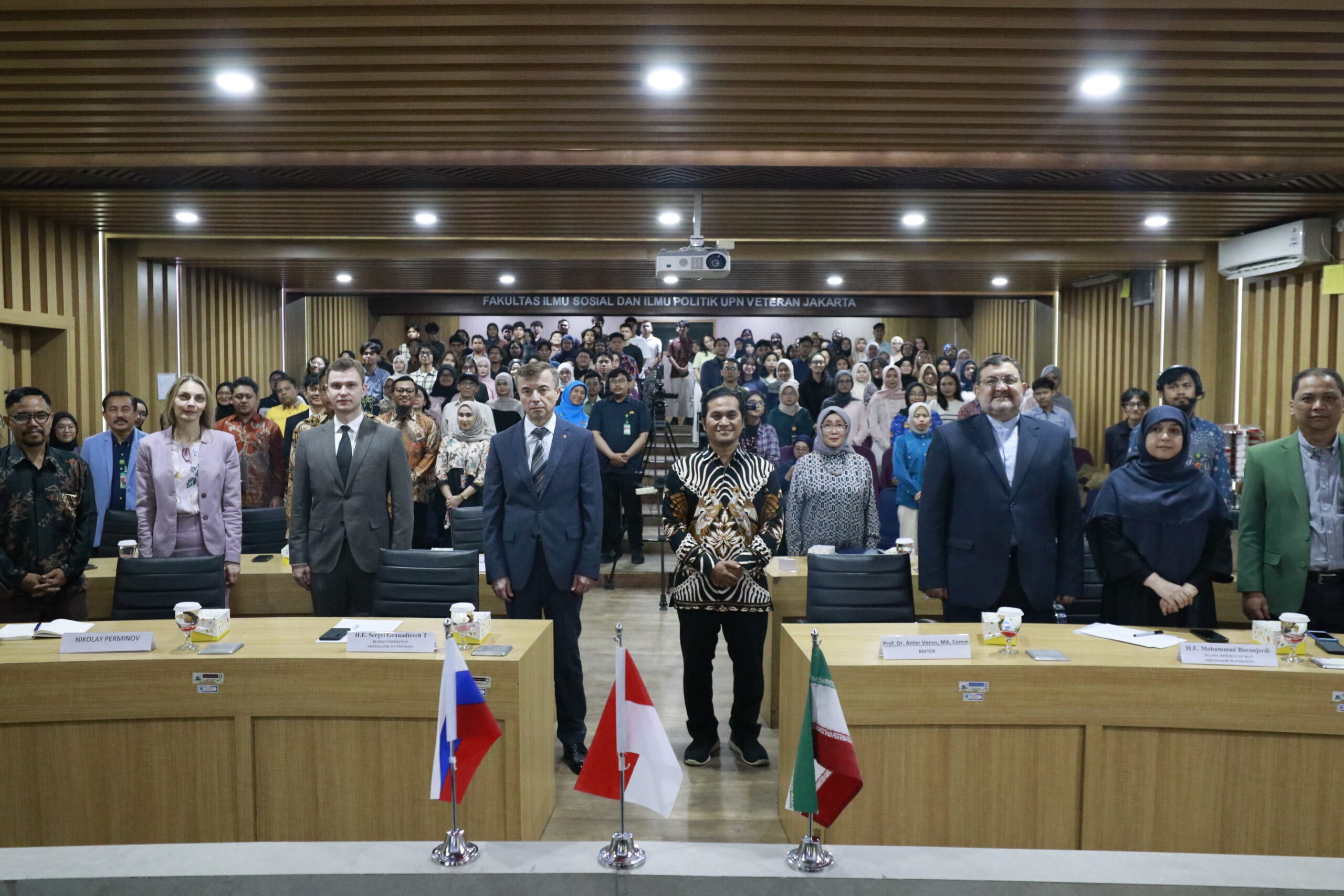

GTI - The Faculty of Social and Political Sciences, Department of International Relations, UPN Veteran, Jakarta, in collaboration with the Global Thinkers Institute (GTI), held an international seminar on the theme of "The Multipolar Future and the Middle East Conflict (Iran War)," on April 16, 2026.
The seminar was attended by Prof. Dr. Anter Venus, MA, Comm., Rector of UPN Veteran, Jakarta.
Present in the first session were Sergei Tolchenov, Russian Ambassador to Indonesia; Mohammad Boroujerdi, Iranian Ambassador to Indonesia; and Muhammad Ma'ruf, Ph.D, Director of the Global Thinkers Institute (GTI).
The second session was attended by Dr. Tim Anderson, Director of Global Hegemonic Studies, Australia; Dr. Asep Kamaluddin, Lecturer in International Relations, UPN Veteran, Jakarta; and Ir. Mujtahid Hashem, Director, The Axis of Resistance Institute, Middle East observer, Rizky Hikmawan, M.Sc., Lecturer in International Relations, UPN, Jakarta.
Anter Venus delivered remarks and highlighted key points on the strategic issues of the Multipolar Future and Conflict in the Middle East. He argued that the conflict must be returned to the vision of international law based on lasting peace.
Venus emphasized that the conflict in the Middle East must not drag on; new global governance (world order) must be based on international law. The US-Israel military aggression against Iran is a clear violation of international law.
Sergei Tolchenov emphasized that the Russian Federation's policy emphasizes diplomatic efforts and implementation within the framework of international law. Russia has vetoed efforts by the US-Israel alliance to open the Strait of Hormuz by military means. Russia has consistently supported diplomatic efforts for Palestinian independence.
Mohammad Boroujerdi specifically urged the public to analyze the situation rationally and seek out reliable news to ensure Indonesia does not miss future opportunities. Iran, as the victim of US-Israeli military aggression, is instead positioned as the aggressor. In fact, Iran is exercising its right to defend its sovereignty against US-Israeli military aggression, which violates Article 2 (4) of the UN Charter and UN General Assembly Resolution 3314.
Iran is invoking Article 51 of the UN Charter, the right to self-defense. However, the US and Israel are cunningly promoting themselves as self-defense, even though the world knows they are the aggressors. Iran's official policy is total war in self-defense until Iran's enemies surrender.
Muhammad Ma'ruf provides a broad overview, stating that the war against Iran is an existential war for the Islamic Republic of Iran, representing a multipolar world that will rapidly undermine the unipolar order. Trump and Netanyahu are clear symbols of the true face of unipolarity: they oppose international law, wage illegal wars, oppose the UN, oppose human rights, and are purely colonial.
Likewise, BRICS economic programs, such as the International North-South Transport Corridor (INSTC) project, and dedollarization gained strategic momentum when the Strait of Hormuz was closed. Although it resulted in a global economic crisis, it would gradually become a catalyst for the dream of a multipolar world to become a reality quickly.
The war waged by the US-Israel will result in Palestinian independence and global justice, not global catastrophe. Multipolar World Order has a simple philosophical foundation: that every person, nation, and state is equal. The wars waged against both Iran and Palestine are rooted in the belief that Israel and the US are racially superior. Of course, national interest motives such as economic greed are the second problem.
Tim Anderson assesses that US-Israeli hegemony is rapidly collapsing, accelerated by the formation of global opinion supporting Iran's position. The widespread support of Iran's position automatically contributes to the rapid achievement of Palestinian independence.
Mujtahid argued that the Iran war had its own prestige, firstly because the winner would determine control of the hub connecting Asia, Africa, and Europe. Secondly, NATO's influence in Western Europe and the Pacific would be drastically reduced, as its core power (NATO) was already nearly destroyed. Iran's strength was based on a shared ideology of resistance and independence, not a single command model, where outside NATO it was merely a branch and followed orders.
Asep argues that the Iran war has provided Indonesia with space to evaluate its unpopular foreign policy, which has contributed to Palestinian independence and even contradicts the Indonesian constitution itself.
Rizki emphasized that the The Board of Peace (BoP) has rendered Indonesia's independent and active foreign policy irrelevant and therefore requires evaluation. Indonesia's signature on the BOP is evidence of its active support for the US and Israel through the BOP. There is no direct link between the BOP and Palestinian independence, as Trump, as the BOP chairman, and Netanyahu, are perpetrators of military aggression against both Palestine and Iran.