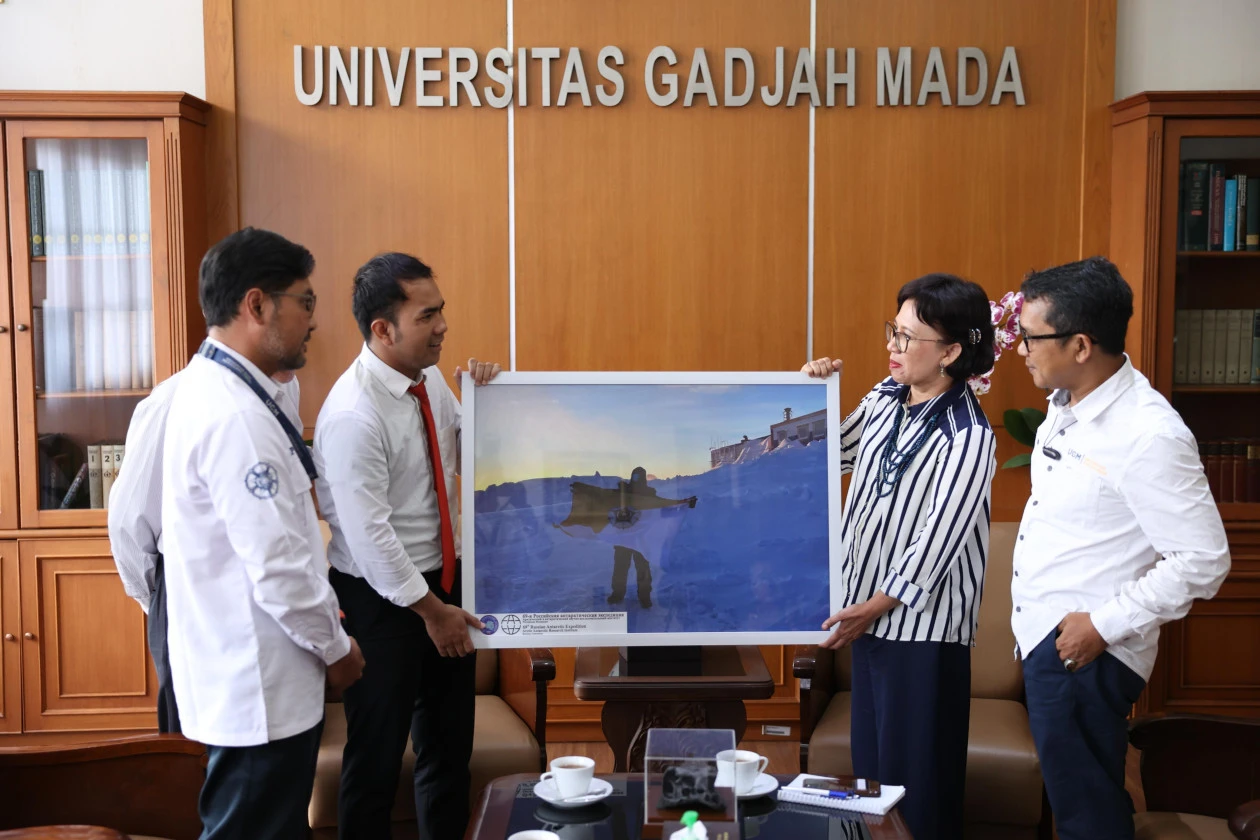

Universitas Gadjah Mada encourages Indonesia's active participation in the global arena through the achievements of two of its alumni, Gerry Utama and Nugroho Imam Setiawan, who successfully explored Antarctica to conduct an international research mission.
The two researchers, Monday (3/2) had an audience with UGM Chancellor, Prof. dr. Ova Emilia, M.Med.Ed., Sp.OG(K), Ph.D. Ova appreciated the achievements of both of them. He believes that the achievements of Nugroho and Gerry will be a motivation for other scientists in Indonesia.
Ova said that the success of the two researchers proves that Indonesia, especially UGM, has the same human resource capacity as other developed countries. Ova promised to encourage UGM's involvement in further research and policies related to Antarctica. "Research is always dynamic. I think there will be a need, maybe a laboratory or Study Center related to Antarctica that we can develop because there is great potential in that field. If it can provide a contribution that has a positive impact on the nation and the world, UGM will support it," said Ova.
Regarding the signing of the Antarctic Treaty System that has been carried out by 58 countries, Ova admitted that there are still many things that must be coordinated with Indonesian government officials. The Antarctic Treaty is one of the important instruments for a country to be actively involved and participate in massive Antarctic exploration. Although Indonesia has not yet stated its readiness to sign the Antarctic Treaty, Ova stated that UGM is always ready to oversee the process. "We have to talk directly with the government, we will convey the good points, then what UGM has done, what needs to be prepared next," explained the Chancellor.
Ova explained that UGM's commitment to the Antarctic Treaty is part of the university's efforts to continue to contribute to global research that has a direct impact on environmental sustainability and climate change. By providing support for the participation of Indonesian students and researchers in international scientific expeditions, UGM plays an important role in strengthening Indonesia's position in managing the Antarctic region. "We want to introduce the importance of Antarctica as a region that requires serious attention from the entire international community,"
Gerry Utama, an alumnus of the Faculty of Geography UGM, became the first Indonesian and ASEAN person to participate in the Russian Antarctica Expedition (RAE) from February to July 2024 when he was studying for a Masters in Paleogeography at Saint Petersburg State University, Russia.
During the expedition, Gerry conducted geomorphological and paleogeographic research to reconstruct a new atlas of the King George Island region, Russia. Gerry's research is very important in the context of global climate change which is currently a world concern. "In addition to wood fossils, I also mapped the presence of moss with color variations. This is an important indicator in understanding the dynamics of the global climate in Antarctica and also the world,".
Gerry (31), who is the youngest researcher in the history of the Indonesian mission to Antarctica, said that three days after the ship landed, he and his team found an iceberg of a very large size. If reconstructed, the release of a larger iceberg from the ice sheet also indicates faster ice melting, which can disrupt the balance of the marine ecosystem and increase threats to human coastal habitats. "Indonesia should be more aware of this phenomenon because our position is mostly ocean. So in order to be actively involved in Antarctic exploration, the signing of the Antarctic Treaty must be pursued immediately," he added.
Dr. Nugroho Imam Setiawan (43), a lecturer in the Department of Geological Engineering, Faculty of Engineering, who also participated in the Japan Antarctic Research Expedition (JARE) in 2016-2017, said that during the expedition, he conducted research on the evolution of the Antarctic continent from a petrological study of methanol rocks aged 2.5 billion - 500 million years. From the Antarctic mission, Nugroho managed to release seven international journals which are certainly useful for the development of geological studies globally. Not to forget, Nugroho also brought home rock samples with honeycomb structures that he found in Antarctica which he has donated to the UGM Biology Museum and the Bandung Geology Museum.