
Introduction
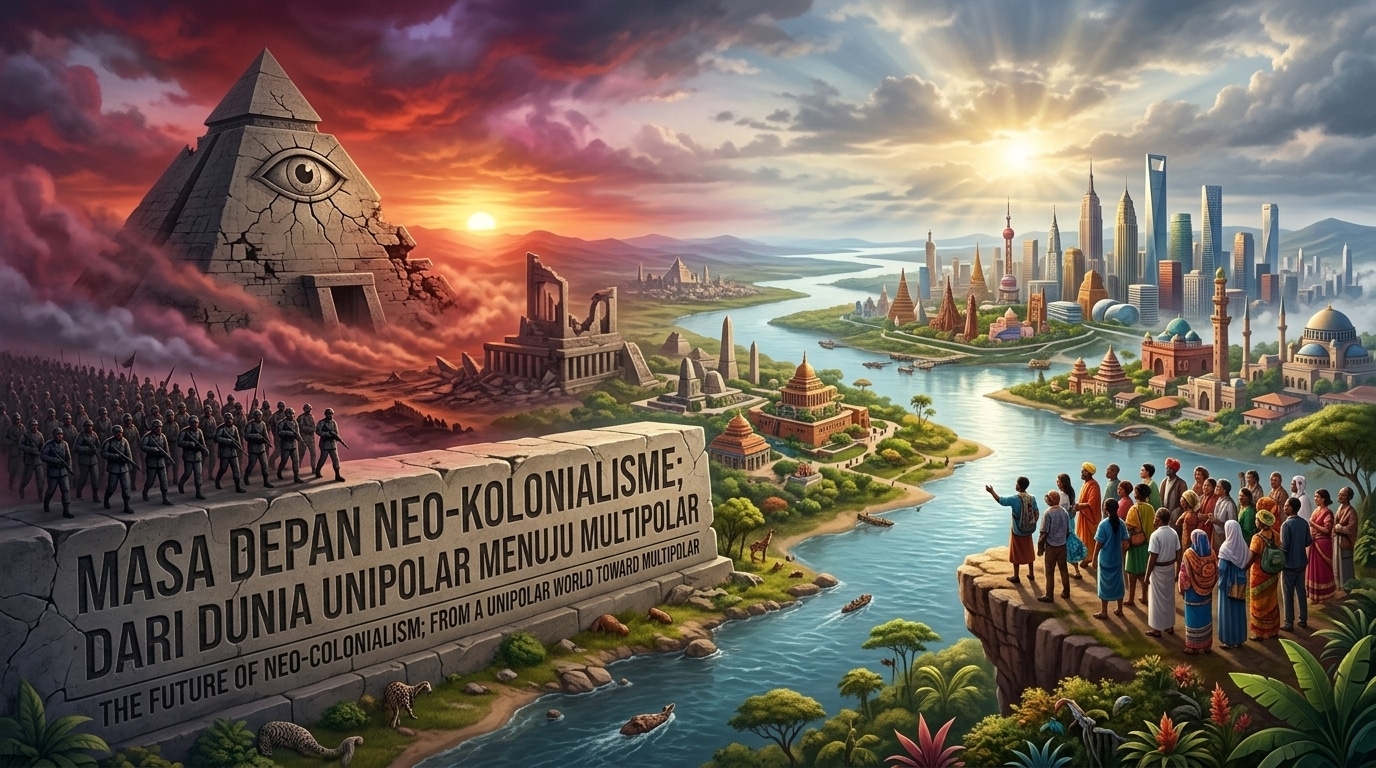
In recent decades, the United States (US) has projected itself as a bastion of democracy, freedom, and human rights. This narrative has become the ideological foundation for its foreign policy in various parts of the world. However, the geopolitical reality revealed through a series of military and political interventions—from Libya, Iraq, Afghanistan, Syria, to Venezuela and Ukraine—demonstrates a fundamental contradiction between idealistic rhetoric and the practice of expansionist power. This article examines how US neo-colonialism has shaped a unipolar world order laden with anti-democratic practices, restrictions on freedom, and support for extremist groups, as well as how current global dynamics are moving toward multipolar governance.
The Traces of US Neo-Colonialism: From Libya to Ukraine
A Recurring Pattern of Intervention
Since the end of the Cold War, the US has been involved in a series of interventions that have transformed the political landscape of various countries. The invasion of Iraq in 2003 under the pretext of weapons of mass destruction—which to this day has never been proven—destroyed the country's infrastructure and gave rise to sustained chaos. NATO's intervention in Libya in 2011, nominally aimed at protecting civilians, resulted in the destruction of that country and opened space for extremist groups to control territory.
Afghanistan, occupied for two decades, ended with the chaotic withdrawal of US troops in 2021, leaving the country in far worse condition than before the intervention. Syria became a proxy battlefield where the US supported opposition groups—some of which had ties to extremism—to overthrow a legitimate government. Venezuela faced crippling economic sanctions and failed coup attempts, while Palestine continues to experience oppression with the US's unwavering political and military support for Israel.
Ukraine: Weakening Russia as a Geopolitical Project
The Ukraine conflict cannot be separated from the US strategy to weaken Russia. Since 2014, the US has supported regime change in Kiev and actively armed and trained Ukrainian forces. The protracted war in Ukraine serves as an instrument to drain Russia's resources, weaken its influence in the region, and maintain US hegemony in Europe.
However, the narrative of support for "Ukraine's defense" often ignores complex internal dynamics, including the involvement of ultranationalist groups such as the Azov Battalion, which has extremist ideological roots. This paradox creates a situation in which the US, which has historically claimed to oppose extremist ideologies, instead provides political tolerance and military assistance for the sake of short-term geopolitical interests.
The Ukraine-Palestine Contradiction
One of the most striking contradictions in US foreign policy is evident in its stance on global conflicts. In Ukraine, the US voices full support for the struggle against external invasion in the name of resistance to colonialism. Yet at the same time, the US provides strong political and military support for Israel's policies in Palestine, which many critics and international observers regard as acts of occupation and oppression that contradict the principles of anti-colonialism.
This double standard reveals that the principles the US campaigns for are not universal values applied consistently, but rather rhetorical tools used selectively to justify intervention in areas considered strategic.
Domestic Contradictions: Democracy, Censorship, and Restrictions on Freedom
Narrative vs Reality
Domestically, the US promotes itself as a bastion of freedom of expression and an open society. However, recent policies involving strict surveillance of social media, screening of digital activity, and visa restrictions and strict vetting of foreign nationals reflect a shift toward tight surveillance.
The US government is increasingly aggressive in monitoring digital communications, pressuring social media platforms to censor content deemed "dangerous," and restricting academic freedom through surveillance of foreign students and academics. This irony shows that the democracy campaigned for abroad is not always reflected in domestic practice.
Anti-Democracy in Practice
Anti-democratic practices are also evident in how the US handles internal dissent. Criticism of foreign policy is often labeled as "anti-American" or "pro-authoritarian regime," while whistleblowers such as Edward Snowden and Julian Assange are pursued and punished for revealing the truth about US intelligence operations.
Support for Extremist Groups: The Policy Paradox
History shows that the US has repeatedly supported extremist groups when it suited its geopolitical interests. During the Cold War, the US supported the mujahideen in Afghanistan against the Soviet Union—a policy that later gave rise to Al-Qaeda and the Taliban. In Syria, the US supported opposition groups with ties to extremism to overthrow Assad. In Ukraine, tolerance of ultranationalist groups became part of the strategy against Russia.
This pattern reveals that the US is inconsistent in opposing extremism; support for extremist groups becomes a tactical tool to achieve geopolitical goals, even if it means sacrificing long-term stability and the values it claims to uphold.
Toward Multipolar Governance: The End of Unipolar Hegemony?
The Shift in Global Power
The unipolar world dominated by the US since the collapse of the Soviet Union now faces increasingly greater challenges. The rise of China, Russia's resurgence under Putin, and the emergence of regional powers such as India, Brazil, and Turkey are creating a more complex and multipolar geopolitical landscape. BRICS as an alternative economic bloc is increasingly strengthening its position as a counterweight to Western dominance.
The Failure of the Neo-Colonial Project
The US neo-colonial project—aimed at maintaining hegemony through intervention, sanctions, and regime change—has shown failure on various fronts. Afghanistan serves as a reminder that military power cannot build a nation. Iraq and Libya show that overthrowing regimes without post-conflict plans only breeds chaos. Sanctions against Venezuela and Iran have failed to overthrow the targeted governments, while worsening the suffering of the people.
Multipolarism as an Alternative
Multipolar governance offers an alternative to a hegemony laden with contradictions. In a multipolar order, no single country dominates absolutely; regional and global powers balance one another. This opens space for more equal cooperation, respect for sovereignty, and collective decision-making in multilateral forums such as the UN, G20, and BRICS.
Conclusion
US neo-colonialism, wrapped in the narrative of democracy and freedom, has left a trail of destruction in Libya, Iraq, Afghanistan, Syria, Palestine, Venezuela, and Ukraine. The contradiction between idealistic rhetoric and the practice of expansionist power reveals that the principles campaigned for are not universal values, but rather tools for maintaining unipolar hegemony.
However, the world is changing. The shift in global power toward multipolar governance marks the end of the era of absolute US dominance. In this new order, equal cooperation, respect for sovereignty, and rejection of neo-colonial intervention become the foundation for a fairer and more stable world. The future is not about who dominates, but about how nations can coexist in diversity and mutual respect.