
GTI-Exclusive Interview with Prof. Ali Mochtar Ngabalin, conducted by the Global Thinkers Institute (GTI), September 7.
Prof. Ali Mochtar Ngabalin, widely known as Ngabalin, serves as the Chair of the Golkar Party's Central Executive Board (DPP) for Foreign Policy and International Relations. Golkar ranks among Indonesia's top three political forces, alongside the Gerindra Party and the Indonesian Democratic Party of Struggle (PDI-P), and stands as one of the key parties endorsing and supporting the administration of President Prabowo Subianto for the 2024–2029 term.
Ngabalin is also a Visiting Professor of International Relations at Tomsk State University (TSU) in Siberia, Russia. In an exclusive interview with GTI, he underscored the critical importance of Indonesia's comprehensive understanding of, and adaptation to, the ongoing World Order transition from Unipolar to Multipolar order. He emphasized the need for a thorough grasp of the profile and vision of the Multipolar World as championed by the Russian Federation in the post-Soviet era, thereby enabling maximum cooperation between Russia's potential as a major power and Indonesia's national interests.
GTI:
To what extent does the Indonesian public, and notably its elite circles, possess an understanding of the Russian Federation in the post-Soviet era?
Prof. Ali Mochtar Ngabalin:
I believe we must candidly acknowledge that public knowledge regarding post-Soviet Russia remains uneven. A significant segment of our society still perceives Russia through a lens heavily shaped by Soviet history, the Cold War, military might, weapons technology, or the persona of President Vladimir Putin.
In reality, the post-Soviet Russian Federation must be understood from a far broader perspective. Russia is one of the world's pivotal power centers, possessing substantial capacity in energy, food security, technology, defense, education, science, culture, and multilateral diplomacy. Russia also holds a crucial position within various international institutions and maintains an extensive network of relations with nations across Asia, Africa, the Middle East, and Latin America.
Therefore, for me, the task of political diplomacy is not to encourage Indonesian society to "side with Russia." That is not our objective. Our aim is to comprehend Russia objectively so that Indonesia can determine its stance based on its own national interests. Conversely, Russia needs to understand Indonesia not merely as a Southeast Asian nation, but as a major democracy, the world's largest Muslim-majority country, a G20 member, a key ASEAN power, and a state with a tradition of an independent and active foreign policy. This is what I refer to as mutual understanding.
GTI:
What is the current state of the formalized relationship between the Golkar Party and the United Russia party, established five years ago on June 11, 2021? What progress has been made, and what obstacles have been encountered?
Prof. Ali Mochtar Ngabalin:
I view inter-party relations, such as that between Golkar and United Russia, as holding significant value in this context. The cooperation agreement signed on June 11, 2021, indeed initially encompassed multiple sectors, including politics, economy, health, and education.
However, five years after that MoU, we must not remain at a purely ceremonial level of engagement. We must advance to the next stages: progressing from mutual contact to mutual understanding, from mutual understanding to mutual trust, and from mutual trust to mutually beneficial cooperation. In my view, this constitutes the future diplomatic work of the Golkar Party.
GTI:
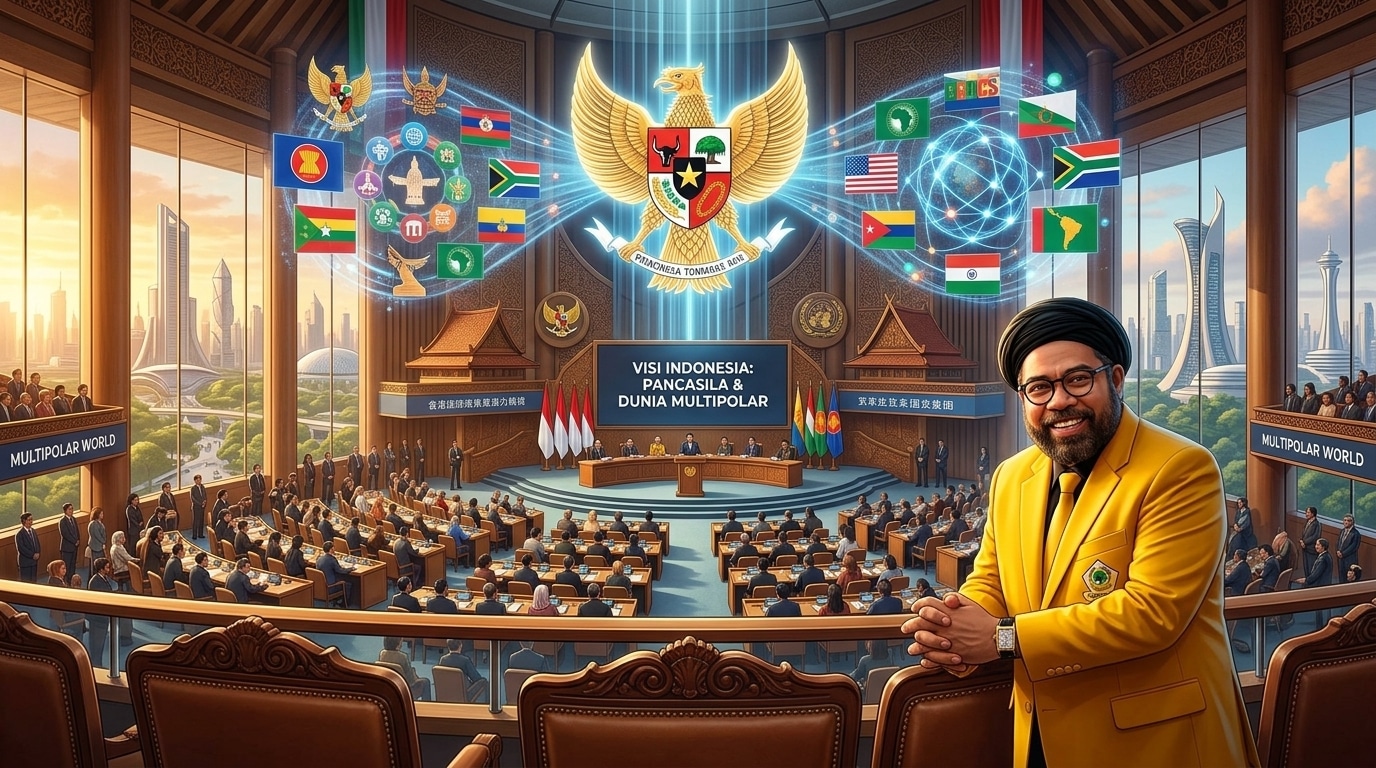
To what degree do the principles of Indonesia's Free and Active foreign policy and Pancasila align with the multipolar concept championed by Russia?
Prof. Ali Mochtar Ngabalin: First and foremost, I wish to make a firm clarification. Indonesia does not adhere to Russia's foreign policy. Indonesia possesses its own foreign policy—namely, the Free and Active doctrine rooted in its Constitution and Pancasila values. Therefore, we must not conflate the two.
Nevertheless, within the current development of the global order, there are several conceptual points of convergence. Indonesia's Free and Active foreign policy fundamentally provides the nation with the latitude to determine its stance independently, free from subordination to any specific great power, while remaining actively engaged in contributing to peace and the resolution of international issues. The Ministry of Foreign Affairs also clarifies that "active" signifies Indonesia does not adopt a passive or reactive posture towards international problems.
Meanwhile, in Russia's "2023 Foreign Policy Concept," the nation explicitly prioritizes the strengthening of a multipolar world order and more democratic international relations as core directions of its foreign policy. This is where a space for dialogue exists.
Pancasila teaches us the principles of humanity, unity, deliberation, social justice, and respect for communal life. Indonesia's foreign policy is likewise not constructed to serve as an instrument of domination over other nations. Consequently, if multipolarity is understood as a world that affords greater space to various power centers, respects state sovereignty, promotes equality, and eschews single-power dominance, then several principles can indeed be dialogued with the Indonesian experience.
However, I wish to add a crucial caveat: Multipolarity does not signify replacing one hegemony with another. If a multipolar world merely results in the emergence of several major powers, each seeking to dominate others, then that is not the world order we desire. For Indonesia, the ideal multipolarity is one that is just, inclusive, respects international law, reinforces multilateralism, and grants developing nations the space to determine their own futures. That is the Indonesian perspective.
GTI:
How do you perceive the shift in global governance from Unipolar to Multipolar system? What actions must Indonesia undertake?
Prof. Ali Mochtar Ngabalin:
I view the transition from a unipolar world to a more multipolar one as one of the most significant geopolitical transformations of the 21st century. The world can no longer be explained through a single center of power. We are witnessing the emergence of various centers of economic, political, technological, and civilizational growth across Asia, the Middle East, Africa, and other regions.
Yet, I do not wish for us to perceive this change merely as a rivalry between the United States versus Russia, or the United States versus China. The world is far more complex than that. The real question is: How can Indonesia ensure that this transformation of the global order creates space for the national interests of Indonesia and other developing countries?
My answer is that Indonesia must become a subject, not an object. There are several steps I deem essential.
First, strengthening Indonesia's *strategic autonomy*. Indonesia must be able to cooperate with the United States, China, Russia, the European Union, India, Japan, Korea, and nations in the Middle East, Africa, and Latin America without losing its independence in defining its national interests. We must not become trapped in the politics of "choosing sides." Indonesia must be capable of engaging with all parties.
Second, strengthening ASEAN. Indonesia must continuously ensure ASEAN remains relevant as a diplomatic and regional power with a strategic position within the Indo-Pacific architecture.
Third, strengthening multilateralism. Indonesia must increasingly utilize the UN, G20, ASEAN, APEC, BRICS-related engagement, the Organisation of Islamic Cooperation, and various Global South forums to advocate for the interests of developing nations.
Fourth, bolstering economic diplomacy. Political diplomacy must yield tangible benefits for the people. We require investment, trade, technology, energy, food security, education, health, and technology transfer.
Fifth, reinforcing peace diplomacy. Indonesia possesses a monumental historical asset, stemming from the 1955 Asia-Africa Conference. Consequently, Indonesia must continue to play an active role in resolving…