
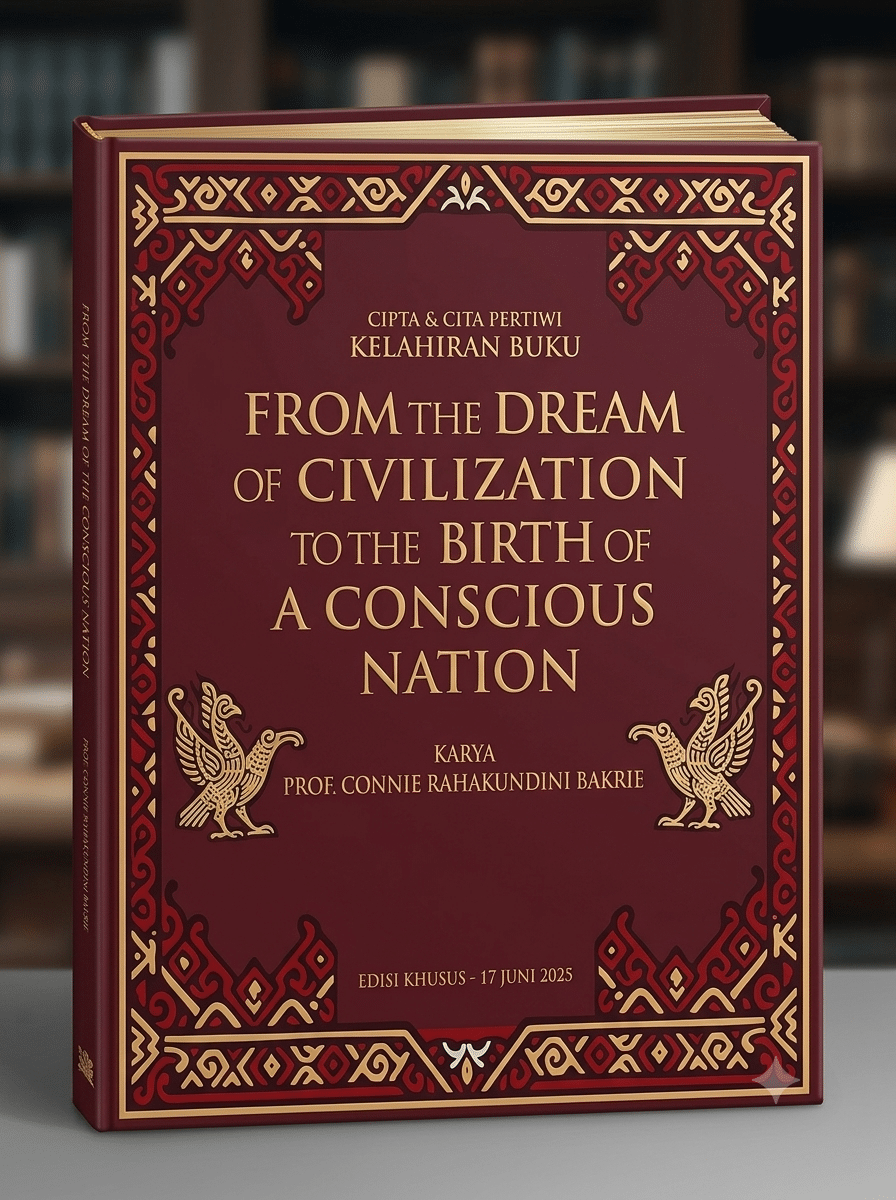

"From the Dream of Civilization to the Birth of a Conscious Nation" (in Indonesian, "Dari Mimpi Peradaban Menuju Lahir Bangsa Berkesadaran" is Connie Rahakundini Bakrie's latest book, released in June 2025. It began writing in early 2022.
Through the title of this book, Connie positions Civilization as the grand ideal of the Indonesian state vision, which must serve as a guide for a nation that maintains (élan vital) the spirit and consciousness of the nation.
Civilization and national consciousness are the key or essence of the nation's existence. The two must be juxtaposed, while structure is secondary. These include technology, economics, politics, ideology, demography, organization, information, and the environment.
Connie attempts to reconnect with the hopes of the Pancasila state popularized by Sukarno.
If Sukarno, through the concept of the Pancasila state, served as the first voice (mouthpiece) of the people, then through this book, Connie becomes the second voice (mouthpiece) of the people in an era of increasingly strengthening Multipolarity.
This book is a kind of summary and affirmative advice. or a book on political ethics written in the tradition of philosophers. The book is not written as factual data, but rather as a preservation of the tradition of writing about the "perfect state" that began with Plato (The Republic), Aristotle (Politic), Augustine's City of God and Aquinas.
Within the tradition of political philosophy, the attempt is to restore the primary rationale, "the emergent of state." Should we rely on the strength of civil society to actualize the values of virtue rather than relying on the power of a ruler within a state? Or should we rely on the leadership of a powerful philosopher-king who transmits the values of virtue to his people?
Connie seems to choose the perfect state—the paripurna state (Indonesia-Negara Paripurna -Yudhi Latief)—the Pancasila state, which is closer to the Platonic tradition than the Aristotelian one. The verses of her political ethical teachings resonate more with the Madinah Fadhilah Al-Farabi than John Locke's protection of property rights and freedom as natural rights that exist before the formation of government, Thomas Hobbes's Leviatan, or Jean-Jacques Rousseau's "general will and The Social Contract."
She articulates is closer to Henry Bergson's Elan Vital, and her exploration of the intersection and transformation of ideas about self-identity and the universality of values is closer to Muhammad Iqbal's Asrar-i Khudi.
Connie's narrative style, indeed close to the style of Ibn Miskawaih's political ethical teachings—Tahdhīb al-Akhlāq wa Taṭhīr al-Aʿrāq—is indeed suited to Indonesian audiences, who find it easier to digest than Iqbal's poetic-philosophical narrative style, which may be more difficult to digest. It is possible that Connie's experiences, raised in Western security and military science, will be crystallized, not in an atmosphere of ethical pedagogy, but in the totality of selfhood Connie as a spiritualist and a geopolitical thinker.
Connie's 10 commandments at the end of her book are: seek wisdom, sanctity in life, justice and integrity, unity in diversity, safeguard peace and harmony, uphold freedom, protect the earth, illuminate the path of youth, be courageous and love, and strengthen sacred bonds between nations.
Succinctly put, this book surprised everyone because Connie reported her geopolitical vision based on a transcendental spiritual-state, implicitly suggesting that Sukarno's Pancasila state was a spiritual state, not a secular one. The state must be harmonious and have a sacred bond between humans, nature, and God. This is in line with the spirit of Multipolar World Governance, equality, respect, and preserving tradition.
Connie Rahakundini Bakrie is a Professor of International Relations at Saint Petersburg State University, Russia, and also the Ambassador of Science and Education of Russia.