
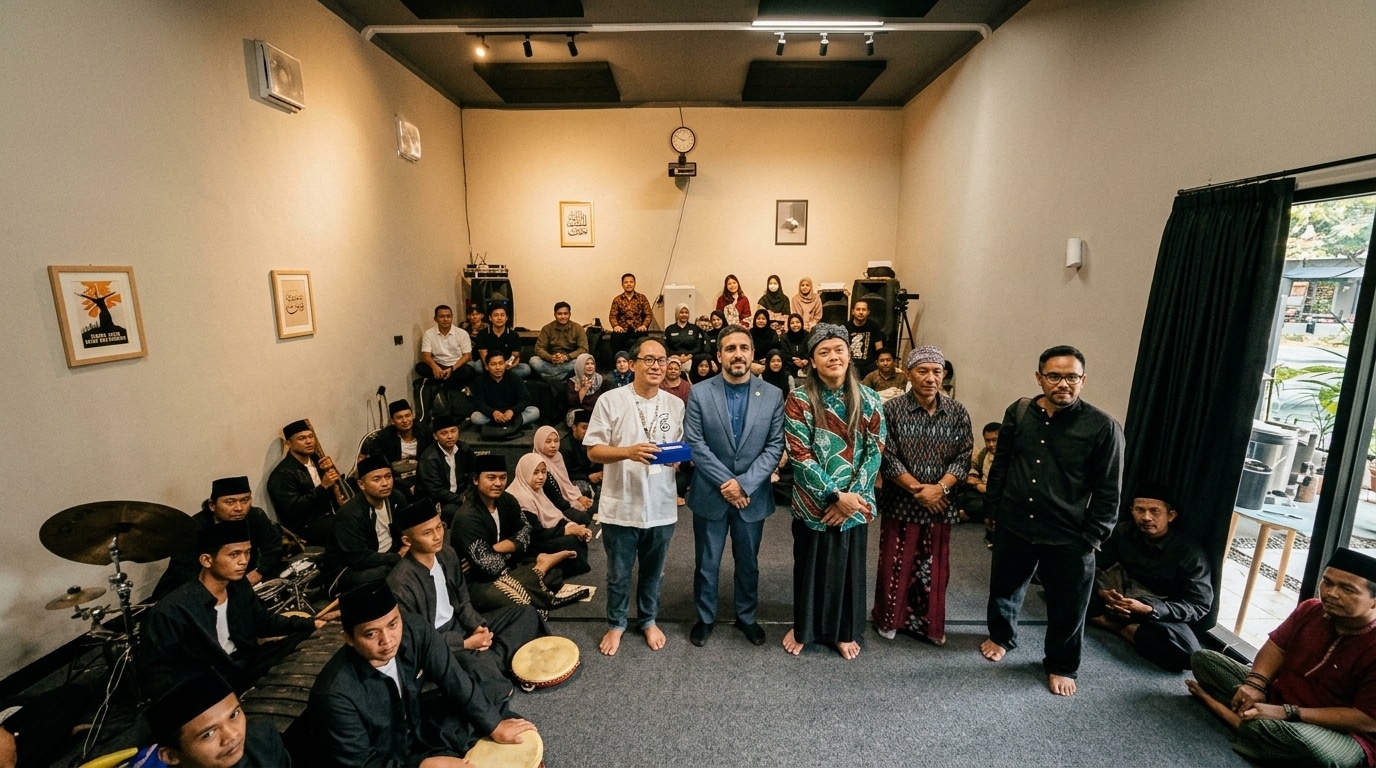

GTI-Jaringan Kebudayaan Rakyat-JAKER, Yogya, Yayasan Garuda Pancasila Raya, Pondok Pesantren Azzuhri Semarang, Panembahan Qitimir, 24/09/2026 organized a "Cultural Dialogue, From Isfahan to Yogyakarta" at Ruang Literasi Kaliurang (RLK)-Kaliurang Literacy Space,Yogyakarta.
The event opened with a performance of the song "Ya Mahdi" by the ethnic music group Panembahan Qitmir from Semarang.
Present were speakers; Muhammad Ma'ruf, Chairman of the Garuda Pancasila Raya Foundation-GPR, Agung, Chairman of JAKER, Yogya, Gus Lukman, Chairman of Pondok Pesantren Azzuhri, Dr. Yahya Jahangiri Shurowadi, Cultural Counselor of the Embassy of the Islamic Republic of Iran for Indonesia.
Ma'ruf said every country typically has a jewel that harbors the soul of its nation, a region considered special. A province deemed to possess depth in tourism, art, culture and civilization. Iran has the city of Isfahan. Indonesia has Yogyakarta. Both share similarities-twin souls.
Isfahan is Iran's icon. Renowned as "half the world," it boasts a wealth of Islamic architecture and Islamic civilization. It once served as the capital of the Safavid dynasty in 1598, under Shah Abbas I. It features destinations such as Naqsh-e Jahan Square (Imam Square), a vast square complex inscribed on the UNESCO world heritage list. Shah Mosque & Sheikh Lotfollah Mosque: iconic places of worship with stunning blue mosaic tiles and symmetrical design. Si-o-se-pol Bridge: a historic stone bridge with elegant arches spanning the Zayandeh River. Chehel Sotun Palace: a magnificent Safavid-era palace famous for the reflection of its 40 pillars in its pool.
Yogyakarta, the capital of the Special Region of Yogyakarta. An imaginary straight line connecting the southern coast and the volcano in Yogyakarta is known as the Philosophical Axis of Yogyakarta (The Cosmological Axis of Yogyakarta).
This north-to-south line passes through several important sites: Mount Merapi in the north as a symbol of sacredness and higher ground. Tugu Yogyakarta (the White Pal Monument). The Yogyakarta Palace at the city center as the seat of governance and culture. Panggung Krapyak in the south-moral education. Parangkusumo Beach or Parangtritis Beach on the southern coast as a symbol of the southern sea.
Yogya is home to the Kraton, the remnants of the Ancient Mataram Kingdom that stood from 732 AD through Islamic Mataram. Numerous temples, inscriptions and the Yogyakarta Kraton remain. It has iconic destinations such as Malioboro Street. Taman Pintar, numerous campuses and dozens of beaches.
Ma'ruf expressed hope that the Isfahan-Yogyakarta sister city project would soon be realized in the near future and that cultural, tourism and arts programs could be implemented promptly.
Meanwhile, Yahya expressed appreciation for the performance of the ethnic Islamic music group Panembahan Qitmir. "You performed the song Ya Mahdi accompanied by traditional music just like Iranians."
Yahya emphasized the importance of music. Ibn Sina in the Book of Shifa said music is capable of awakening your soul or heart to draw closer to Allah. Islam was born in Arabia but artists made Islamic teachings beautiful, Islam became rational in the hands of philosophers. Islam became spiritualism thanks to the contributions of arifs or Sufis. The presentation of Islam became more attractive and appealing thanks to artists and cultural figures. Islam's teachings are inherently beautiful, and with the packaging of art and culture, its audience becomes vast without barriers.
Yahya added, "as a cultural counselor, my task is to foster understanding and bring the two cultures of Iran-Indonesia closer through film, music, and culture among others. Mustofa Dibou, a traditional artist, recently went to Iran. He recited Iranian poetry, accompanied by very beautiful music.
You also today played the music 'Salam Ya Mahdi' very well, like Iranians. I hope you can perform in Iran. You can later join the project, collaborate and play music together."
Meanwhile Gus Lukman offered several points. He said the scope of culture is vast, yet art, tradition and Islam should be able to harmonize. The challenge today is the colonial effort that continues to this day to destroy Islamic art and culture in order to undermine the cultural foundations and soul of the nation.
The Dutch destroyed our traditions, history and culture, they sowed division, creating a great Java and a lesser Java. The Dutch took Majapahit and Sriwijaya literature, as in the Pararaton, the Kidung Sunda is not history, its content is divisive.
We are obstructed by colonial propaganda, restrictions on artistic expression in the name of "bi'dah, kafir, superstition (shirk)," intimidated into avoiding Shia, so that we cannot be artistic and Islamic at once, we cannot perform suluk, prophetic salawat, all of which ultimately push us to distance ourselves from Iran.
Even now it continues, International Zionism also destroys the identity of Islamic tradition, art and culture. Colonialism seeks to erase our identity of tradition and Islam. The US and Israel are now trying to destroy Iran militarily after failing to destroy the cultural and Islamic identity in Iran. But I am confident the US, Israel and their supporters will fail.
I am proud of Iran because there remains a figure held in high esteem such as the late Seyyed Ali Khamenei, who is loved by his people from all walks of life. A figure who can be a source of solace, a guardian of the hearts of good, faithful and artistic people. The figure of Seyyed Ali Khamenei enables the Iranian people to be religious (Islamic) and artistic at the same time.
Ancient Indonesia (Nusantara) also once had figures who served as role models, who could inspire the integration of cultural and artistic identity, being Javanese and Islamic at once, being Sundanese and Islamic at once.
I am proud of Iran and Nusantara, because Islam can harmonize with literature and music, thus becoming the driving force of Islamic culture and civilization for the world.
Meanwhile Agung said culture has a very broad meaning, not merely art and food, but life itself. I agree with Gus Lukman, our culture is under full-scale attack by colonialism, meaning we are not fully able to control our own lives and become the owners of our own life. The history of Nusantara, rich in teachings of wisdom, was severed by colonialism. The wealth of manuscripts containing teachings of wisdom was taken to the Netherlands.
Pancasila Moral Education lessons have been removed from the curriculum. We used to say "excuse me" when passing in front of elders; children today are indifferent. Our noble culture is being attacked by Korean culture, American culture, making us egoistic and individualistic.
We possess a wealth of traditions, languages, cultures and foods renowned under the motto Bhineka Tunggal Ika, unified and distilled into the five values of Pancasila. The rich teachings of customs, arts, ethnic groups, cultures and religions across Nusantara are united by the values of Pancasila. Since ancient times our ancestors believed in God, upheld humanity, unity, deliberation and justice.
We are brothers and sisters, in one faith, but also one humanity as fellow human beings, equally creatures of God's creation.
The dialogue and Panembahan Qitmir performance ran for approximately 2 hours, followed by an informal dialogue with artists and cultural figures from JAKER and Pesantren Azzuhri.