

By: Muhammad Ma’ruf
GTI-On paper, the political map of West Asia is always drawn with sharp, clear lines: allies on one side, adversaries on the other. Washington, for instance, once envisioned a neatly organized region shaped by the India–Middle East–Europe Economic Corridor (IMEC). The vision was nearly flawless: ships from India docking in the Gulf, cargo flowing across Saudi Arabia and Jordan, and finally arriving at Israeli ports. The US would provide support, Israel would contribute technology, the UAE would inject capital, and India would supply industrial capacity—a comprehensive package designed to integrate Israel and—subtly—marginalize Iran.
Yet, the region has never been willing to be organized in such a way. Like a web of overlapping threads, the nations of West Asia are busy forging their own lines of connection, often crossing boundaries that Washington deems "wrong." Ironically, it is precisely within this tangle of routes that Iran has secured a position that makes it impossible to isolate.
When One Map Isn't Enough
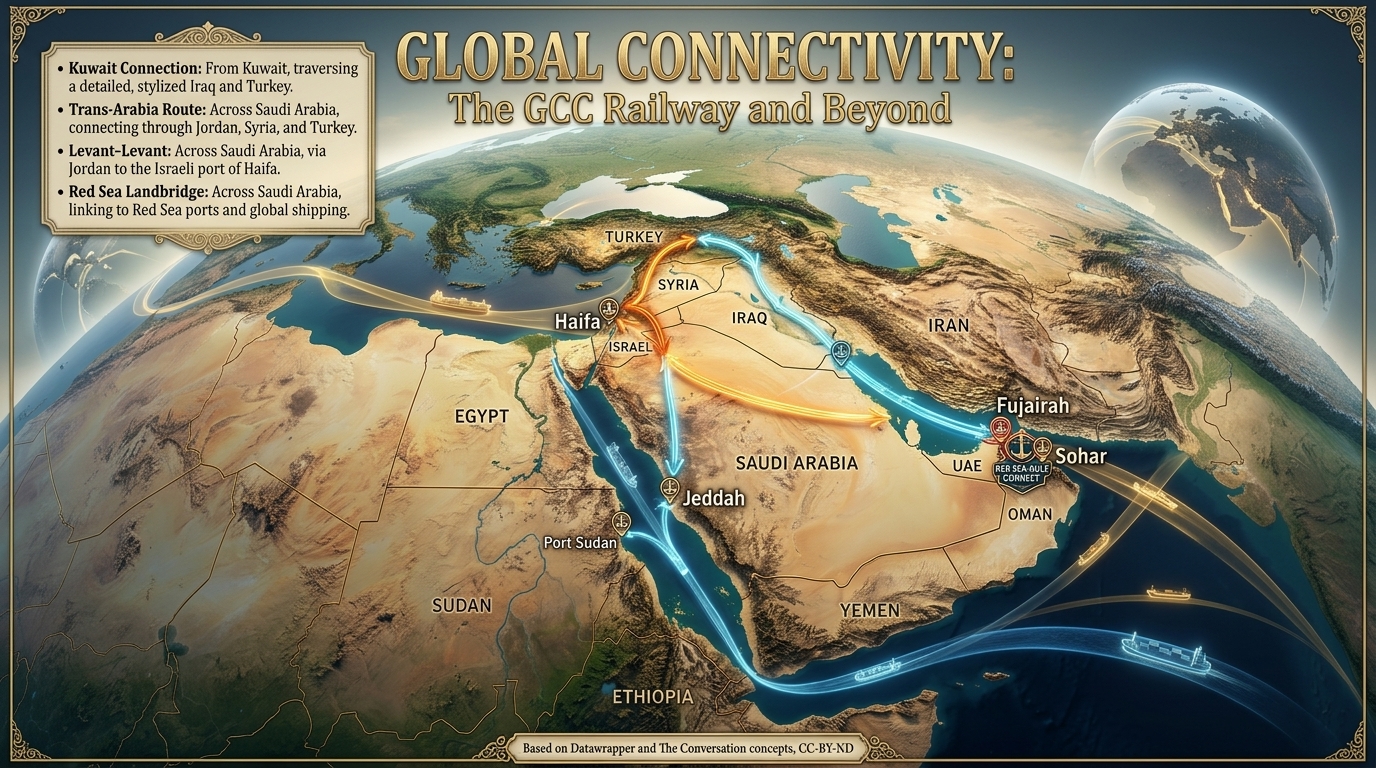
Look at the map again. There is a railway line recently unveiled under the Gulf sun that veers eastward toward Iran’s Chabahar port. Elsewhere, container ships dock at Gwadar, Pakistan—part of China’s grand ambition. Meanwhile, in northern Iraq, the "Development Road" project is being touted as a conduit to transport goods from the Persian Gulf, through Turkey, and into the heart of Europe.
India—viewed by Washington as a natural partner for IMEC—has never abandoned the Chabahar port, which it manages jointly with Iran. In fact, New Delhi is actively developing the International North–South Transport Corridor (INSTC), linking the Indian Ocean—via Iran—to the Caspian Sea and Russia. The UAE is playing a dual game: maintaining friendly ties with Israel and the US in official forums while simultaneously picking up the phone to trade with Tehran and Beijing. Saudi Arabia, seemingly unwilling to be left behind, is exploring the IMEC initiative while also strengthening its partnership with the People's Republic of China.
Each nation pulls its own threads, creating a vast, tangled web. And at the center of this vortex sits Iran, calm and composed.
Iran: The Unavoidable Node
Why? Because geography speaks the loudest. Iran is the only country whose territory embraces both the Persian Gulf and the Indian Ocean, while also extending to the Caspian basin, Central Asia, the Caucasus, and Turkey. For any vessel or shipment moving from south to north—India to Russia—or east to west—China and Central Asia to the wealthy markets of the Gulf—transiting through Iran offers the most logical shortcut.
This position grants Iran a triple advantage: revenue from transit fees, foreign investment in ports and railways, and access to new markets. More importantly, every truck, ship, or train crossing Iranian territory represents a vital interest for its trading partners. India, Russia, and China would not stand idly by in the face of foreign pressure seeking to shut down these routes. In short, every shipment passing through Iran creates a political stake for Tehran in the eyes of other nations. The more routes established, the deeper the economic interdependence, making it difficult for Washington to sideline Iran.
Cracks in the Western Plan
The IMEC initiative itself is not without flaws. This ambitious project hinges on a single, fragile thread: the normalization of relations with Israel. The war in Gaza and persistent tensions involving Iran throughout the year have made the corridor appear more like a pipe dream than the backbone of regional trade. Investors and transit nations alike are having second thoughts—why route cargo through a corridor that could suddenly transform into an active conflict zone? At the same time, demand for alternative overland routes is actually rising. As maritime and air corridors become fraught with risk, overland rail and road networks—including those traversing Iran—have emerged as the new preferred options.
Survival, Not Victory
Ultimately, Washington’s old script of "isolating Iran" appears increasingly detached from reality. Iran need not defeat the IMEC, dismantle the Pakistan-China connection, or sever all its competitors' outlets. Tehran simply needs to maintain its position as a vital node across multiple routes simultaneously, compelling any serious regional trade system to come to terms with geographical realities and Iran’s own strength.
The West Asian region may be being rebuilt by ports, railways and data cables. But the resulting map is not a straight line of Washington. It is a complex web, with each country holding its own end of the thread—and Iran, with its geographic smile, holds more knots than the strategists ever imagined.