

By Muhammad Ma’ruf
The Mecca Defense Pact Promises Solidarity, Yet Reality Tells a Different Story
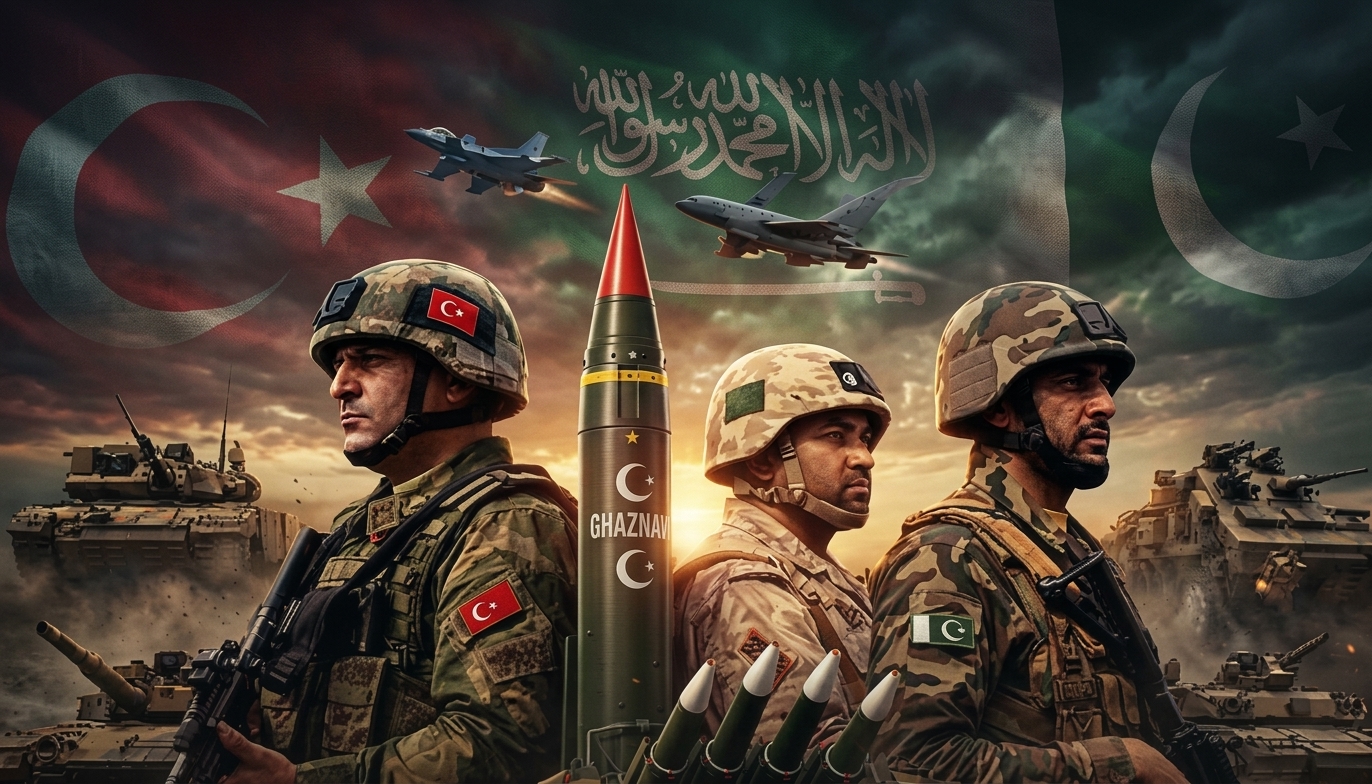
GTI-Mecca, August 7, 2025—Three of the Muslim world's most powerful military nations signed a Joint Defense Treaty in the holy city of Mecca. Saudi Arabia, Turkey, and Pakistan declared a solemn commitment: an attack on one is an attack on all. Turkish Foreign Minister Hakan Fidan proudly likened it to NATO’s Article 5—the clause that has served as the backbone of the North Atlantic alliance for seven decades.
Yet, beneath the grand rhetoric and warm handshakes, military analysts and diplomats see a fragile foundation. The comparison to NATO falls apart the moment the slogans meet the actual mechanisms on the ground.
Promises on Paper
The first suspicious fact: the full text of the treaty was never made public. Only a general framework is known—lacking a joint command, assigned troops, or a clear automatic response mechanism. Fidan himself acknowledged that members would decide the "level, form, and format" of support through consultation after an attack occurs. Operational rules still await a first ministerial meeting, which has not yet been scheduled.
"This isn't a defense treaty; it's a statement of intent," said a Middle East security analyst who requested anonymity. "NATO has a permanent structure, a headquarters in Brussels, a supreme commander, and thousands of personnel working daily. The Mecca Pact doesn't even have a secretariat yet."
Divergent Enemies
The most fundamental issue: the three nations lack a common enemy. Pakistan, with its long history of conflict, focuses its military attention on India. Saudi Arabia, however, is actually expanding investment, energy, and defense cooperation with New Delhi. Riyadh has different strategic interests—with Iran and Yemen serving as its primary fronts.
Turkey, a loyal NATO member, is actually embroiled in its most dangerous dispute with Greece—a fellow member of the Atlantic alliance. Ironically, Greek forces operate the Patriot batteries protecting Saudi Arabia's energy sites. Imagine this: in a scenario involving a Turkish-Greek conflict, Riyadh would have to choose between its new pact partner and the security of its own oil facilities.
A Track Record That Speaks Volumes
History shows that such solidarity is easier proclaimed than practiced. Saudi Arabia signed a bilateral defense pact with Pakistan in 2025. Yet, when the Kingdom came under attack that same year, Islamabad did not send a single soldier to assist. Even more embarrassing, in 2015, the Pakistani parliament flatly rejected Riyadh’s request to deploy ships, aircraft, and troops to Yemen.
Turkey’s Dilemma
Ankara now finds itself in a complex position. NATO’s Article 8 explicitly prohibits commitments that conflict with the North Atlantic Treaty. If Riyadh were to launch an overt attack on Greece, the Mecca defense clause should not apply. However, if both sides claim self-defense—as is invariably the case in conflicts—Athens would invoke NATO’s Article 5, while Riyadh would call upon Pakistan and Turkey under the Mecca Pact. Ankara would be forced to choose, and there are no published rules to resolve this conflict of interest.
Lessons from NATO
Even NATO itself, with its far more mature infrastructure, faces significant public skepticism. A 2025 YouGov poll revealed that only 18–39 percent of respondents in the UK, France, Spain, and Italy expected Washington to defend the Baltic states against a Russian invasion. Decades of integrated command structures and military exercises cannot erase the reality that the decision to go to war always rests with individual national capitals.
The Mecca Pact imports this same ambiguity—but without the infrastructure needed to manage it. Its secretariat, command mechanisms, joint military exercises, and air defense integration remain merely plans on paper. Pakistan, a nuclear-armed state, has not extended its nuclear umbrella to other members; officials in Islamabad state that atomic weapons are "not on the radar" for this agreement.
Hope Amidst Skepticism
Despite its structural weaknesses, the pact still holds potential. This pact could facilitate the flow of Saudi funds to purchase Turkish weaponry, finance the deployment of Pakistani troops, and coordinate joint military exercises. Intelligence cooperation and technology transfers could proceed without the need for grandiose collective defense clauses.
However, true collective defense begins when one capital is willing to go to war on behalf of another capital's sworn enemy. Pakistan has refused to fight for Saudi Arabia. Riyadh has little reason to jeopardize its lucrative partnership with India—Pakistan's arch-rival. And Turkey cannot simply cast aside its NATO obligations by signing a document on holy soil.
The three governments signed the same text, yet to this day, they maintain divergent war plans.
While the agreement projects a bold image in the media and holds significant symbolic value, it faces substantial structural challenges; as a collective defense alliance, it remains far from effective or operational. Beyond technical constraints regarding theaters of military operation, the absence of a common enemy creates a vulnerability that the US and Israel could exploit to dismantle the Iran-led "axis of resistance." This defense pact is better understood as part of a broader strategy following a failed diplomatic initiative led by Pakistan. Even if the pact were to yield operational results, it would be difficult for these three nations to assist NATO in defeating Iran, given the weak moral-political backing within their own countries—where public sentiment strongly favors the Palestinian cause against Israel.