

By Muhammad Ma'ruf
GTI-Nineteen years ago, that memory began in the dust of Iranian roads. My footprints then spread far, crossing turbulent geographical boundaries: Iraq, Lebanon, Egypt, Jordan, Oman, Saudi Arabia, Syria, Pakistan, and even to the land of Gaza, which never tires of weeping. Under the Middle Eastern sky, I witnessed how the shadow of Iran's influence loomed large, supporting the veins of resistance in Iraq, Lebanon, and Syria—a country that, despite having lain dormant after Jolani and Israeli rule, still harbored embers of power that quietly burned in silence.
Before 2020 locked down the world, Iran had become a second home for my thoughts, but now Russia and, later, China captivate my thoughts. Two or three times a year, in between the burden of my doctoral studies, I return to Tehran. A creeping obsession arose in my mind, an intellectual desire to dissect the essence of power. I wanted to gauge how a president moves and guides the Executive, Judicial, and Legislative branches. I wanted to peek behind the scenes: was there the same "invisible hand" in Tehran as in Washington, controlling the ebb and flow of supply and demand in the economic market and the political arena?
However, more than mere political theory, my curiosity was drawn to the figure of the Wali Faqih. How could one person wield supreme control over the Army, Navy, Air Force, and even Space Force? How could he guide the media and direct educational institutions without resorting to an iron fist, guiding his nation through the storm of eight years of war between Western and Eastern powers. Guiding peace under economic sanctions, which must be productive and self-sufficient? To me, the potential leadership of the Wali Faqih was a profound enigma—a multipolar magnet challenging the unipolar dominance that had long been gripped by the United States.
A Wait That Ended on a Wind's Edge
As I was about to finish the final pages of my lecture, a request was made: I wanted to meet directly with Seyyed Ali Khamenei, the supreme leader.
The protocol at the time was brief, yet it held out hope: "Wait."
So I waited. Days turned into months, and months dissolved into years. Finally, the bloody calendar stopped on February 28, 2026. There was no more news of a meeting. What came instead was the news of a devastating blow: Seyyed Ali Khamenei had been assassinated in the midst of negotiations. A pair of iron fists—Trump and Netanyahu—had cowardly taken his life.
Instantly, a deep, silent regret gripped my chest. I had never even met this good man face to face.
A Miscalculation on the Altar of History
The killers probably thought their plan would pan out. They imagined the Ayatollah's end would be similar to the tragic fate of Gaddafi in Libya or Saddam Hussein in Iraq. However, Trump and Netanyahu had truly miscalculated.
This tragedy is a cracked mirror that confirms a bitter truth: that the pinnacle of the Western liberal order, which champions human rights and democracy, is far from honorable and eternal, as Francis Fukuyama once proclaimed. The true face of liberal governance is, in fact, dictatorship, colonialism, and a new style of imperialism. It's exactly what Rubio's speech proclaimed—a forced attempt to drag the world back to the colonial era of the past through the Monroe Doctrine or the Donroe Doctrine (Trump).
This greedy face of Western imperialism is actually nothing new to the Indonesian archipelago. Long ago, Sukarno had already smelled the stench. The Proclaimer firmly rejected a multi-party system controlled by greedy financiers and oligarchic capitalists. A taste for expensive politics that imitated the US, as if it were the only doctrine and path to prosperity, is somehow still maintained by some Indonesians to this day.
The Deceased and the Reincarnated
Today, Trump and Netanyahu may still be breathing on this earth. But on the other side of the globe, Seyyed Ali Khamenei, though physically gone, is undergoing a process of "reincarnating."
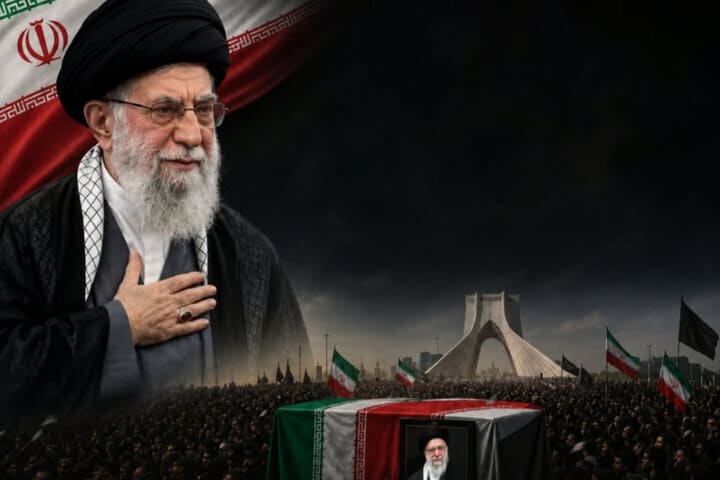
His death did not bury his ideas; instead, it breathed new life and revived the consciences of the 10 to 20 million mourners who poured into the streets, as well as millions of others around the world. The sea of weeping humanity was a wordless proclamation: that the death of the leader of the oppressed has given birth to a million new hopes.
Hope for the establishment of true international law, and a shared determination to conquer Trump's law of the jungle that has gripped the world with its arrogance. In Tehran, the wind blows with the scent of mourning, but within it, there are clenched fists ready to continue their journey.
The Politics of Martyrdom
Seyyed Ali Khamenei is the second wali faqih (Islamic jurist), after Imam Khomeini. Both are the driving force and navigator of the wilayatul faqih system, which transcends Montesquieu's triaspolitik. The secret lies in faith and trust in the oppressed people.
The body of Seyyed Ali Khamenei (2026) will be paraded by millions, just as Imam Khomeini was in 1979. Without Seyyed Ali Khamenei, who adhered to the revolutionary values outlined by Imam Khomeini, Iran would have been easily conquered militarily in a matter of days by the US and Israel. Without these two Sufis, high-precision missiles, various hypersonic missiles, martyrdom drones, and other technological achievements would not exist. As long as the Iranian reformist group, even if it can be controlled by Zionist magic, will still return to the revolutionary track as long as the system of wilayatul faqih and wali faqih exists.
Seyyed Ali Khomeini was indeed capable, and his system was compatible with navigating sanctions as a golden opportunity to undermine the US empire. He knew and had a mature program that liberating Palestine meant defeating NATO, which supported Israel. Liberating the Islamic world from the grip of US bases was inextricably linked to liberating Palestine. This program would also be auspicious—it would facilitate China and Russia in their multipolar movements.
The fourth promise of this great political artist has been fulfilled. The promise of an Imam who was intelligent, humble, gentle, brave, and chivalrous, like the Prophet Muhammad and the Shia Imams. The promise of a saint, a representative of the power of the world's oppressed. His promise, through a beautiful missile dance performance that bullied the Iron Dome, David's Sling, Arrow 2, 3, and Patriot, comforted the grief of the people of Gaza, who were being subjected to genocide, who could not be helped by the UN and nuclear powers.
The Grand Condolences
Now, the Iranian sky is darkened gray, as if bearing the burden of a supreme grief. In corners of the city that are usually bustling with the buzz of life, only the whispers of prayers and the rush of footsteps can be heard. The country is holding one of the greatest final gatherings in its modern history—a farewell that has summoned millions of mourners from all corners of the globe to pay their respects to the fallen Leader of the Islamic Revolution, Ayatollah Seyyed Ali Khamenei.
Death never chooses a time, but it always leaves a lasting echo. Through the national farewell ceremonies that spanned several days, this grief was not confined to one city. It flowed across national borders, stopping in Iraq's historic holy lands, and crept solemnly through Najaf and Karbala. They gathered not simply to send off a leader, but to mourn a bitter human tragedy: the Ayatollah's death along with four members of his beloved family in a cowardly airstrike at the end of February.
The loss was especially poignant as their names were spelled out one by one in silence. There was Dr. Mesbah al-Hoda Bagheri Kani, his son-in-law; Seyyedeh Boshra Hosseini Khamenei, the longing eldest daughter; Zahra Haddad Adel, wife of the current Leader of the Islamic Revolution, Ayatollah Seyyed Mojtaba Hosseini Khamenei; and most poignantly, a tiny 14-month-old granddaughter, Zahra Mohmadi Golpayegani. A tiny baby who had not yet had the chance to explore the world, now must join the eternity of history.
Tears in Five Cities
For officials and diplomats, this ceremony was a national and international event, the second only to Imam Khomeini—a tangible reflection of the Ayatollah's deeply rooted political, religious, and spiritual standing in the Muslim world. But for the millions of ordinary people who took to the streets, it was a matter of the heart.
The grief reached its peak on July 3rd. More than 45 foreign representatives arrived bearing wreaths and deep sympathy. The cities of Tehran, Qom, Najaf, and Karbala transformed into a sea of people moving in unison. Finally, this long procession would proceed to Mashhad, the final resting place of Imam Reza (AS), the eighth Shia Imam. There, on sacred ground, the Leader and his family would be embraced by the earth.
More than 100 countries sent envoys, religious figures, and high-ranking officials. Thousands of journalists from around the world tried to capture the moment through their cameras. However, even the best cameras could not capture the depth of the pain that surged through the hearts of the millions of Iranians in attendance.
"Someone Must Rise"
Amidst the atmosphere of grief, a manifesto blazed with passion. Under the cover of half-mast flags and black-clad garb, a slogan resounded loudly: "Someone Must Rise."
This slogan is not just a decorative phrase, but a pledge. Simultaneously, the clenched fist adopted as the official symbol of the week-long commemoration continues to be raised in the air—a symbol that steadfastness will not be buried with the bodies of the fallen.
To make room for these tears and tributes, the wheel of time seems to have stopped for a moment. Authorities declared a national holiday in Tehran, Qom, and Mashhad. All elements of logistics, security, transportation, and even medical teams were deployed extensively to care for the millions of souls who arrived with wounded hearts.
Iran is now weaving its new history, toppling the US empire, helping the BRICS realize a more revolutionary multipolar world. Amidst sobs and firm fists, they accompanied the departed Leader to his final resting place—a silent journey, but his voice will continue to echo through the ages. When the power of the oppressed defeats the oppressor (superpower), the new power will be equal. Be the enemy of the oppressor, be the friend of the oppressed!!! Make your country the enemy of the oppressor and the friend of the oppressed. A political philosophy of the state that is too heavy, for those unfamiliar with revolution.