

By Muhammad Ma’ruf, Director, Global Thinkers Institute (GTI)
The Evolution of Indonesian Diplomacy: From Pragmatism to Principled Leadership
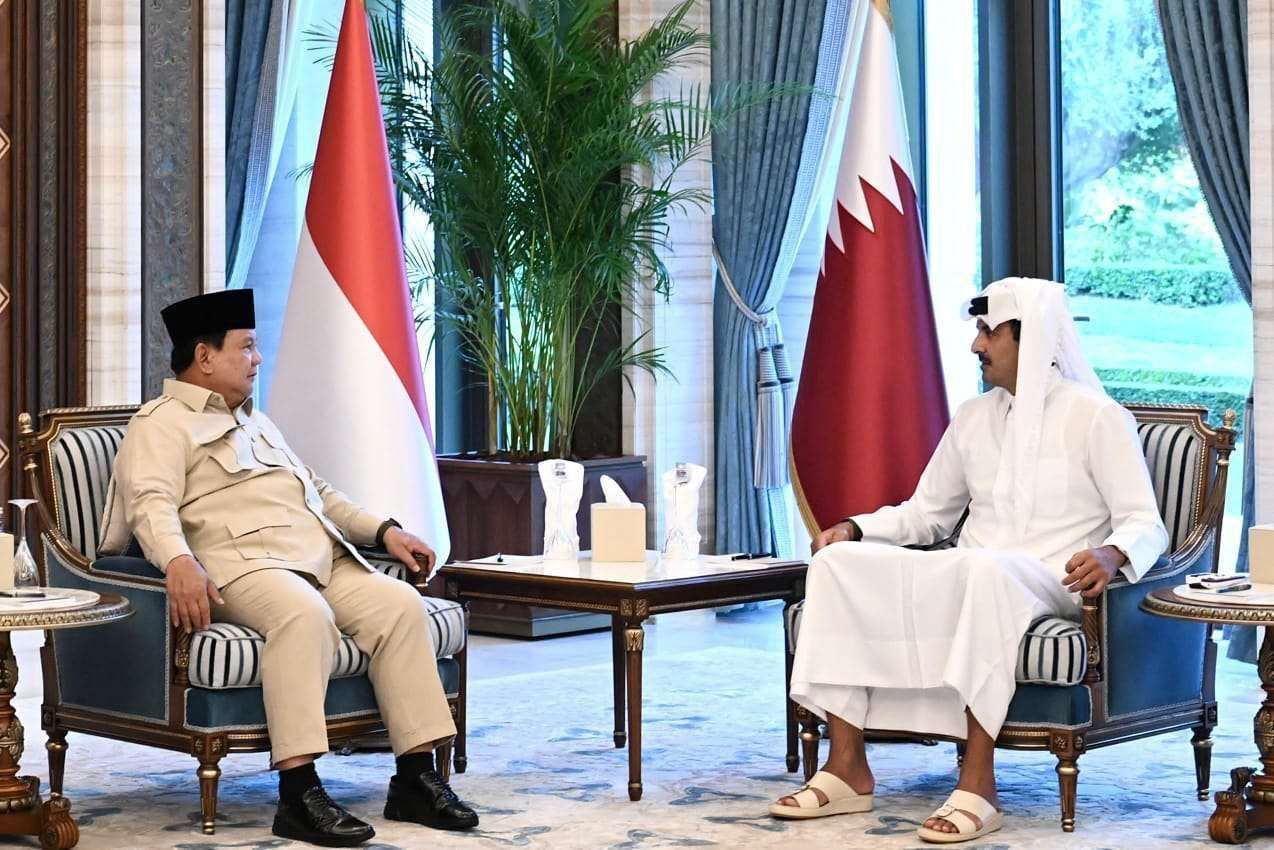
Prabowo's visit to Qatar marks a fundamental evolution in Indonesia's diplomatic tradition. While the Jokowi era (2014-2024) was characterized by "economic diplomacy" with a focus on investment and trade, the Prabowo era demonstrates a shift toward "values-based diplomacy" that integrates economic interests with moral principles.
Indonesia is evolving from its role as a "regional power" focused solely on ASEAN to a "global balancing force" actively engaging in global issues. The timing of Prabowo's response—72 hours after the attack—reflects what is known as a "crisis decision-making model." Unlike the "rational actor" model, which requires extensive time to calculate costs and benefits, Prabowo employs "bounded rationality" with a priority on values and principles.
The diplomatic substance of the visit encompasses five strategic elements: (1) affirming support for Qatar's sovereignty, (2) condemning violations of international law, (3) committing to regional stability, (4) strengthening bilateral economic partnerships, and (5) coordination in multilateral fora. This approach reflects "multi-track diplomacy" that integrates political, economic, and cultural dimensions.
Strengthening the Architecture of the Global South: Network Power and Institutional Balance
Indonesia can leverage this visit to build network power—the ability to influence through networks of relationships rather than hierarchical dominance. With a Muslim population of 231 million (87% of the total population), Indonesia possesses significant soft power in the Islamic world.
Another strategy is "institutional balance," which Indonesia seeks to achieve through active participation in various multilateral forums. As a member of the G20 and the largest economy in ASEAN (40% of ASEAN's total GDP of US$3.6 trillion), Indonesia wields substantial economic influence. Membership in BRICS+, starting in 2024, provides access to a market worth US$28.5 trillion and a population of 3.2 billion.
Trade data shows significant diversification. Indonesia's trade with BRICS countries increased 35% in 2024 to US$87.3 billion, while with OIC countries it rose 28% to US$45.7 billion. Conversely, dependence on traditional markets (the US, Europe, and Japan) decreased from 52% in 2020 to 43% in 2024.
The visit to Qatar also strengthened Indonesia's "triangular diplomacy" in the Middle East. Relations with Saudi Arabia (bilateral trade of US$7.8 billion), the UAE (US$4.2 billion), and now Qatar (US$1.9 billion) create balanced geopolitical leverage.
Political-Economic Dimension: Beyond Symbolism to Strategic Partnership
Qatar offers economic potential that goes far beyond diplomatic symbolism. The Qatar Investment Authority (QIA), with US$475 billion in assets under management, is the world's fifth-largest sovereign wealth fund. QIA has invested US$2.3 billion in Southeast Asia by 2024, with Indonesia a priority target for infrastructure and energy.
The economic synergy between Indonesia and Qatar has transformative potential in several strategic sectors. In the energy sector, Qatar, as the world's largest LNG exporter (22% of total global exports), can meet 30% of Indonesia's gas needs, which are projected to reach 150 MMSCFD by 2030. This collaboration could save US$3.2 billion annually from LNG imports from Australia and Malaysia.
The infrastructure sector offers investment opportunities worth US$15 billion for the development of the Indonesian Capital City (IKN). The Qatari International Monetary Fund (QIA) has expressed interest in investing in smart city technology, renewable energy infrastructure, and transportation systems. This investment could accelerate the development of the new capital city from a 20-year target to 15 years.
Technological cooperation includes the digital economy and financial technology, where Qatar has a strong presence in Islamic banking and digital payment systems. Indonesia's US$95 billion Islamic finance market (the largest in the world) could be integrated with Qatar's expertise to create a regional Islamic finance hub.
Challenges and Risks: Navigating a Complex Geopolitical Landscape
Prabowo's visit to Qatar faces complex geopolitical challenges in the context of the US-China "great power competition" and regional rivalries in the Middle East. Indonesia's move to strengthen ties with Qatar could be perceived as a threat by Israel and its allies.
The risk of Israeli retaliation against Indonesian interests is asymmetrical but significant. Israel possesses advanced cyber warfare capabilities and could target Indonesia's digital infrastructure. A cyberattack on the banking system or power plants could result in billions of dollars in economic losses. Indonesia needs to strengthen its cyber defense capabilities and diversify its technology to mitigate its vulnerabilities.
US pressure could take the form of diplomatic pressure through multilateral forums or economic sanctions. However, a cost-benefit analysis suggests that the US has too significant an economic interest in Indonesia (US$35 billion in bilateral trade) to take such drastic action. Instead, the US will likely use "soft pressure" through trade restrictions.
Long-Term Implications: Towards a New International Order
Prabowo's visit to Qatar contributed to what Richard Haass calls a "world in disarray"—the transition from a unipolar America to a multipolar world order. Indonesia positioned itself as a "norm entrepreneur" promoting alternative principles: sovereignty, non-intervention, and mutual respect.
Indonesia was able to capitalize on opportunities when the hegemonic power (the US) experienced a relative decline while rising powers (China, India, and Brazil) were not yet fully established. Positioning as a "bridge power" between various blocs gave Indonesia unique diplomatic leverage.
Contributions to institutional reform included strengthening BRICS+, the SCO, and the OIC as counterweights to the dominance of the Bretton Woods institutions. Indonesia also promoted "South-South cooperation" through the Asian Infrastructure Investment Bank (AIIB) and the New Development Bank (NDB) as alternatives to the World Bank and IMF.
Conclusion: Transformative Diplomacy in a Multipolar Era
President Prabowo's visit to Qatar represents a transformative moment in Indonesian diplomacy and the architecture of the Global South. More than a mere gesture of solidarity, this visit marked Indonesia's evolution from a reactive middle power to a proactive leading power in a multipolar order.
This visit achieved at least three strategic objectives: (1) strengthening Indonesia's moral legitimacy as an influential country in the Global South, (2) opening up billions of dollars in economic opportunities through a partnership with Qatar, and (3) establishing a precedent for practical solidarity in international crises.
Long-term success will depend on Indonesia's ability to maintain diplomatic momentum while managing geopolitical risks. Prabowo's "principled solidarity" approach must be balanced with economic pragmatism and strategic patience in the face of pressure from hegemonic powers.
This visit demonstrates that in the multipolar era, Global South countries no longer have to choose between opposing blocs. Instead, they can build a "third way" that combines independence, solidarity, and shared prosperity. Indonesia can be an inspiration, showing the way to a more just and balanced future world order.